
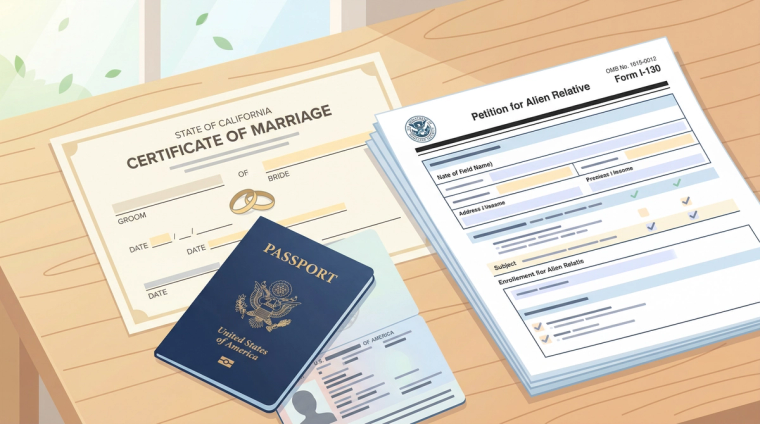
If you're a U.S. citizen or green card holder who wants to sponsor your spouse for a green card, Form I-130 (Petition for Alien Relative) is the first form you need to file. It proves to USCIS that your marriage is legally valid and that you qualify as a sponsor. USCIS rewrote its family-based petition guidance on August 1, 2025 and tightened the marriage-evidence standard on October 17, 2025, so spouse cases now get more scrutiny than they did a year ago. This guide covers the current requirements, the documents you'll need, the fees you'll pay, and realistic processing timelines based on 2026 data.
What is Form I-130 and why do you need it?
Form I-130, Petition for Alien Relative, is the USCIS form that establishes a qualifying family relationship between a U.S. citizen or lawful permanent resident (LPR) and a foreign national relative (USCIS I-130 Page). For spouse petitions, it's the required first step before your husband or wife can apply for a green card, whether they're in the U.S. or abroad.
The I-130 does not grant a green card by itself. It only proves the relationship. After USCIS approves the petition, your spouse still needs to go through either adjustment of status (if they're in the U.S.) or consular processing (if they're abroad) to actually get the green card.
The thing most people don't realize until they're deep into the process: your immigration status as the petitioner changes everything.
If you're a U.S. citizen, your spouse is classified as an "immediate relative" under INA § 201(b)(2)(A)(i). There's no cap on the number of visas available, no priority date wait, and your spouse can receive a visa as soon as the petition is approved and processed.
If you're a lawful permanent resident (green card holder), your spouse falls under the F2A preference category (INA § 203(a)(2)(A)). F2A is subject to annual visa caps, which means your spouse will wait years for a visa number to become available, even after the I-130 is approved.
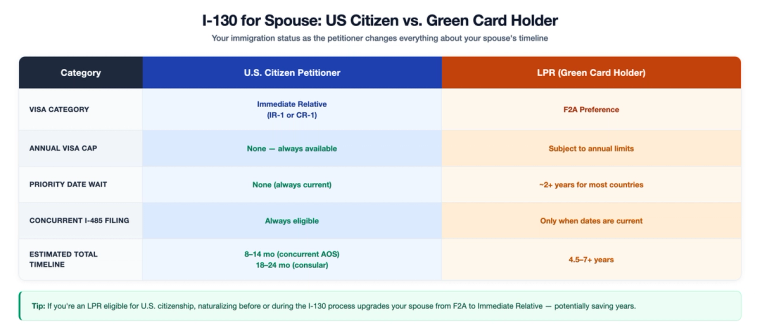
| U.S. Citizen Petitioner | LPR Petitioner | |
|---|---|---|
| Visa category | Immediate Relative (IR-1 or CR-1) | F2A Preference |
| Visa cap | None | Subject to annual limits |
| Priority date wait | None (always "current") | Years (currently ~2+ years for most countries) |
| Concurrent I-485 filing | Yes, always eligible | Only when Dates for Filing are current |
| Estimated total timeline | Roughly 2-3 years (consular) or 8-10 months (concurrent AOS) | 4.5-7+ years |
I-130 eligibility requirements for spouse petitions in 2026
To file Form I-130 for your spouse, you must meet these requirements (8 CFR § 204.2):
You (the petitioner) must be:
- A U.S. citizen, OR
- A lawful permanent resident (green card holder)
Your marriage must be:
- Legally valid in the place where it was performed (the "place of celebration" rule)
- A bona fide marriage, meaning you married with the genuine intention of building a life together, not to get immigration benefits
You must also show that:
- Any prior marriages for both you and your spouse have been legally terminated (through divorce, annulment, or death of the former spouse)
- You are not subject to the 5-year petitioner bar (which applies to LPRs who obtained their own green card through a prior spousal petition, unless that prior marriage ended by death or you can prove it wasn't fraudulent)
Same-sex spouse eligibility
USCIS recognizes same-sex marriages the same way it recognizes opposite-sex marriages, so long as the marriage is legally valid in the place where it was celebrated.
If you married in a U.S. state or a foreign country that legally recognizes same-sex marriage, your marriage is valid for I-130 purposes, even if your spouse's home country doesn't recognize same-sex unions. One practical challenge for same-sex couples: gathering third-party affidavits can be harder if family members are estranged or unsupportive. In those cases, lean on documentary evidence like joint finances, shared leases, and photographs.
Common-law and proxy marriages
Common-law marriages are recognized if they're valid where established. Only a handful of U.S. states still recognize new common-law marriages, so check your state's laws.
Proxy marriages (where one or both spouses weren't physically present at the ceremony) are recognized by USCIS only if the marriage is legal where performed AND the couple has met in person afterward (USCIS Policy Manual, Vol. 6, Part B, Ch. 6). A proxy marriage without an in-person meeting won't work for an I-130.
I-130 document checklist for spouse petitions (2026)
Spouse petitions need more paperwork than any other I-130 category, because USCIS wants proof of both the legal marriage and that it is real. The core package:
- Form I-130 (Edition 04/01/24), Form I-130A from the beneficiary spouse, and the filing fee ($625 online, $675 on paper)
- Proof of your U.S. citizenship or LPR status, your civil marriage certificate, and termination records for every prior marriage on either side
- Bona fide marriage evidence submitted with the petition itself: joint financial records, shared housing proof, photos across time, and affidavits from people who know you as a couple
- Certified English translations of anything not in English
Our I-130 documents checklist by relationship type covers the full list in depth, including photo requirements, secondary evidence options when the standard records cannot be obtained, and the extra scrutiny LPR petitioners face if they married within five years of getting their own green card.
How to file I-130 for your spouse
You can file Form I-130 in two ways:
Online filing ($625): Through your myUSCIS account. USCIS currently allows Form I-130 to be filed online, and petitioners may upload supporting evidence, including a completed Form I-130A, through the online account.
Paper filing ($675): Mail your complete package to the correct USCIS lockbox address based on where you live and whether Form I-485 is being filed concurrently. USCIS currently uses Chicago, Dallas, Elgin, or Phoenix lockbox addresses for Form I-130 filings, depending on the filing situation.
Concurrent filing: I-130 + I-485 together
If you're a U.S. citizen and your spouse is already in the U.S. and is otherwise eligible to adjust status, you can file Form I-130 and Form I-485 at the same time. This is called "concurrent filing," and it's the fastest path to a green card because your spouse doesn't have to wait for the I-130 to be approved before starting the green card application. Immiva's I-130 preparation walks you through the petition either way, and generates Form I-130A for you.
LPR petitioners can also file concurrently, but only when USCIS authorizes use of the "Dates for Filing" chart and the F2A filing date is current for your spouse's country. Check our latest Visa Bulletin analysis to see whether concurrent filing is available now.
With concurrent filing, your spouse can also submit Form I-765 (for work authorization) and Form I-131 (for travel documents) with the Form I-485. The work-permit rules tightened in late 2025: renewals filed on or after October 30, 2025 no longer get an automatic extension while they're pending, and new adjustment-based EADs are capped at 18 months of validity.
Adjustment of status vs. consular processing
Adjustment of status is for spouses already in the United States. You file I-485 with USCIS (either concurrently or after I-130 approval), attend a biometrics appointment, and go to an interview at a local USCIS field office.
Consular processing is for spouses living abroad. After I-130 approval, the case transfers to the National Visa Center (NVC), which collects Form DS-260, Form I-864 (Affidavit of Support), civil documents, and fees. Once everything is processed, NVC schedules an interview at the U.S. embassy or consulate in the spouse's country.
I-130 processing time for spouse in 2026
Spouse petitions split into two timelines depending on whether the petitioner is a U.S. citizen or an LPR.
USC immediate relative timeline
Concurrent I-130 + I-485 inside the U.S.: about 8 to 10 months total from filing to green card. Consular processing through a U.S. embassy abroad: roughly 2 to 3 years all-in, including the NVC stage and embassy interview scheduling. Exact timing depends on the USCIS office handling the case and the consulate's schedule.
LPR F2A category timeline
Green-card-holder petitioners file in the F2A preference category, which has annual visa caps. In the June 2026 Visa Bulletin the F2A Final Action Date is January 1, 2025 for most countries and January 1, 2024 for Mexico. The total wait combines USCIS adjudication of the I-130 (currently about 35 months on the service-wide range) with the visa bulletin wait, so a fixed multi-year estimate is unreliable.
What's slowing things down in 2026
Two recent shifts are hitting spouse cases hardest. Under USCIS Policy Alert PA-2025-23 (October 17, 2025), officers review marriage bona fides when they adjudicate the I-130 and again at adjustment, which is producing more RFEs and denials on thin evidence. Enhanced vetting is also adding background-check time on cases flagged by the new AI-driven review center.
Our I-130 processing time guide covers all relationship categories side by side, country-of-birth effects, and what to do when your case stalls past the USCIS receipt-date threshold for an inquiry.
How to check your case status
After filing, you receive a receipt number (starting with IOE for online filings or MSC/SRC/LIN/EAC for paper). Track it at egov.uscis.gov/casestatus. If you filed concurrently with I-485 and added Form I-765, the same tool shows EAD status.
What happens after I-130 approval
Getting the I-130 approved feels like a finish line, but it isn't. There's still more to do.
If your spouse filed for adjustment of status (I-485): USCIS will schedule a green card interview at a local field office. Both of you must attend. Bring originals of all documents you submitted with the petition, plus updated bona fide marriage evidence. After the interview, USCIS will either approve the green card, request more evidence, or (rarely) deny the application.
If your spouse is going through consular processing: The approved I-130 transfers to the National Visa Center (NVC). NVC will contact you and your spouse to collect Form DS-260 (Immigrant Visa Application), Form I-864 (Affidavit of Support), civil documents, and a $325 immigrant visa fee. Once NVC finishes processing, they schedule an interview at the U.S. embassy in your spouse's country.
Either way, you're the financial sponsor, so your own income has to meet the I-864 threshold for your household size. Our Green Card Sponsor Income Calculator shows where you land before you file.
CR-1 vs. IR-1: conditional vs. permanent residence
If you've been married for less than 2 years at the time your spouse is admitted to the U.S. with their immigrant visa (or receives their green card through adjustment), they'll receive a conditional green card (CR-1 category). This card is valid for only 2 years. Before it expires, you'll need to jointly file Form I-751 to remove conditions during the 90-day window before the card's expiration date.
If you've been married for 2 years or more, your spouse receives a standard 10-year green card (IR-1 category) with no conditions to remove.
What changed in 2025-2026: policy updates that affect your filing
If you're filing in 2026, be aware of these policy changes:
1. PA-2025-12: family-based petition overhaul (August 1, 2025)
PA-2025-12 rewrote USCIS's Policy Manual guidance for family-based petitions. It spells out documentation expectations, sets criteria for referring petitions for an interview, and confirms that USCIS may issue a Notice to Appear to a removable beneficiary even after approving a petition. The practical takeaway: submit complete initial evidence with the filing instead of counting on an RFE to fix gaps.
2. PA-2025-23: bona fide marriage evidence standard (October 17, 2025)
Under PA-2025-23, USCIS reviews marriage bona fides twice, once when it adjudicates the I-130 and again at the adjustment stage. It applies to petitions pending or filed on or after October 17, 2025. Front-load your evidence: joint finances, shared housing, and proof that the relationship is ongoing rather than a snapshot from the wedding day.
3. EAD auto-extension eliminated (October 30, 2025)
If your spouse filed I-485 concurrently and also applied for an EAD, two changes matter. Renewals filed on or after October 30, 2025 no longer receive an automatic extension while the renewal is pending, so file the renewal as early as the rules allow. And since December 5, 2025, new adjustment-based EADs are issued with a maximum validity of 18 months, not the 5-year cards USCIS used to issue.
4. Form edition: unchanged (04/01/24)
Despite everything else that changed, the form itself did not. As of June 2026, the USCIS Form I-130 page still lists Edition Date 04/01/24. Download the current version directly from uscis.gov/i-130 before filing rather than reusing an old saved copy.
Common mistakes that delay or sink I-130 spouse petitions
We see the same problems come up again and again:
- Insufficient bona fide marriage evidence. A marriage certificate alone is never enough. USCIS wants to see a pattern of shared life: finances, housing, insurance, photos, and third-party statements.
- Missing prior marriage termination documents. If either of you were previously married, you must submit proof that every prior marriage ended. Missing one divorce decree can get your petition denied outright under the new rules.
- Using the wrong form edition. Double-check the edition date at the bottom of the form and confirm the current acceptable edition on the USCIS Form I-130 page before filing. As of June 2026, USCIS lists Edition Date 04/01/24.
- Not including Form I-130A. Every spouse petition requires the supplemental I-130A form. Forgetting it is a common rejection reason.
- Untranslated foreign documents. Every document in a language other than English needs a certified translation. Missing translations are one of the most frequent causes of RFEs.
- Incorrect payment. Since October 28, 2025, USCIS no longer accepts checks or other mailed paper payments. Paper filings must include Form G-1450 (credit/debit card) or Form G-1650 (ACH bank transfer); online filings pay through Pay.gov.