
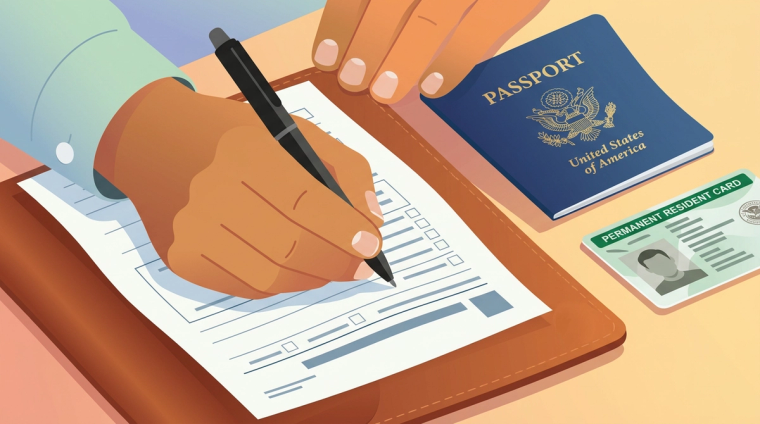
Form I-130A is the supplemental form that every spouse beneficiary must complete when a U.S. citizen or lawful permanent resident files Form I-130 on their behalf. It collects your biographical details, five years of address and employment history, and information about your parents. There's no separate filing fee. Despite being mandatory for all spousal I-130 petitions, this form trips up thousands of filers every year because of confusion about who fills it out, what goes where, and whether the beneficiary needs to sign. This guide goes through every part of the I-130A, field by field, so you can complete it correctly and avoid delays.
If you're new to the I-130 process, keep in mind that Form I-130A is only one piece of the spousal petition filing. The petitioner (the U.S. citizen or LPR sponsor) files Form I-130 itself, and the beneficiary (the immigrant spouse) fills out the I-130A. Both must be submitted together as part of the same I-130 filing: by mail in the same paper package, or online by uploading the completed I-130A with the online I-130 submission. You can learn more about how Immiva works: it prepares both forms together and checks every answer before you file.
What is Form I-130A and how is it different from Form I-130?
Form I-130A is officially called "Supplemental Information for Spouse Beneficiary." USCIS introduced it on April 28, 2017, as part of the updated Form I-130 process, replacing the old spousal biographic-information requirement that had been handled through Form G-325A. Since that date, every spousal I-130 petition must include a completed Form I-130A (see the current Form I-130/I-130A instructions).
The biggest point of confusion is the relationship between the two forms. Form I-130 is the main petition, filled out and signed by the petitioner (the U.S. citizen or green card holder sponsoring their spouse). Form I-130A is a supplemental form filled out by the beneficiary (the immigrant spouse being sponsored). They serve different purposes and collect different information.
A quick summary of the differences:
- I-130 collects the petitioner's information, relationship evidence, and the basis for the petition. It costs $625 when filed online or $675 on paper (USCIS Fee Schedule).
- I-130A collects the spouse beneficiary's biographical details: current and past addresses, employment history, and parent information. It has no separate filing fee.
- Both forms must be submitted together. USCIS won't process an I-130 for a spouse without the I-130A.
Who must file Form I-130A
Every spousal I-130 petition requires a completed I-130A. This applies whether the petitioner is a U.S. citizen or a lawful permanent resident, and whether the beneficiary spouse is inside or outside the United States (8 CFR § 204.2(a)).
Specifically, I-130A is required when:
- A U.S. citizen petitions for a spouse (immediate relative category)
- A lawful permanent resident petitions for a spouse (F2A preference category)
I-130A is NOT required when petitioning for parents, children, or siblings. It's exclusively for spousal petitions.
I-130A filing fee: $0
Form I-130A has no separate filing fee. The cost of the I-130A is included in the I-130 filing fee, which is currently $625 for online filing or $675 for paper filing (USCIS Fee Schedule). There is no separate biometrics payment for Form I-130; USCIS folded biometric costs into its filing fees generally in 2024.
When paying the I-130 fee, keep in mind that for most paper-filed cases postmarked on or after October 28, 2025, USCIS requires electronic payment by card using Form G-1450 or by ACH using Form G-1650. USCIS allows limited exemptions; filers who qualify can still pay on paper with Form G-1651. For a full breakdown of payment options and exemptions, see our guide on how to pay USCIS filing fees.
How to fill out Form I-130A: line-by-line instructions
Form I-130A is 6 pages long with 7 parts. USCIS estimates it takes about 50 minutes to complete. The current edition date is 04/01/2024. Make sure you're using this edition because USCIS rejects outdated forms (USCIS Forms Updates).
Before you begin:
- Use black ink if completing by hand, or type directly into the fillable PDF
- Answer every question. If something doesn't apply, write "N/A" or "None." Never leave a field blank.
- The attorney/representative section at the very top of the form should be left blank if the beneficiary isn't represented by an attorney
Part 1: Information about you (the spouse beneficiary)
This is the longest section. It collects biographical data, five years of address history, your last foreign address, and information about both parents.
Alien Registration Number (A-Number). Enter it if you have one. This is an 8- or 9-digit number starting with "A" that USCIS assigns when an immigrant petition, adjustment of status application, or removal proceeding is initiated. Most first-time beneficiaries won't have one. If you don't have an A-Number, leave this field blank. For more about what an A-Number is and where to find it, see our A-Number explainer.
USCIS Online Account Number. Enter this if the beneficiary has previously created an account on myUSCIS. It appears at the top of notices from prior USCIS filings. This isn't the same as an A-Number. Leave blank if none.
Full Legal Name (3a-3c). Enter family name (last), given name (first), and middle name exactly as they appear on the beneficiary's birth certificate, unless legally changed. If the name contains special characters like accents or tildes (e.g., "Garcia"), use the closest English equivalent on the form and note the correct spelling in Part 7.
Current Physical Address (4a-4h). List the address where the beneficiary currently lives. For foreign addresses, enter "N/A" in fields that don't apply (such as State or ZIP Code for a non-U.S. address). Don't leave any field blank.
Five-Year Address History (5a-7b). You need to account for the last five years of addresses with no gaps. If you need more than the two address slots provided, continue in Part 7. Enter "Present" for the end date of your current address.
Last Physical Address Outside the United States (8a-9b). This is the address where the beneficiary last lived outside the U.S. for more than one year. You must provide it even if it's already listed in your five-year history above, and even if it was more than five years ago. This catches a lot of people off guard. The rule is: enter the last foreign address where you lived for 1+ year, regardless of when it was.
Parent Information (10-23). Provide the full name, date of birth, sex, city and country of birth, and current city and country of residence for both parents. If a parent is deceased, write "Deceased" for the residence fields. If information is unknown, write "Unknown."
Part 2: Employment history (last 5 years)
List the beneficiary's employment for the past five years, whether inside or outside the United States. Start with the current or most recent employer.
If the beneficiary is currently unemployed, write "Unemployed" as the employer name. The same applies for students ("Student") and homemakers ("Homemaker"). Self-employed individuals should enter their business name, or "Self-employed" if there's no business name.
You need to account for every period in the last five years with no gaps. This is a common RFE trigger. If you were a student for two years, then unemployed for six months, then employed, you need to list all three periods. If more than two employers in five years, continue in Part 7.
Part 3: Employment outside the United States
This section only needs to be completed if the beneficiary's most recent employment outside the U.S. is NOT already listed in Part 2. If it's already listed, write "See above." If the beneficiary has never worked outside the U.S., write "N/A."
Part 4: Beneficiary's statement, contact information, and signature
Language Checkbox (Q1a-1b). Check 1a if the beneficiary reads and understands English and completed the form without help. Check 1b if an interpreter assisted (this triggers Part 5). Select one or the other, not both.
Preparer Checkbox (Q2). Check this if someone other than the beneficiary prepared the form. This is common when the petitioning spouse fills it out on behalf of a beneficiary who is overseas. If checked, Part 6 must be completed.
Contact Information (Q3-5). Provide daytime phone, mobile phone, and email. The email is particularly important because the National Visa Center (NVC) and U.S. consulates may use it for communications during consular processing.
Signature (Q6a-6b). The beneficiary must sign in ink if they're physically in the United States. If the beneficiary is overseas, the signature isn't required (USCIS Policy Manual, Vol. 6, Part B, Ch. 6). No digital or electronic signatures are accepted for in-U.S. filers.
Parts 5-6: Interpreter and preparer sections
Part 5 is required only if the beneficiary used an interpreter (checked Q1b in Part 4). The interpreter provides their contact information and certifies fluency in both languages.
Part 6 is required if someone other than the beneficiary prepared the form. The scenario many couples face: the petitioning U.S. citizen fills out the I-130A for their spouse who is living abroad. In this case, the petitioner completes Part 6 as the "preparer" and checks box 7a (indicating they aren't an attorney or accredited representative). This is perfectly normal and expected.
Part 7: Additional information
Use this section whenever you run out of space in any part. For each additional entry, write the Page Number, Part Number, and Item Number so USCIS can match it to the right question. Sign and date each additional page.
Even if you have no additional information, don't remove or omit this page from your filing. Submit all 6 pages of the form.
Does Form I-130A ask about criminal history?
No. Form I-130A doesn't include any questions about criminal history, arrests, or convictions. This is a common misconception. Criminal history questions appear on other forms, specifically Form I-130 Part 4 (for the petitioner) and Form I-485 (for the beneficiary, during adjustment of status).
That said, beneficiaries should be aware of an important policy change. As of August 1, 2025 (Policy Alert PA-2025-12), USCIS explicitly clarified that it may issue Notices to Appear (NTAs) to I-130 beneficiaries who are determined to be removable. The address and employment information you provide on I-130A is accessible to USCIS officers. While the form itself doesn't ask about criminal history, the information you provide can affect other aspects of your case.
If the beneficiary has any criminal record or prior immigration violations, consult an immigration attorney before filing.
Filing I-130A: online vs. paper and concurrent filing
Paper filing. Print the completed I-130A, have the beneficiary sign it (if in the U.S.), and mail it with your I-130 petition package to the appropriate USCIS lockbox. The I-130A goes in the same envelope as the I-130. Don't mail them separately.
Online filing. When you file I-130 through the USCIS online portal (myUSCIS), the I-130A isn't built into the online form. Instead, you need to complete the PDF version of I-130A separately, have it signed (if applicable), scan it, and upload it as a supporting document under the "I-130A" document category. This is one of the most frequently asked questions in online filing forums.
Concurrent filing (I-130 + I-485). If the beneficiary is in the United States and eligible to adjust status, you can file Form I-130 and Form I-485 (Adjustment of Status) at the same time. Form I-130A is still required in concurrent filings. If the beneficiary will eventually apply for removal of conditions on their green card, the information on I-130A should be consistent with what they later provide on Form I-751.
7 common mistakes that delay your I-130A
The errors that most often lead to rejections or RFEs:
1. Forgetting to include I-130A entirely. USCIS won't process a spousal I-130 without the supplemental form. Your packet will either be rejected outright or you'll receive an RFE.
2. Leaving fields blank instead of writing "N/A." A blank field signals to USCIS that you may have overlooked the question. Always write "N/A" or "None" for questions that don't apply.
3. Gaps in 5-year address or employment history. Every day of the last five years must be accounted for. If you moved between apartments and stayed with family for two weeks in between, list that temporary address.
4. Missing signature when the beneficiary is in the U.S. If the beneficiary resides in the United States and the I-130A is unsigned, USCIS will issue an RFE (USCIS Policy Manual, Vol. 6, Part B, Ch. 6).
5. Using an outdated form edition. The current edition is 04/01/2024. Check the bottom-left corner of the first page. USCIS rejects petitions that use old editions.
6. Inconsistent information between I-130 and I-130A. The beneficiary's name, date of birth, and other details must match exactly across both forms. Inconsistencies trigger additional scrutiny.
7. Not submitting all 6 pages. Even if Part 7 is blank, include it. USCIS expects the complete form.