
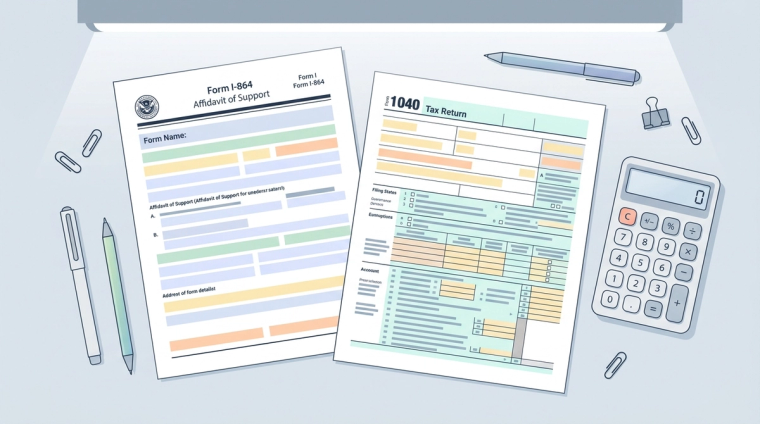
What Form I-864 is and why it matters for your I-485
Form I-864, the Affidavit of Support Under Section 213A of the INA, is a legally binding contract between a U.S. sponsor and the U.S. government. The sponsor promises that the intending immigrant will not become a public charge, and agrees to reimburse certain means-tested public benefits if they do. The authority comes from INA § 213A and the regulations at 8 CFR Part 213a.
For most family-based I-485 applicants, the I-864 is required. It's also required for some employment-based adjustment cases where a qualifying relative filed the underlying I-140 or holds a 5% or greater interest in the petitioning entity. There is no USCIS filing fee when the form is submitted with an I-485 (see 8 CFR § 106.2(a)(55)), but consular processing through the National Visa Center carries a $120 fee.
A few categories are exempt: refugees, asylees, VAWA self-petitioners, U and T nonimmigrants, Afghan and Iraqi SIVs, applicants with 40 qualifying Social Security quarters, and children who automatically acquire citizenship on admission. Everyone else filing a family-based I-485 will need one.
Who must file Form I-864 with the I-485
The person who filed the underlying Form I-130 is the petitioning sponsor, and they must always file an I-864, even if their income is not enough on its own. That's the rule most applicants miss. If the petitioner's household income is insufficient, you do not replace their I-864; you add a second one from a joint sponsor.
The petitioning sponsor must be:
- A U.S. citizen or lawful permanent resident
- At least 18 years old
- Domiciled in the United States or a U.S. territory
Domicile is not the same as residency. A sponsor who has been working abroad can still qualify if they can show the U.S. is their principal residence and that they intend to reestablish physical presence no later than the immigrant's admission (USCIS Policy Manual, Vol. 8, Part G, Ch. 6). This trips up a lot of U.S. citizen sponsors who live overseas with their spouse, and it is worth sorting out before the I-130 is approved.
2026 income requirements by household size
The minimum income is set at 125% of the federal poverty guideline (FPG) for the sponsor's household size. For 2026, the HHS poverty guidelines went up 2.63% and took effect for I-864 purposes on March 1, 2026. Any I-864 filed from that date forward has to use the 2026 numbers.
For the 48 contiguous states and D.C., the current thresholds are:
| Household size | 125% of FPG (annual income) |
|---|---|
| 2 | $27,050 |
| 3 | $34,150 |
| 4 | $41,250 |
| 5 | $48,350 |
| 6 | $55,450 |
| 7 | $62,550 |
| 8 | $69,650 |
| Each additional person | +$7,100 |
Alaska and Hawaii use higher thresholds. For a household of four, Alaska requires $51,563 and Hawaii requires $47,438. The full table is on the USCIS I-864P page, which USCIS updates each spring.
One exception worth knowing: active-duty members of the U.S. Armed Forces sponsoring a spouse or minor child only need to meet 100% of the FPG, not 125%. Everyone else uses the 125% column.
The income figure USCIS looks at is your current annual income, which is what you expect to earn this year based on your present employment. That number should line up with the "total income" line on your most recent federal tax return (line 9 on the 2024 Form 1040). If the two numbers diverge, you have to explain why, usually with recent pay stubs, an employer letter, or evidence of a pay change.
How to calculate your household size
Getting household size right is the most common reason I-864s get RFE'd. The count is broader than most people expect. Under 8 CFR § 213a.1, the sponsor's household includes:
- The sponsor (always person number one)
- The intending immigrant, plus any derivative beneficiaries immigrating at the same time
- The sponsor's spouse, if married
- Any unmarried children under 21 (or older dependents) claimed on the most recent federal tax return
- Any other dependents claimed on the most recent federal tax return
- Household members contributing income via Form I-864A
- Previously sponsored immigrants whose I-864 obligation has not yet ended
That last category is the ambush. If you sponsored a parent in 2018 and they're still a lawful permanent resident, you still have an open I-864 obligation for them. They count in your household size, even though they don't live with you. CLINIC, the Catholic Legal Immigration Network, has identified this as the most common I-864 mistake practitioners see.
A quick example. A U.S. citizen petitioner has two children from a prior marriage claimed as dependents, previously sponsored her mother in 2020 (still an LPR), and is now petitioning for her new spouse. Household size for the new I-864 is 5, not 4: the sponsor, her two children, her mother, and the new spouse. At five people, the 2026 threshold is $48,350 rather than the $41,250 she may have budgeted for a household of four. If she runs the math on 4 and files, she'll get an RFE. Immiva's I-485 preparation counts household size from your answers and prepares the I-864 alongside the I-485.
I-864 vs. I-864A: which form do you need?
This is where applicants and sponsors get tangled up. The I-864 and I-864A are related, but they do different work.
Form I-864 is the main affidavit. It's filed by the petitioning sponsor, and also by any joint sponsor. It's a standalone document. Most family-based I-485 cases have at least one I-864, but exempt applicants request the exemption directly on Form I-485 instead of filing Form I-864.
Form I-864A is a contract between the sponsor and a household member whose income or assets the sponsor wants to use to help meet the 125% threshold. I-864A never stands alone. It always accompanies an I-864, and it lets the sponsor pool income or assets with a qualifying household member, who is usually in the same principal residence but can also be a person claimed as a dependent on the sponsor's most recent federal tax return even if that person does not live at the same residence.
A household member, for I-864A purposes, can be:
- The sponsor's spouse, parent, adult child, or sibling, living at the same principal residence
- Anyone claimed as a dependent on the sponsor's most recent federal tax return
- The intending immigrant, if they live with the sponsor or are the sponsor's spouse, and if their income will continue from the same source after they get the green card
Here is the distinction people miss. A household member's income can be combined with the petitioning sponsor's income. A joint sponsor's income cannot. If your petitioning sponsor earns $30,000 and their live-in adult son earns $20,000, they can file an I-864A and treat the total as $50,000. If a friend two states away wants to help instead, that friend is a joint sponsor, files their own I-864, and has to hit the 125% threshold on their own income alone.
Joint sponsor rules and when you need one
A joint sponsor is how the I-864 system handles petitioners whose income falls short even with household members helping. The joint sponsor files a separate, complete I-864 of their own and takes on the same legal obligations as the petitioning sponsor.
To qualify as a joint sponsor, a person must be:
- At least 18 years old
- A U.S. citizen, U.S. national, or lawful permanent resident
- Domiciled in the United States
- Able to meet 125% of the FPG on their own, based on their own household size plus the immigrants being sponsored
A joint sponsor does not need to be related to the petitioner or the immigrant, does not need to live with either of them, and does not need to know them personally. Plenty of joint sponsors are family friends or more distant relatives.
A few rules that catch people by surprise:
- The joint sponsor's income is evaluated on its own. You cannot combine the petitioning sponsor's income with the joint sponsor's income to clear the threshold. Each I-864 stands alone.
- A joint sponsor can use their own household members via I-864A. So a joint sponsor with low income but a high-earning spouse can still qualify if the spouse files an I-864A.
- No more than two joint sponsors are allowed per family unit immigrating together (8 CFR § 213a.2(c)). And no individual immigrant can have more than one joint sponsor on their case.
- All sponsors on an immigrant's case are jointly and severally liable. If the government comes after reimbursement for public benefits, it can come after any of them for the full amount.
For petitioners sponsoring multiple relatives on the same I-130 (like a married sibling with a spouse and two children under I-130 for siblings), you can use different joint sponsors for different family members, which sometimes solves income problems that a single joint sponsor could not fix on their own.
Using assets when income falls short
If your sponsor doesn't quite make the income threshold, the I-864 rules let you count assets, but at a discount. The math is straightforward once you know which multiplier applies.
- 3x the shortfall if the sponsor is a U.S. citizen petitioning for a spouse or child (18 or older)
- 5x the shortfall for everyone else: LPR sponsors, and U.S. citizens petitioning for parents, siblings, or more distant relatives
- 1x the shortfall for orphans being adopted by U.S. citizens who'll acquire citizenship on admission
Here is a worked example. A U.S. citizen petitioner has a household size of four and 2026 income of $30,000. The 125% threshold is $41,250, so the shortfall is $11,250. If she's sponsoring her spouse, she needs $11,250 × 3 = $33,750 in qualifying assets. If she's sponsoring a parent under I-130 for parents, the same shortfall requires $11,250 × 5 = $56,250 in assets. Same income gap, very different asset requirement.
You don't have to do the household-size and asset math by hand. Our Green Card Sponsor Income Calculator runs your numbers and shows whether you clear the 125% threshold, or how much in assets you'd need to make up a shortfall.
Qualifying assets have to be convertible to cash within one year without considerable hardship:
- Checking, savings, money market accounts, and CDs
- Stocks, bonds, mutual funds
- Real estate (net of mortgages and liens, with a recent appraisal)
- Retirement accounts, counted at net value after withdrawal penalties, with documentation
- Cars only count if the sponsor owns more than one working vehicle
Foreign assets can count, but only if you can show they can legally be removed from the country. Vehicles the family actually uses don't count, since USCIS assumes you need your primary car to keep earning income.
The intending immigrant's own assets also count toward the calculation. A lot of couples overlook this. If the spouse being sponsored has $40,000 in their own account from pre-marriage savings, that money is countable against the asset requirement even though they are the beneficiary, not the sponsor.
Self-employed sponsors and the AGI problem
Self-employed sponsors run into a recurring issue. USCIS doesn't look at gross revenue. It looks at the "total income" line on the Form 1040, which is after Schedule C deductions. A sponsor who grossed $120,000 but deducted $90,000 in business expenses shows $30,000 of total income on their tax return, and that's the number that counts.
If you are self-employed and your deductions put your reportable income below 125% of FPG, you have three options: use a joint sponsor, add a household member's income via I-864A, or meet the asset requirement at the 3x or 5x multiplier. What you cannot do is go back and redo your tax return to reduce deductions; adjustments to past returns raise their own red flags.
USCIS accepts either an IRS tax transcript or a copy of the federal income tax return for the most recent tax year. IRS tax transcripts are usually cleaner evidence because they reflect what was actually filed, but USCIS only requires the most recent tax year. Second and third most recent tax years are optional and can be submitted if they help establish eligibility.
How long the I-864 obligation lasts
This is the part that surprises sponsors after the fact. The I-864 is not a temporary support arrangement. Under 8 CFR § 213a.2(e), the obligation terminates only when one of the following happens:
- The sponsored immigrant becomes a U.S. citizen
- The sponsored immigrant credits 40 qualifying quarters of Social Security work (roughly 10 years of work)
- The sponsored immigrant permanently leaves the United States and abandons LPR status
- The sponsored immigrant dies
- The sponsor dies (obligation ends for the sponsor's estate, though not automatically for a joint sponsor)
Divorce does not end the I-864 obligation. That is the most common misconception in our support inbox. Courts have repeatedly enforced I-864 contracts against ex-spouses, and federal courts have held that the immigrant's duty to mitigate damages by working is limited, meaning an ex-spouse can sometimes recover support from the sponsor even years after divorce. Prenuptial and postnuptial waivers of I-864 rights are generally not enforceable, because the contract runs between the sponsor and the U.S. government, not between the spouses.
Bankruptcy also does not discharge I-864 obligations. The contract survives Chapter 7 and Chapter 13 filings.
What changed in 2025 and 2026
A few policy shifts have changed how I-864s are adjudicated, and on August 31, 2026 the form itself changed too. USCIS published the 08/24/26 edition that day with a 30-day grace period. The old 10/17/24 edition is accepted through September 30, 2026, and only the 08/24/26 edition from October 1. The new edition adds a credit-report authorization above the sponsor's signature.
2026 poverty guidelines, March 1, 2026. The 2.63% increase means sponsors who were right at the edge of 2025 thresholds now need to either update pay stubs to show a raise, add an I-864A, or bring in a joint sponsor. An employer letter confirming the new annual salary is usually the cleanest fix.
I-864W is gone. A December 10, 2024 USCIS policy update retired Form I-864W. Exemption categories are now claimed directly on the I-485. Older online guides that still tell people to file I-864W are out of date.
What hasn't changed are the common I-864 problems: missing the most recent tax documentation, wrong household-size calculations, prior I-864 obligations left out, and not enough proof of current income.
Public charge is still governed by the 2022 rule. A November 19, 2025 proposed rule would rescind the 2022 public charge regulation and give officers broader discretion, but as of April 2026 the 2022 rule remains in effect. That means the I-864 itself is still treated as a "positive and significant" factor under 8 CFR § 212.22(b).
The State Department's January 21, 2026 pause on immigrant visa issuances for certain listed nationalities affects consular processing only. Separately, USCIS memo PM-602-0194 placed pending applications, including the I-485, on hold for nationals of the roughly 39 countries covered by Proclamation 10998; a federal court struck those holds down on June 5, 2026, though an appeal is likely. And for families currently overseas, Form I-485 is generally not an alternative, because adjustment of status is for applicants who are physically in the United States and otherwise eligible to file Form I-485.