
The F4 sibling category has the longest wait in U.S. immigration. Here's why filing your I-130 today still matters.
Filing an I-130 for a brother or sister means getting in the longest line in U.S. immigration. The F4 preference category, reserved for siblings of adult U.S. citizens, currently carries waits of roughly 15 to 22+ years depending on your sibling's country of birth. That's not a typo. Mexico's F4 line is currently processing petitions filed in April 2001.
Despite those numbers, filing now is still the smartest move you can make. Your priority date locks in the day USCIS receives your petition, and every day you delay pushes your sibling further back in a decades-long queue. If you want a broader overview of the I-130 process across all relationship types, our I-130 complete guide covers everything from filing to approval.
This guide walks through who qualifies to file, what the current wait times actually look like, what happens during the long wait, and why the math still favors filing today.
Who can file an I-130 for a sibling
Only U.S. citizens can petition for a sibling. If you're a green card holder (lawful permanent resident), you cannot file an I-130 for a brother or sister. No exceptions (8 CFR § 204.2(g)(1)).
To file, you must:
- Be a U.S. citizen (by birth or naturalization)
- Be at least 21 years old at the time of filing
- Have a qualifying sibling relationship: full sibling, half-sibling, step-sibling (if the marriage creating the step-relationship happened before both siblings turned 18), or adopted sibling (adoption finalized before the sibling turned 16)
Your sibling can be married or unmarried. Their spouse and unmarried children under 21 are automatically included as derivative beneficiaries on your petition. You don't need to file separate I-130s for them (INA § 203(a)(4)).
One thing to note: you must file a separate I-130 for each sibling. You can't batch multiple brothers and sisters into one petition.
The F4 category: why sibling petitions take 15 to 22+ years
Sibling immigration falls under the F4 family preference category. Congress caps F4 visas at about 65,000 per year, plus any overflow from the F1 through F3 categories (INA § 203(a)(4)). Demand far exceeds that number, so the backlog stretches back decades.
On top of the annual cap, each country is limited to 7% of total family and employment preference visas. Countries with high demand, especially Mexico, the Philippines, and India, hit this ceiling every year, which makes their waits even longer.
For more on how the line works, check our complete guide to how the Visa Bulletin works. Here's the March 2026 snapshot for F4:
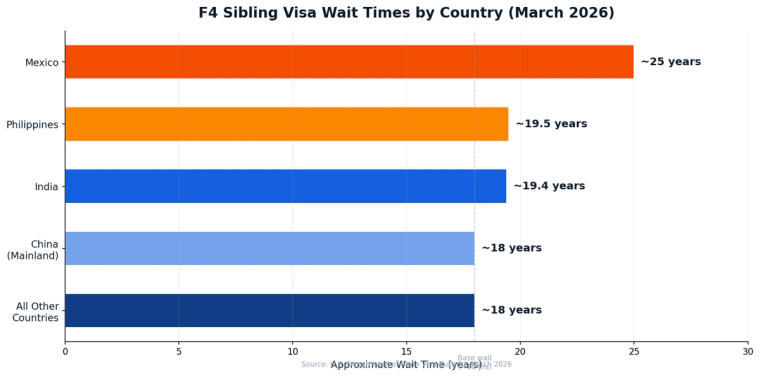
F4 Final Action Dates (March 2026 Visa Bulletin)
| Country | Final Action Date | Approximate Wait |
|---|---|---|
| All Other Countries | January 8, 2008 | ~18 years |
| China (Mainland) | January 8, 2008 | ~18 years |
| India | November 1, 2006 | ~19.4 years |
| Philippines | September 1, 2006 | ~19.5 years |
| Mexico | April 8, 2001 | ~25 years |
Source: U.S. Department of State Visa Bulletin, March 2026
These dates move slowly. F4 priority dates typically advance a few weeks to a few months per bulletin. Some months they don't move at all, and occasionally they retrogress (move backward). For the latest movement, check our June 2026 Visa Bulletin analysis.
How to file: the step-by-step process
The sibling petition has two phases. Phase one is the I-130 petition itself, and USCIS processing times vary by office and workload rather than following a single uniform timeline. Phase two is waiting for a visa number to become available through the Visa Bulletin, which is where the 15 to 22+ year timeline comes from. Immiva's I-130 preparation walks through the F4 petition question by question.
Phase 1: I-130 petition (processing time varies by USCIS office)
- Gather proof of your U.S. citizenship and your sibling relationship (birth certificates showing a common parent, marriage certificates for step-siblings, adoption documents if applicable)
- File Form I-130 online at my.uscis.gov ($625) or by mail ($675). USCIS stopped accepting checks as of October 28, 2025, so pay by card or ACH debit (USCIS Fee Schedule)
- Attend a biometrics appointment if USCIS requests one
- Wait for I-130 approval. Your filing date becomes your priority date, which is your place in line.
Phase 2: Visa availability (15 to 22+ years)
- After I-130 approval, your case transfers to the National Visa Center (NVC)
- When your priority date becomes current on the Visa Bulletin, NVC contacts you and your sibling to submit the DS-260, financial documents, and civil documents
- Your sibling attends a consular interview at a U.S. embassy
- If approved, your sibling receives an immigrant visa and enters the U.S. as a permanent resident
If your sibling is already in the U.S. with a qualifying immigration status and their priority date is current, they may be able to file for adjustment of status (Form I-485) instead of going through consular processing.
Why you should file today: the priority date strategy
Your priority date is the date that matters most in this process. It's the moment USCIS receives your I-130 petition, and it determines when your sibling's turn comes up on the Visa Bulletin.
Say you file in mid-2026 and the F4 line for "all other countries" is processing January 2008 petitions, you're about 18 years from the front. Wait two years, and you'll be about 20 years out. The line moves slowly and new filings keep pushing the queue further.
The filing fee is $625 online. For that, you're locking in your sibling's place in a line that only gets longer. There's no faster track for siblings, and premium processing is not an option for I-130 petitions.
If you're a green card holder who wants to petition a sibling, the clock starts with your own path to citizenship. Most lawful permanent residents must wait at least 5 years before applying for naturalization, while some applicants married to U.S. citizens may apply after 3 years. You can't file the sibling I-130 until you're a citizen.
What happens during the long wait
Once USCIS approves your I-130 and your case sits at NVC, not much happens for a long time. Here's what to expect during those years.
Your sibling gets no immigration benefit from a pending or approved I-130. No legal status, no work authorization, no travel privileges in the United States.
Be aware that filing the I-130 creates a record of immigrant intent for your sibling. That can complicate applications for tourist visas (B-2) or student visas (F-1), since consular officers may question whether your sibling intends to return home after a temporary visit.
Children aging out is a real risk. If your sibling has kids who are under 21 when you file, those children are included as derivative beneficiaries. But if a child turns 21 before the visa becomes available, they may "age out" and lose eligibility. The Child Status Protection Act (CSPA) provides some relief by subtracting the time USCIS spent processing the I-130 from the child's age, but it's not guaranteed.
An approved I-130 is automatically revoked if the petitioner dies. Humanitarian reinstatement is possible but discretionary, and Section 204(l) may provide relief if at least one beneficiary was residing in the United States when the qualifying relative died and continues to reside in the United States when seeking relief.
Keep your information current with USCIS and NVC. Update them on any address changes. Track the Visa Bulletin monthly to monitor priority date movement.
2025-2026 policy changes that affect sibling petitions
Several policy changes from the past year matter for sibling petitions:
- August 1, 2025: USCIS rewrote its family-based petition guidance (PA-2025-12), spelling out documentation expectations and interview referral criteria. The update reinforces that USCIS may deny an I-130 without first issuing a Request for Evidence if required initial evidence is missing, so file complete the first time. An incomplete filing does not automatically trigger a Notice to Appear; NTA decisions follow separate USCIS guidance.
- October 28, 2025: For most paper-filed benefit requests, USCIS stopped accepting checks and money orders and generally requires payment by Form G-1650 (ACH debit) or Form G-1450 (card), unless the filer qualifies for an exemption. Forms filed online continue to be paid online through USCIS.
- January 21, 2026: The State Department paused immigrant visa issuances for immigrant visa applicants who are nationals of 75 countries. For F4 applicants who waited 15 to 22+ years, this pause can hit right at the finish line.
- Travel bans: Executive orders issued in mid- and late 2025 restrict travel and immigration from 39+ countries.
- USCIS backlog: With more than 11 million pending family petitions, F4 cases get deprioritized in favor of immediate relative and employment-based petitions.
All of this points in one direction: file a complete, accurate petition from the start. Missing documents that once would have triggered an RFE can now result in a straight denial.
How much does it cost to petition a sibling?
The I-130 filing fee is $625 online or $675 by paper. That is the only government fee you pay upfront. Most other costs are years away because of the F4 backlog.
When your sibling's priority date finally becomes current, expect to pay the $325 NVC immigrant visa fee, the $120 NVC Affidavit of Support fee, $200 to $500 for the medical exam in your sibling's country, $50 to $300 for document translations, and the $235 USCIS Immigrant Fee after the visa is approved. Across the life of the case that typically adds up to around $1,500 to $1,900 in today's dollars, about $1,300 of it in government fees and the rest going to the medical exam and translations.
Our I-130 filing fee 2026 guide breaks down each fee, the October 2025 payment-method changes, and when each one comes due. For optional legal help, attorney fees for sibling petitions usually run $1,500 to $5,000+.
The catch is timing. The I-130 fee gets paid today, but the NVC fees, medical exam, and Immigrant Fee don't come due until your priority date is almost current. For F4, that can be a decade or two later.