
Your I-130 petition just got approved. That's good news, but your relative does not have a green card yet. The approval confirms USCIS recognizes the family relationship. What comes next depends on where your beneficiary lives and which family category you fall under. This guide covers both paths, the fees, and 2026 policy changes that could affect your case.
What I-130 Approval Actually Means (and What It Does Not)
When USCIS approves your Form I-130, it means the agency has verified the qualifying family relationship (USCIS I-130 Official Page). That is it.
What I-130 approval does not do:
- It does not grant your beneficiary any immigration status
- It does not authorize your beneficiary to work in the U.S.
- It does not authorize your beneficiary to travel to the U.S.
- It does not guarantee a green card
From USCIS: "The filing or approval of this petition does not give your relative any immigration status or benefit" (USCIS Policy Manual, Vol. 6, Part B, Ch. 5).
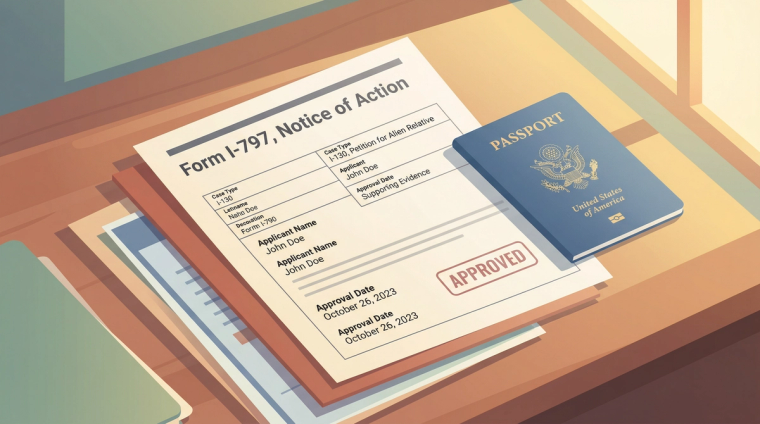
When your I-130 is approved, you receive a Form I-797, Notice of Action. This document contains your priority date, which is the date USCIS originally received your I-130 petition. This is your place in line for a visa number. Keep this notice, because you will need the priority date throughout the process.
Your priority date and Alien Registration Number (A-Number) both appear on the I-797. You will use both in future filings.
Your Two Paths Forward: Which One Applies to You?
After I-130 approval, your case follows one of two routes based on what the petitioner indicated on the I-130 and where the beneficiary lives:
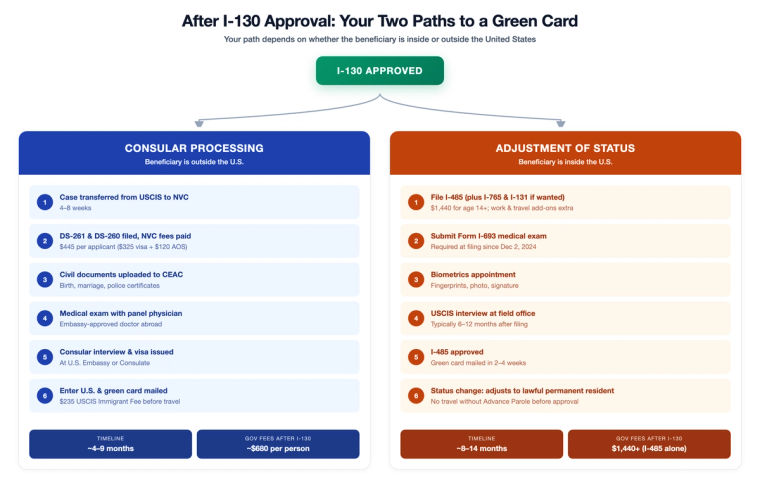
Consular Processing applies when the beneficiary is outside the United States. USCIS forwards the approved petition to the National Visa Center (NVC), which is part of the State Department. The beneficiary will eventually attend an interview at a U.S. Embassy or Consulate abroad.
Adjustment of Status applies when the beneficiary is already inside the United States with a lawful entry. USCIS retains the approved petition and the beneficiary files Form I-485 to adjust to permanent resident status without leaving the country.
Before you go further, you also need to understand whether your beneficiary is an immediate relative or in a preference category, because this determines how long they wait for a visa number.
| Category | Who Qualifies | Visa Wait |
|---|---|---|
| Immediate Relative (IR) | Spouse of U.S. citizen, unmarried child under 21 of U.S. citizen, parent of U.S. citizen (petitioner must be 21+) | None. Always available |
| F1 | Unmarried adult children of U.S. citizens | 7 to 15+ years |
| F2A | Spouses and minor children of green card holders | Roughly 4.5 to 7 years total |
| F2B | Unmarried adult children (21+) of green card holders | 5 to 10+ years |
| F3 | Married children of U.S. citizens | 10 to 15+ years |
| F4 | Siblings of adult U.S. citizens | 15 to 22+ years |
Immediate relatives can move to the next step right away. Preference category beneficiaries must wait until a visa number becomes available, which you track through the Visa Bulletin. Category-by-category timing estimates are in our I-130 processing time guide.
Path 1: Consular processing (beneficiary outside the U.S.)
If your beneficiary is abroad, USCIS automatically forwards the approved I-130 to the National Visa Center (NVC). From there, your case moves through nine stages: NVC case creation, the welcome letter and CEAC account setup, paying the $325 immigrant visa processing fee and $120 Affidavit of Support fee, submitting DS-260 and uploading civil documents, NVC review until you are documentarily qualified, interview scheduling at the embassy, the medical exam with a panel physician, the interview itself, and finally visa issuance plus the $235 USCIS Immigrant Fee before entry.
Total time for an immediate relative is roughly 4 to 12 months from approval to the visa interview, plus travel and entry time once the visa is issued. Preference categories add the visa bulletin wait on top, which can stretch from several years for F2A to two decades or more for F4. Check the NVC Timeframes page for the case-creation and review dates NVC is working on right now.
Two warnings to know about. First, panel physicians abroad are not interchangeable with civil surgeons in the U.S.; medical exams done by the wrong provider get rejected. Second, under INA § 203(g) the State Department can terminate a visa registration if the beneficiary fails to apply within one year of a visa availability notice.
The stage-by-stage breakdown, with current wait times for major consular posts and the document checklist for each stage, is in our I-130 consular processing timeline.
Path 2: Adjustment of status (beneficiary in the U.S.)
If the beneficiary is already in the U.S. and entered lawfully, they can file Form I-485 to become a permanent resident without leaving the country. The package usually includes Form I-485 ($1,440 for adults), the I-693 medical exam (required at filing since December 2, 2024), and optional but recommended Form I-765 ($260 with I-485) for a work permit and Form I-131 ($630) for travel authorization.
Immediate relatives can file the I-485 right after I-130 approval, or concurrently with the I-130 from the start. Preference categories must wait until the priority date is current under the chart USCIS designates that month. After filing, USCIS schedules biometrics, then a field-office interview 6 to 12 months later, then approves or asks for more evidence. Approved cases get the green card in the mail 2 to 4 weeks after the interview.
Concurrent filing in one sentence
Concurrent filing means submitting the I-485 with the I-130 (or after the I-130 is filed online), and it saves months by collapsing two waits into one. Eligibility depends on visa availability; immediate relatives always qualify, preference categories only when their dates are current. The full breakdown of who can and cannot file concurrently is in our I-130 vs I-485 comparison.
Travel and work warnings
Leaving the U.S. without approved Advance Parole while the I-485 is pending is generally treated as abandoning the application. The exceptions are narrow: certain applicants in valid H, L, K-3/K-4, or V status may travel and return without abandoning if they meet the regulatory requirements for re-entry in the same status.
AOS fees (2026)
Beyond the I-130 itself, government fees on the adjustment path run about $1,440 for the I-485, plus an optional $260 for the I-765 work permit and $630 for the I-131 travel document, roughly $2,330 if you file all three. Fee waivers via Form I-912 are available for some forms based on income or hardship, though NVC fees and the USCIS Immigrant Fee cannot be waived. The full path-by-path fee breakdown is in our I-130 filing fee 2026 guide.
Understanding the visa bulletin and priority dates
Immediate relatives can skip this section. A visa number is always available for them, so the Visa Bulletin never matters (INA § 201(b)(2)(A)(i)).
For preference categories (F1 through F4), the State Department publishes the Visa Bulletin every month with cutoff dates by category and country. Two charts are used: Final Action Dates (when USCIS or a consulate can actually approve the case) and Dates for Filing (when applicants can submit the I-485 or send NVC documents). USCIS picks one chart per month for AOS filing; using the wrong chart is one of the most common application errors.
What to do while waiting: check the bulletin monthly for movement, keep your address current with USCIS and NVC, watch for marital-status or age changes that could affect classification (CSPA may help in some cases), and respond fast to any NVC communication to avoid case termination.
Our I-130 priority dates and the visa bulletin guide explains Chart A vs Chart B in plain language, walks through the five preference categories, and covers the August 2025 CSPA policy reversal.
Critical 2025 to 2026 Policy Updates Affecting Your Case
Several policy changes from 2025 and 2026 could affect your next steps.
75-Country Immigrant Visa Pause (effective January 21, 2026). The State Department announced a pause on immigrant visa issuance for nationals of 75 listed countries under a public-benefits screening policy. Bangladesh, Nigeria, and Pakistan are on the published list, but India is not on the State Department's February 2, 2026 list. Separately, Presidential Proclamation 10998 imposed full or partial visa suspensions for certain nationals of 39 countries effective January 1, 2026. If your beneficiary may be affected, check the current State Department country list and any applicable proclamation guidance before proceeding.
Stricter Family Petition Scrutiny (effective August 1, 2025). USCIS policy alert PA-2025-12 updated the Policy Manual to strengthen screening and vetting for family-based immigrant visa petitions, clarify when interviews may be required, and clarify that USCIS may issue a Notice to Appear if a beneficiary is otherwise removable because a family-based petition does not grant status or relief from removal.
I-765 and I-131 Are No Longer Included in the I-485 Fee. Since April 1, 2024, work permits and travel documents require separate fees when filed with I-485. This increased the total adjustment of status package cost by roughly 90% compared to the old fee structure.
I-693 Medical Exam Required at Filing. Since December 2, 2024, Form I-693 must be submitted with your I-485 at the time of filing. Missing it can result in your application being rejected outright.
Travel Restrictions. If your beneficiary is affected by the current travel restrictions, consult an immigration attorney before proceeding with either path.
5 Common Mistakes to Avoid After I-130 Approval
1. Assuming I-130 approval means you have a green card. It does not. The I-130 only confirms the family relationship. You still need to complete either consular processing or adjustment of status to actually get the green card.
2. Traveling without Advance Parole during a pending I-485. If the beneficiary leaves the U.S. without approved Advance Parole while their adjustment of status application is pending, USCIS generally treats it as abandoning the case. Exceptions may apply to certain applicants in valid H, L, K-3/K-4, or V nonimmigrant status who meet the return requirements for that status.
3. Not responding to NVC within deadlines. NVC can terminate a case after one year of inactivity under INA Section 203(g). If you receive a Welcome Letter or document request, respond promptly even if your priority date is not yet current.
4. Using the wrong Visa Bulletin chart. The "Dates for Filing" chart and the "Final Action Dates" chart serve different purposes. Using the wrong one can lead you to file too early (resulting in rejection) or wait longer than necessary. Our Visa Bulletin explainer breaks this down in detail.
5. Letting the beneficiary's status lapse. I-130 approval does not grant or extend any immigration status. If the beneficiary is in the U.S. on a temporary visa, they must maintain that status until they file for adjustment of status or leave the country. Special exemption: immediate relatives of U.S. citizens can adjust status despite a visa overstay, as long as they originally entered lawfully (8 CFR Section 245).