
Most I-485 applicants go in assuming the interview is mandatory. Under 8 CFR 245.6, every adjustment applicant is interviewable unless USCIS waives the interview, and USCIS decides waivers case by case.
Adjusting status with I-485 is well-documented right up until the interview. At that point, most people realize they have no idea what USCIS will actually ask them, or whether they'll even be called in. This post covers the questions you're likely to face, how to prepare, and what the waiver rules actually say.
Form I-485 is the last step before a green card, but the road to filing usually runs through Form I-130 first. Once it's pending, USCIS decides whether you get interviewed, when, and what they'll want to ask. The default under 8 CFR § 245.6 is that every applicant gets interviewed. In practice, most employment-based cases skip the interview entirely, while most marriage-based cases don't. That gap is bigger than most people going into the process realize.
What follows covers the questions officers ask, what to bring, how the day plays out, and what to do if something goes sideways. It also covers recent policy developments that can affect adjustment cases, including USCIS's February 28, 2025 Notice to Appear policy and USCIS's requirement, effective December 2, 2024, that certain applicants submit Form I-693 with Form I-485.
When the I-485 Interview Is Waived (and When It Isn't)
8 CFR § 245.6 is where the interview requirement actually lives. It says each adjustment applicant "shall be interviewed by an immigration officer." Three exceptions are built in: the applicant is under 14, the applicant is clearly ineligible, or USCIS determines the interview isn't necessary. That third one is where most waiver decisions get made.
USCIS Policy Manual, Volume 7, Part A, Chapter 5 spells out general waiver categories that include certain unmarried children of U.S. citizens, parents of U.S. citizens, and certain unmarried children under 14 of lawful permanent residents, while still making clear that waiver decisions are case by case.
- Unmarried children under 21 of U.S. citizens
- Parents of U.S. citizens
- Unmarried children under 14 of lawful permanent residents
Being on that list doesn't guarantee a waiver, and not being on it doesn't rule one out. USCIS still makes the call case by case. Employment-based cases are a good illustration: they were formally dropped from the waiver list in 2018 under Policy Alert PA-2018-04, yet most EB applicants with clean packages never see an interview.
Waiver rates by category in 2026
USCIS decides interview waivers case by case and does not publish waiver rates by category. For family-based applications, USCIS generally requires the Form I-130 petitioner to appear with the principal applicant if an interview is scheduled. Treat any specific waiver-rate percentage you see online with skepticism; none of them come from official USCIS data.
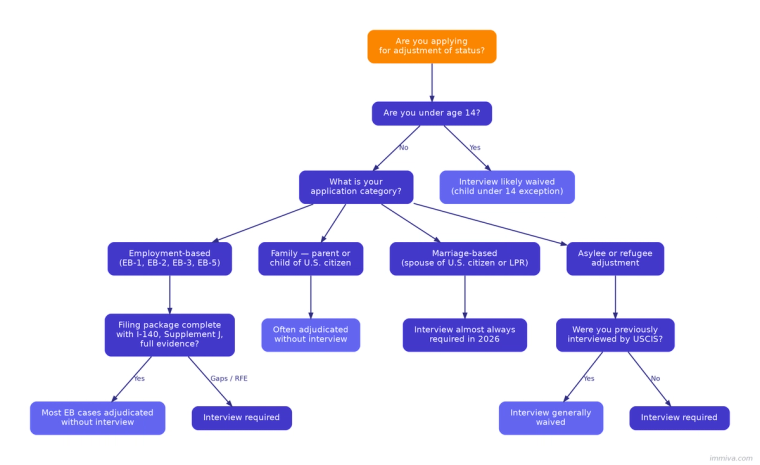
A simplified decision tree covering I-485 interview waiver eligibility by category. Employment-based applicants with clean filings are usually adjudicated without an interview; marriage-based applicants usually aren't.
What triggers a mandatory interview anyway
Even waiver-eligible applicants can get pulled in if the file has problems: missing or contradictory documents, an unresolved Request for Evidence, criminal history flags, prior immigration violations, visa fraud allegations, fingerprint discrepancies at biometrics, or a third-party fraud tip. The cleaner the filing, the better the odds of skipping the interview entirely. That's why Immiva walks you through the I-485 question by question, catching the inconsistencies and evidence gaps that tend to push a case into mandatory-interview territory.
How to find out if your interview was waived
There's no formal request for a waiver and no way to apply for one. The signals USCIS sends are indirect:
- Your USCIS online account moves to "Decision was made" or shows Step 3 (interview) marked as completed without an interview having taken place.
- You receive an email or notice stating the case "may be adjudicated without an interview."
- Your case approval comes through the mail with no interview notice ever issued.
Don't count on the USCIS contact center for a straight answer here. The National Benefits Center can suggest a waiver, but the field office has the actual authority.
What Happens at the I-485 Interview, Step by Step
If your interview is scheduled, USCIS generally notifies you by Form I-797C with the appointment information. For family-based applications, USCIS generally requires the Form I-130 petitioner to appear with the principal applicant, and derivative applicants are also required to appear regardless of filing category.
Before you arrive
The appointment notice lists what to bring, but the standard checklist covers most cases anyway. Block out at least two to three hours at the field office even if the interview itself runs short. No food, no weapons, and your phone needs to be off or on silent. Standard federal building rules.
Check-in and security
Metal detectors and bag screening at the entrance. Get there at least 30 minutes early. If you're late, whether they still see you or reschedule depends on the field office.
The interview itself
Once you're called back, the officer takes you to a private room and swears you in. The first few minutes are identity checks: they compare your photo ID, often take a fresh set of fingerprints, and confirm your name, date of birth, A-Number, and address.
After that, the officer goes through your I-485 page by page. You confirm your answers, explain anything unclear, and flag anything that's changed since you filed. They'll check originals of anything you submitted as copies and look over any updated documents you brought.
Family-based and marriage-based interviews usually run 20 to 45 minutes. Employment-based ones, when they happen at all, tend to be shorter, around 15 to 30. Stokes interviews are in a different category and can take two to eight hours.
After the interview
The interview can end a few different ways: approval, a Request for Evidence, continued review with a decision later by mail, or denial. USCIS may issue temporary evidence of permanent resident status in some cases, but approval does not automatically mean you will receive an I-551 stamp at the interview. USCIS's current RFE policy generally provides 87 days for USCIS to receive an RFE response mailed within the United States. Under USCIS's February 28, 2025 NTA policy, a denial can also carry removal-proceedings consequences in some cases. Same-day decisions happen but aren't guaranteed. Getting a decision in the mail weeks later is completely normal.
Common I-485 Interview Questions by Category
Most people reading this are here for the actual questions. The ones below come from USCIS guidance, the USCIS Policy Manual, and what applicants have reported being asked at field offices over the past 18 months.
Questions asked in every I-485 interview
Every interview starts with identity verification and a full review of your application. Standard questions:
- "Please state your full name and date of birth."
- "What is your A-Number?"
- "When did you last enter the United States and on what visa?"
- "Have you filed any other immigration applications before this one?"
- "Has anything changed since you filed Form I-485 (address, job, marital status, children, criminal history)?"
- Every yes-or-no inadmissibility question on Part 8 of the I-485, read aloud (drug use, terrorism affiliations, prior removals, communist party membership, polygamy, prostitution, and so on).
The Part 8 questions catch a lot of people off guard. Officers read every single one aloud, even when the answer is obviously no. Just answer calmly and move on.
Marriage-based I-485 interview questions
The whole interview is built around one question: is this marriage genuine? Officers approach it differently, but the questions spouses typically get asked include:
- How did you meet?
- Who proposed and where?
- When and where did you get married?
- What did you do for your last birthday and your spouse's last birthday?
- Where do you live, and who else lives in the home?
- What time does each of you leave for work in the morning?
- Do you have joint bank accounts, leases, insurance, or utility bills?
- What did you do this past weekend?
- What's your spouse's favorite food, TV show, or hobby?
This isn't a memory test. Officers compare your answers to your spouse's, looking for consistency. Getting a birthday wrong matters less than giving different answers about where you live or how your daily life actually works.
Employment-based I-485 interview questions
On the rare occasion an EB case goes to interview, the questions tie directly to the I-140 petition and the underlying job offer:
- Are you still working for the petitioning employer?
- Has the offered position or your job duties changed?
- Do you intend to work in the offered position after your green card is approved?
- Have you submitted Form I-485 Supplement J (confirmation of bona fide job offer or AC21 portability)?
- For AC21 portability cases, did you change to a same-or-similar job at least 180 days after your I-485 was filed?
These come up because EB cases are anchored to a specific job offer. If the petitioning employer closed or you moved to a role that doesn't qualify under AC21, USCIS needs that documented before they can adjudicate.
Additional background and eligibility questions
Background-check questioning has gotten more involved under the current administration. Officers may also ask about:
- Social media accounts and aliases used in the past five years
- All international travel since you entered the United States
- Foreign government contacts, employment, or military service
- Political and religious affiliations in your home country
- Whether you've ever applied for asylum, refugee status, or TPS
Documents to Bring to Your I-485 Interview
Bring originals of everything you submitted as copies, plus updated versions of anything that's changed since filing. The documents most offices expect:
- Form I-797C interview appointment notice
- Government-issued photo ID, ideally your unexpired passport (bring expired passports too)
- Your I-94 arrival/departure record, even if expired
- Birth certificate with certified English translation
- Marriage certificate, divorce decrees, and death certificates for any prior spouse, with translations
- Complete copy of your filed I-485 package, including I-130 or I-140, I-864 affidavit of support, I-693 medical exam, I-765 EAD, and I-131 advance parole if filed
- Updated relationship evidence for marriage-based cases: joint lease or mortgage, joint bank statements (last 12 months), joint utility bills, joint insurance policies, photos together across the relationship, recent travel together
- Updated financial evidence: most recent tax returns, W-2s, pay stubs from the last six months, employer verification letter
- Certified police and court records for any criminal history, including arrests that didn't lead to charges
- Two passport-style photos
- Evidence of changes since filing: new address, new employer, new children's birth certificates, legal name change documents
Forgot something? Show up anyway. Officers issue a Request for Evidence for missing documents more often than they deny outright.
7 Preparation Tips for Your I-485 Interview
Pulled from immigration practitioners and people who've been through the interview recently.
1. Re-read your entire I-485 before the interview. You can refer to documents during the interview, but officers expect you to know what you put on the form. The most common stumble is forgetting an old address or a previous employer.
2. Organize everything in a labeled binder with tabs. Use categories: identity, finances, relationship, medical, criminal history. Officers notice when it's organized, and it moves the interview faster.
3. Bring originals and copies of everything. Officers sometimes keep copies and hand back originals. Showing up with originals only puts you in a bad spot.
4. For marriage-based cases, don't over-rehearse. Couples who script their answers come across as rehearsed, which raises skepticism rather than lowering it. A bit of natural back-and-forth, including mild disagreement about small household details, actually reads as evidence of a real marriage.
5. Get there 30 minutes early and plan for a wait. Lobby wait times range from 15 minutes to over two hours depending on the field office and how busy the day is. Bring something to do.
6. Be honest. "I don't know" is better than guessing. Contradictions between your answers and your spouse's, or between the interview and your I-485, do far more damage than saying you can't remember a specific date.
7. Don't let the officer's tone throw you off. USCIS officers are trained to stay neutral, sometimes to the point of seeming cold. A stern face is not a sign your case is in trouble. Just answer the questions directly.
What to Do If Your I-485 Interview Goes Wrong
Most people walk out with an approval or a note that their case is under review. A smaller share get denied or get flagged for a Stokes interview.
Denial at the interview
A direct appeal isn't available for I-485 denials, but you may be able to file Form I-290B as a motion to reopen or reconsider, or in some cases file a new Form I-485 if you remain eligible. For a general paper-filed Form I-485 (edition 01/20/25 before September 18, 2026, then 09/18/26), the USCIS filing fee for an applicant 14 or older is $1,440, as set by the USCIS fee schedule (Form G-1055).
Stokes interviews
A Stokes interview is when officers separate spouses and question each one individually before comparing answers. It may be used when officers see significant inconsistencies, credibility concerns, or insufficient evidence regarding the bona fides of the marriage. They can take several hours. The same approach applies: be honest, don't guess, and don't let the unusual format rattle you.
NTA risk after a denial
The biggest policy shift in 2025 was expanding when USCIS issues Notices to Appear after denials. Under the February 2025 NTA policy, if you're out of status when your I-485 gets denied, you can end up in removal proceedings. That changes the stakes around getting everything right the first time, and it makes the growing USCIS backlog more of a problem, not less, for cases with documentation gaps.
2026 Policy Changes Affecting I-485 Interviews
A few things have shifted since 2024 that are worth knowing about:
Marriage-based waivers are not a given. USCIS decides interview waivers case by case and does not publish marriage-based waiver rates, so plan on attending an interview unless USCIS notifies you otherwise.
NTA expansion raises the cost of a denial. In 2024, a denied I-485 usually meant refiling or exploring another path. In 2026, it can mean removal proceedings if you're out of status when USCIS issues the decision.
If you are required to submit Form I-693, USCIS now requires you to submit it with Form I-485. USCIS announced this requirement on December 2, 2024, and warns that Form I-485 may be rejected if the required Form I-693 is not filed together with it.