
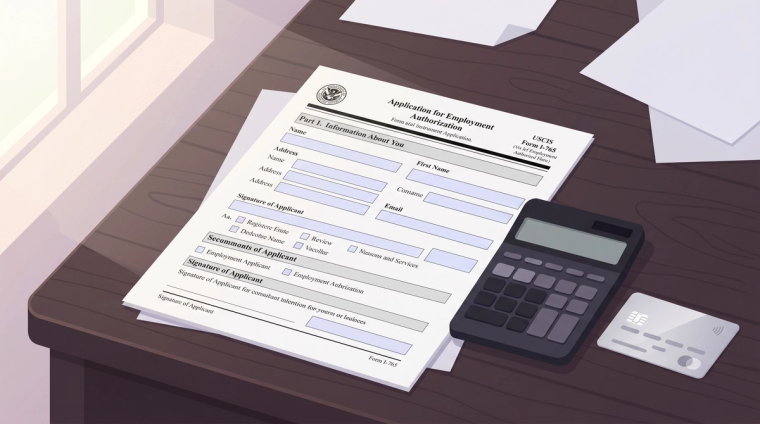
The OPT application fee right now is $470 online or $520 on paper. Premium processing is a separate $1,780. Here's the full picture, and why so many websites still show the wrong number.
If you file online in 2026, the I-765 filing fee for OPT is $470. Mail a paper application and it's $520. No separate biometrics fee anymore. Premium processing is optional, costs $1,780, and brings you to $2,250 if you go online plus premium (the fastest combo). Seen $410 quoted somewhere? That number was retired on April 1, 2024. Pay it today and USCIS will reject your application (USCIS, October 2024 stakeholder message).
This guide walks through every cost an F-1 student should plan for, including the stuff most competitor pages skip: university service fees, the new October 2025 payment rules, and whether premium processing actually pays off in your situation. If you want the full filing walkthrough instead of just the cost angle, our OPT application guide covers eligibility, timing, and documents.
The current I-765 OPT fee in 2026
The USCIS fee for Form I-765 in employment categories (c)(3)(A), (c)(3)(B), and (c)(3)(C) is:
- $470 for online filing through your myUSCIS account
- $520 for paper filing mailed to the lockbox
That covers pre-completion OPT (c)(3)(A), post-completion OPT (c)(3)(B), and the 24-month STEM OPT extension (c)(3)(C). The fees come from Form G-1055, the USCIS fee schedule, and are codified at 8 CFR 106.2. Keep in mind that the same Form I-765 also covers a bunch of other EAD categories (J-2 dependents, H-4 spouses, asylees), each with its own fee. If you're filing under a different one, the J-2 walkthrough is here: I-765 J-2 field-by-field instructions.
The fee structure took effect on April 1, 2024 under the USCIS Fee Schedule final rule, published at 89 FR 6194. It was the first comprehensive USCIS fee restructuring since 2016, and it scrapped the separate $85 biometrics fee that used to apply to OPT applicants. USCIS now confirms that "there will be no separate biometric services fee for most applicants." OPT (c)(3) is one of the categories where the biometric piece is rolled into the $470 or $520.
As of September 30, 2026, USCIS accepts the 08/21/25 Form I-765 edition and does not accept the 09/15/26 edition. The court postponed the rule that would have required the September edition. Check the current form page before filing; using an unaccepted edition can lead to rejection.
Why so many websites still show $410
Google "OPT filing fee" and at least half the first-page results still show $410. Some throw in a separate $85 biometrics fee for a total of $495. That number has been wrong since April 1, 2024. Stilt, Shouse Law, OpenSphere, Path2USA, ImmigrationHelp.org: none of them have updated their fee pages, even though some carry "2026" in the title. Wikipedia and a number of university PDFs still show the old figure too.
This matters because USCIS rejects applications submitted with the wrong fee. In an October 2024 stakeholder message, USCIS flagged "a significant increase of Forms I-765 being filed without the correct fee" and warned applicants directly that mailing $410 today will get the application returned, with no refund of anything already processed. The fix is simple. Pull the number straight from USCIS Form G-1055 or the I-765 page itself before you pay.
Why online filing saves you $50
USCIS introduced the $50 online discount as part of the 2024 fee rule. Part of the goal was pushing applicants away from paper. Part of it was offsetting what it actually costs the agency to run physical lockbox facilities. Online filings flow straight into the USCIS Electronic Immigration System (ELIS), which means less mail handling, fewer hands touching paper, and faster initial data entry. The discount is the agency sharing some of that savings with you.
Online filing is available for all three F-1 OPT categories, and as of 2026 it's the dominant channel for new (c)(3)(B) post-completion applications. One thing to watch for. The University of Washington's ISS office reported in late 2025 that several students were charged $1,020 instead of $470 because of an online filing bug, and had to dispute the charge with their card issuer. Before you click submit, check that the final amount on the Pay.gov confirmation screen matches the fee on Form G-1055. If anything looks off, screenshot it and contact USCIS before you submit.
Premium processing: the $1,780 question
Premium processing has been available for F-1 OPT and STEM OPT since March and April 2023. You file Form I-907 alongside Form I-765 (or after USCIS receipts the I-765), and USCIS commits to a response within 30 business days. The response can be an approval, a denial, a request for evidence, or a notice of intent to deny.
The fee changed on March 1, 2026. Under the Federal Register notice published January 12, 2026, premium processing for the I-765 (c)(3) category went from $1,685 to $1,780. That's a 5.72% bump, tracking CPI-U inflation between June 2023 and June 2025. The adjustment is codified at 8 CFR 106.4(c).
A few things worth knowing that most guides skip:
- The 30-day clock is business days, not calendar days. It got switched to business days under the 2024 fee rule, so the real-world wait is closer to 6 weeks once you account for federal holidays.
- An RFE or NOID resets the clock. Once you respond, USCIS gets a fresh 30 business days from receipt.
- Premium speeds up adjudication, not card production. Your EAD still has to be produced and mailed by USCIS card services after approval. Most cards arrive 2 to 4 weeks after approval whether you paid for premium or not.
- Employers can pay the I-907 fee. It's one of the few USCIS fees that someone other than the applicant can legitimately cover. If you have a job offer riding on OPT timing, asking your employer is a fair conversation.
Online filing plus premium processing: $470 + $1,780 = $2,250. Paper plus premium: $2,300.
The true total cost of OPT
Most fee pages stop at the USCIS number and miss the costs that actually hit your wallet. Here's a fuller picture.
On top of the USCIS fee, expect some or all of these:
- Passport-style photos: $0 to $15, depending on whether you use a friend's phone or a professional service. USCIS doesn't usually require new photos with online filing, but DSO recommendations vary.
- University DSO service fee: typically $100 to $550 depending on the school. Public DSO pages show Binghamton at $100, Bentley at $150, Cornell at $225, ASU at $300, Northeastern at $400, and UC Santa Cruz at $550. The fee covers your DSO's time issuing the updated I-20 with the OPT recommendation. Your school bills you for this, not USCIS.
- Mailing and tracking: $0 for online filing, $20 to $45 if you mail paper and want USPS Priority Mail with tracking. International students should use tracked mail.
- Premium processing (optional): $1,780.
- Attorney (optional): $250 to $1,500 depending on the firm. AllLaw cites $250 to $500 as typical for an EAD-only matter.
A realistic mid-range total for an online DIY filer paying a university service fee lands around $565 to $1,020. Full attorney plus premium processing pushes most cases to $3,000 to $4,500. Most F-1 students don't need to spend anywhere near that. The I-765 for OPT is a straightforward form, and the cost of legal help is often way out of proportion to the actual complexity of the case.
DIY vs guided service vs attorney
There's a wide gap between filing it yourself and hiring counsel. Guided services have grown up to fill it.
| Path | USCIS fee | Service fee | Total | What you get |
|---|---|---|---|---|
| DIY (no help) | $470 online | $0 | $470 | You handle the form, deadlines, and any USCIS correspondence on your own. |
| DIY plus DSO support | $470 online | $100 to $550 | $570 to $1,020 | Your school's DSO issues the I-20 OPT recommendation and answers questions. Most schools include this in tuition or charge a flat service fee. |
| Guided service | $470 online | $50 to $200 | $520 to $670 | Online software walks you through each question, flags inconsistencies, and generates a filing-ready package. No legal advice, but the format catches common errors. |
| Full attorney | $470 online | $250 to $1,500 | $720 to $1,970 | An immigration attorney reviews and files on your behalf. Useful for complex cases (criminal history, visa overstay, prior denials), but overkill for most F-1 OPT cases. |
If your case is straightforward (current F-1 status, clean immigration history, valid I-20, no prior denials), you don't need an attorney to file OPT. Immiva prepares OPT and STEM OPT Form I-765 applications with category checks and a document list. You can also prepare the application yourself with DSO support. If you choose Immiva, the preparation fee is separate from USCIS fees and is listed on our pricing page.
Fee waivers don't apply to OPT, and other myths to retire
One of the stickiest myths about OPT costs is the idea that F-1 students can use Form I-912 to waive the filing fee. They can't. Fee waiver eligibility is governed by 8 CFR 106.3(a), which lists the specific employment authorization categories that qualify. The list includes certain asylum applicants (c)(8), adjustment-of-status applicants (c)(9) and (c)(16), NACARA beneficiaries (c)(10), T and U nonimmigrants, refugees, and VAWA applicants. F-1 (c)(3) OPT is not on that list. Sending in an I-912 with an OPT application gets the package rejected and returned.
A few other myths worth retiring:
- There is no separate $85 biometrics fee for OPT. It was eliminated in the April 2024 fee rule and folded into the $470/$520 figure.
- Premium processing is available for OPT and STEM OPT. It has been since 2023. Several competitor pages still claim it isn't.
- Employers can pay the I-907 premium processing fee. USCIS doesn't restrict who pays that one.
- The I-765 fee is not refundable once USCIS accepts and processes your filing, regardless of whether the case is later approved, denied, or withdrawn. A lockbox rejection for an incorrect fee, wrong form edition, or missing signature is different though: the filing usually doesn't get a filing date, and you have to fix the problem and refile. That's a strong argument for getting the form right the first time, which is where guided filing or attorney review earns its keep if you're nervous about errors.
STEM OPT extension and renewal costs
If you're filing the 24-month STEM OPT extension under category (c)(3)(C), the USCIS fee is the same: $470 online or $520 paper. The DSO service fee at your school usually applies again, and many schools charge a bit more for the STEM extension because it requires reviewing the Form I-983 training plan.
A realistic lifetime cost of F-1 work authorization, if you do both initial OPT and a STEM extension:
- Initial OPT: $470 + ~$300 DSO fee = ~$770
- STEM OPT extension: $470 + ~$400 DSO fee = ~$870
- Baseline total: ~$1,640 across two filings, no premium processing, no attorney
If you expedite both with premium processing: $1,640 + $3,560 = up to $5,200 for the full lifecycle. Most students pay closer to the baseline. Premium processing is worth paying for when your start date depends on it, not as a default.
One more change worth knowing. The October 30, 2025 DHS interim final rule eliminated the 540-day automatic EAD extension that used to cover the gap during EAD renewal processing. Our explainer on the auto-extension elimination covers the policy in detail. STEM OPT's separate 180-day auto-extension at 8 CFR 274a.12(b)(6)(iv) survived the change, but late filers in any OPT renewal scenario now face real work-stoppage risk.
How to pay your fee in 2026
Payment methods changed substantially in late 2025, and most fee pages haven't caught up.
Online filers still pay through Pay.gov when you submit the form. Credit cards, debit cards, prepaid cards, and ACH transfers from a U.S. bank account all work. International students without a U.S. bank can use a foreign-issued credit or debit card on most major networks.
Paper filers have to use one of these forms, effective October 28, 2025 under USCIS Policy Alert PA-2025-19 implementing Executive Order 14247:
- Form G-1450: Authorization for Credit/Debit/Prepaid Card Transactions
- Form G-1650: Authorization for ACH Transactions (U.S. bank account only)
- Form G-1651: Exemption for Paper Fee Payment (hardship only, granted rarely)
Personal checks, business checks, cashier's checks, and money orders are no longer accepted for paper filings. Mail a check today and USCIS will return your entire package. The Immiva guide to the new USCIS payment rules covers the transition and the most common rejection traps. You can also find broader payment guidance in our USCIS filing fee payment guide.
One last detail. Mixing payment types in a single filing (say, G-1450 for the I-765 and G-1650 for the I-907) gets the package rejected. Use the same payment form for everything in one package.
What this means for your filing
The I-765 OPT filing fee in 2026 is $470 online or $520 paper, with no separate biometrics charge. Premium processing adds $1,780 if you want a 30-business-day adjudicative response. Pay through Pay.gov for online filings, or use Forms G-1450/G-1650 for paper. Checks aren't accepted anymore. F-1 students don't qualify for the I-912 fee waiver. Most applicants don't need an attorney, and a guided self-filing service handles the form correctly for a fraction of typical attorney fees.
Immiva prepares OPT and STEM OPT Form I-765 applications. Choose your F-1 category to start your application with Immiva and work through Form I-765 with the applicable checks and document list.