
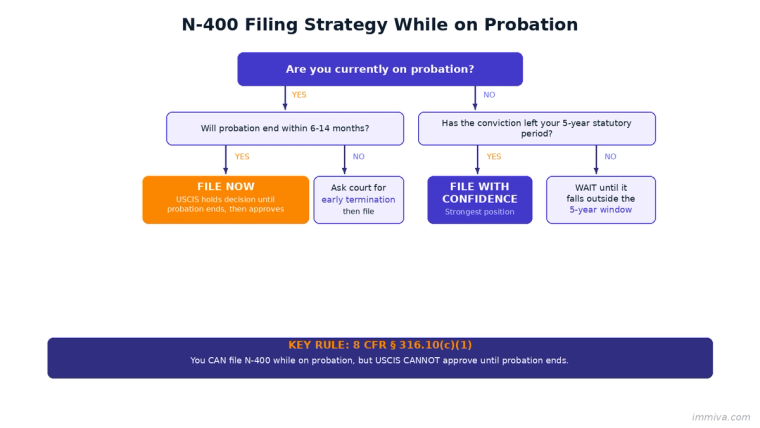
If you're on probation and want to apply for U.S. citizenship, yes, you can submit your N-400 application. But USCIS is legally barred from approving it while you're still serving probation. That distinction between filing and approval is what most guides get wrong.
The regulation behind this is 8 CFR § 316.10(c)(1). It says your application "shall not be approved" until after probation, parole, or a suspended sentence has been completed. Notice what it does not say: it does not say you can't file. If you want a broader picture of how criminal history affects eligibility, see our guide on N-400 with a criminal record.
The filing-vs-approval distinction
USCIS can accept your Form N-400 while probation is active and may continue processing it, including biometrics reuse or a biometrics appointment and an interview. If you file online, the filing fee is $710; if you file by paper, the filing fee is $760. If you request a reduced fee ($380) or a fee waiver, you must file by paper. But the officer cannot approve the application while probation is active. If probation ends before a decision is made, you can submit proof that probation has been completed.
If probation is still active at the time of your interview, USCIS cannot approve the application while probation remains active. Depending on the record and timing, USCIS may continue the case for additional evidence or deny it. Processing times vary by field office, so applicants should check USCIS's current processing-times tool rather than rely on a fixed 6-to-14-month estimate.
All types of probation are treated the same
The regulation does not distinguish between supervised probation, unsupervised probation, informal (court) probation, or summary probation. All forms prevent approval equally under 8 CFR § 316.10(c)(1).
This catches a lot of people off guard, especially in states like California where DUI convictions often carry 3 to 5 years of informal, unsupervised probation. You never report to a probation officer, you might not even think about it month to month, but the court order is still active and USCIS treats it no differently.
Deferred adjudication counts too. Under INA § 101(a)(48), if you entered a guilty or no-contest plea and the court imposed any restraint on your liberty (including probation), USCIS considers it a conviction regardless of how your state classifies it.
When to file: strategic timing
Your best timing depends on when probation ends relative to USCIS processing times.
If probation ends within 6 to 14 months, consider filing now. N-400 processing generally takes that long, so your probation may wrap up before the officer reaches a decision. Submit certified proof of completion as soon as probation ends.
Another option: ask the court for early termination. Many jurisdictions let you petition for early termination if you've completed all conditions (fines paid, classes done, community service finished). This actually works. In one documented case, an applicant was denied naturalization because of active informal DUI probation, went back to court, got probation terminated early, and was approved afterward. If early termination is available in your jurisdiction, it may be faster than waiting out the clock.
If your offense is a crime involving moral turpitude or you have multiple DUI convictions, there's a third path: wait until the conviction falls outside your 5-year (or 3-year) lookback window. The conviction won't disappear from your record, but it won't trigger a conditional bar either.
The August 2025 GMC policy change matters here
USCIS Policy Memorandum PM-602-0188 (effective August 15, 2025) overhauled how officers evaluate good moral character. Under the new "totality of circumstances" standard, officers weigh both negative and positive factors about your conduct (USCIS Policy Manual, Vol. 12, Part F, Ch. 2).
For probation applicants, the new standard helps and hurts. Successfully completing probation now counts as rehabilitation evidence, and things like steady employment, paying taxes, community involvement, and family caregiving work in your favor. But officers also have broader discretion to deny even when no statutory bar applies. Bring documentation of your positive conduct to your interview.
Documents you need to prove probation is complete
If you've completed probation, start gathering these before you file. Court records can take weeks to arrive, so don't wait. For the full application document list, see the N-400 document checklist.
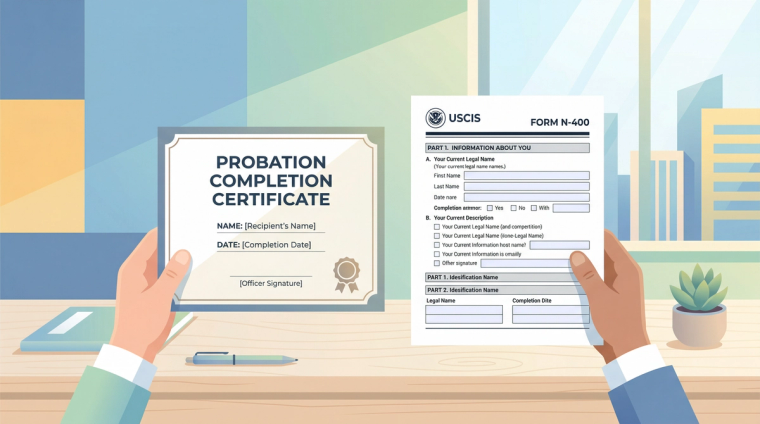
The probation-specific items: a probation completion certificate or court order confirming termination, proof that all fines and restitution are paid, and completion certificates for any court-ordered programs (DUI school, anger management, community service). If you completed probation early, bring the court order granting early termination. For the certified dispositions and sentencing records every applicant with a record needs, see our N-400 criminal record guide.
Under the 2025 GMC policy, also prepare positive evidence: employment verification letters, tax transcripts, volunteer or community involvement records, and character reference letters.