
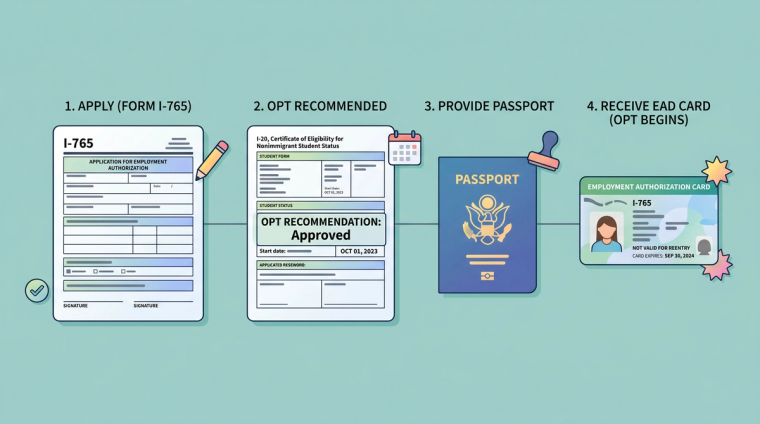
USCIS publishes a live processing-time estimate for Form I-765 category (c)(3) in its Processing Times tool, but it does not publish separate official OPT processing times for online versus paper filings. Here's what to expect from receipt to EAD card, and when premium processing actually pays off.
If your I-765 has been sitting at "Case Was Received" for weeks, you're not alone, and you're probably not behind schedule. This post lays out where OPT processing time stands in 2026, broken down by filing method, with a real framework for when premium processing is worth the money and answers to the questions students actually ask while they wait.
This guide builds on our other OPT resources: the OPT application process and how to check the status of an EAD application.
Current OPT processing times in 2026
F-1 OPT filings under categories (c)(3)(A), (c)(3)(B), and (c)(3)(C) go through USCIS-designated intake channels, and USCIS may shift routing based on workload. Paper OPT filings go to the Chicago Lockbox, and online-filed cases may carry IOE receipt numbers instead of YSC.
USCIS publishes one "80% completion" figure for I-765 (c)(3) cases. That's the time within which 80 percent of cases get decided, along with an "inquiry date." It does not publish separate numbers for c(3)(A), c(3)(B), or c(3)(C). Once you have the official number, the practical breakdown comes from DSO postings, attorney trackers, and user-reported data.
As of April 2026, typical I-765 processing for OPT cases at the Potomac Service Center runs about 2 to 3 months for online filings and 3 to 5 months for paper, and premium processing has been available to all (c)(3) categories since April 2023.
A few caveats. First, broad I-765 figures on aggregator sites may combine multiple eligibility categories and should not be treated as OPT-specific. Second, USCIS currently allows OPT applicants in categories (c)(3)(A), (c)(3)(B), and (c)(3)(C) to file online, but USCIS does not publish an official online-versus-paper OPT processing gap. Third, USCIS currently warns that unmounted or digitally retouched photos can delay processing and may trigger an Application Support Center appointment. Always pull the live USCIS number on the day you check.
OPT timeline: from DSO recommendation to EAD card in your mailbox
The total wait isn't just USCIS time. There are real steps before and after the agency decision, and each one has its own clock.
Step 1. DSO recommendation and updated I-20 (1 to 2 weeks). Your designated school official (DSO) updates SEVIS and issues a new I-20 with the OPT recommendation. You then have a fixed window to file: 30 days for post-completion OPT, 60 days for STEM OPT (the STEM window was corrected in USCIS Policy Manual Vol. 2, Part F.5.C.3 on September 25, 2024). File late and USCIS denies the application. No exceptions.
Step 2. USCIS receipt notice (1 to 3 weeks). Once USCIS has your I-765 and fee, it issues an I-797C receipt notice with your YSC receipt number. Online filers usually see this faster.
Step 3. Biometrics, if scheduled (adds 2 to 4 weeks). Most OPT cases skip this step. But after PA-2025-29 took effect in December 2025, USCIS is scheduling some applicants without a usable photo on file for an Application Support Center appointment. If you get a notice, treat it like any other USCIS biometrics appointment. Show up, bring ID, and the appointment itself takes about 30 minutes.
Step 4. Adjudication, the long stretch (2 to 5 months). This is the part where nothing visible happens. USCIS reviews your case, runs background checks, and either approves it, denies it, or issues a Request for Evidence (RFE).
Step 5. EAD card production and mailing (1 to 2 weeks). Approval and the physical card are not the same day. After approval, USCIS sends production data to its card vendor, then mails the EAD via USPS Priority Mail. Track the card status at uscis.gov/ead using your receipt number.
The point most students miss: you cannot work until your EAD start date has passed and you physically have the card in hand. The I-797 receipt notice does not authorize work for initial OPT. Your I-9 employer needs the card itself.
What affects your processing time
A handful of things matter more than the rest.
Filing method. Online filings clear roughly 30 to 60 days faster than paper. If you have the option, file online.
Filing season. May through July is the post-graduation surge. Cases filed in this window can run a month longer than off-season filings because every May graduate in the country is filing at the same time. USCIS staffing doesn't surge to match.
RFEs. A Request for Evidence resets your clock. The most common triggers for OPT RFEs are wrong-sized photos, the wrong category code (using c(3)(A) when you meant c(3)(B), or the reverse), and SEVIS data that doesn't match what's on your I-20. Catching these before you file is the single best thing you can do to keep your case on schedule, and it does more for most students than premium processing.
USCIS is still working through a large pending caseload, and OPT cases sit inside that broader workload. Across all I-765 eligibility categories combined, not OPT alone, the agency reported a 4.8-month average processing time in February 2026, up from a 2.5-month low the previous summer. About 1.78 million I-765 cases were pending that month, and roughly 1.18 million of them had been waiting longer than six months. Those numbers blend every EAD type, so don't read them as OPT-specific. For current case-specific timing, rely on the USCIS Processing Times tool for Form I-765 category (c)(3).
Can premium processing speed up your OPT?
Premium processing is available for all I-765 (c)(3) OPT categories. For an extra $1,780 (Form I-907), USCIS commits to act on your case within 30 business days instead of the usual months, which can rescue a start date that is close. It does not guarantee approval, only a decision: that could be an approval, a denial, an RFE, or a Notice of Intent to Deny, and an RFE pauses the clock until you respond. Whether the $1,780 is worth it depends on your timeline; our premium processing guide for OPT walks through the full cost-benefit decision.
You can upgrade a pending I-765 to premium any time after USCIS receipts the case. File Form I-907 separately with the $1,780 fee.
What to do while your I-765 is pending
The waiting period is uncomfortable but bounded. Here's what matters.
You cannot work yet. This bears repeating because students get it wrong every year. For initial OPT, you need the physical EAD card and the start date has to have passed. The receipt notice is not a work permit.
The 90-day unemployment clock starts on your OPT start date, not when the EAD arrives. This is one of the biggest myths in OPT. Whether your card shows up two weeks before your start date or two months after, the counter starts on the start date printed on your EAD. Plan accordingly.
Travel during pending I-765 is risky. Pre-completion OPT students with a valid F-1 visa and travel signature can usually re-enter. Post-completion OPT applicants are the most exposed: if you leave the U.S. before USCIS approves the EAD, your application can be considered abandoned. Most DSOs say wait until the card is in hand. The travel-while-pending principle that applies to other EAD categories carries similar logic for OPT.
File a USCIS e-Request only after the published 80% time has passed. Filing earlier is a waste. USCIS will tell you the case is within normal processing and won't act. The "case outside normal processing time" e-Request becomes available automatically once you cross the published threshold.
Expedite is harder than students think. USCIS expedite criteria require severe financial loss to a company or person (the criteria are written from the employer's perspective, not the applicant's), USCIS error, urgent humanitarian reasons, or compelling government interests. A delayed personal start date alone usually doesn't qualify. An employer letter showing severe financial loss is the most realistic path, and even that is rare in practice.
Filing windows and deadlines that affect timing
Three windows matter for OPT timing.
Post-completion OPT (c)(3)(B). File no earlier than 90 days before your program end date and no later than 60 days after it. USCIS must also receive the application within 30 days after your DSO enters the OPT recommendation in SEVIS. These are separate limits, and both must be met.
The 60-day deadline after program completion still applies. The September 14 court order postponed the rule that would have shortened it to 30 days. USCIS confirms the previous regulations still apply. STEM OPT retains its separate EAD-expiry window and 60-day DSO recommendation limit.
STEM OPT extension (c)(3)(C). File up to 90 days before your current OPT EAD expires. After the DSO enters the STEM OPT recommendation, you have 60 days to file.
Eligible F-1 students who maintained status generally have 60 days after post-completion OPT ends to prepare to depart, transfer to another SEVP-certified school, or seek another qualifying status. You cannot work during this grace period. The postponed September rule does not introduce a 30-day grace period; status violations may affect your eligibility for the ordinary period.
Cap-gap. If you have an approved or pending H-1B cap petition with a start date of October 1 and your OPT expires before then, your status and work authorization are automatically extended until April 1 of the relevant fiscal year (or the petition’s start date, whichever is earlier) (Study in the States, Cap-Gap). Check your I-94 record using the I-94 retrieval system to confirm cap-gap is reflected.
Approaching graduation without an EAD
This is the panic scenario. Three options, in order of cost.
Option 1: Talk to your employer. Most are willing to push the start date by a few weeks once you show them the receipt notice and the published USCIS processing time. Bring data, not anxiety.
Option 2: Upgrade to premium processing. $1,780 buys 30-day adjudicative action. If your start date is less than two months away and you don't have a receipt notice, upgrading is usually the cleanest fix.
Option 3: Request an expedite. Free but rare. The USCIS criteria are narrow, and a delayed personal start date isn't enough on its own. An employer letter showing the position is at risk and the company will suffer severe financial loss is the strongest path. Even then, USCIS denies most expedite requests.
If your case is older than the 80% time and you've heard nothing, file a Case Outside Normal Processing Time inquiry through the USCIS Contact Center first. It's free, fast to submit, and sometimes triggers movement within a week.
What changed in 2025 and 2026 (and what didn't)
Three policy changes have OPT students worried in 2026. Two of them don't actually affect you.
DHS removed the up-to-540-day automatic extension for EAD renewals filed on or after October 30, 2025 (90 FR 48799). That renewal auto-extension never applied to OPT anyway: initial post-completion OPT was never part of it, and timely filed STEM OPT extension applicants continue to receive their separate 180-day automatic extension under 8 CFR 274a.12(b)(6)(iv).
USCIS policy continues to provide separate OPT validity rules by regulation: initial post-completion OPT is up to 12 months, and STEM OPT extensions are up to 24 months.
December 12, 2025: PA-2025-29 (photo reuse). USCIS now reuses photos on file from the prior 36 months. The catch: applicants without a usable photo are scheduled for biometrics at an ASC, which adds two to four weeks to OPT processing. Form I-765 instructions still tell applicants to submit two photos. That conflict has not been resolved on the agency side.
March 1, 2026: Premium processing fee adjustment. I-907 for I-765 (c)(3) rose from $1,685 to $1,780.
USCIS Director Joseph Edlow, confirmed on July 15, 2025, has publicly committed to restricting post-completion OPT through future rulemaking. As of this update, no rule has been proposed. There's also a separate duration-of-status NPRM from August 2025 that would replace D/S with fixed admission periods and require Form I-539 to extend stay during OPT. Also not finalized.
We update this post monthly. If something material changes between updates, check the live USCIS Processing Times tool first.