
On May 22, 2026, USCIS announced a policy memo that has a lot of green card applicants worried. The short version is calmer than the headlines: the new adjustment of status memo does not change the law, and it does not remove any green card category. What it changes is how officers are told to use their discretion when someone applies for a green card from inside the United States.
If you have a Form I-485 pending or are planning to file one, this matters. The rest of this post explains what the memo says, what it does not say, and what it means for different kinds of applicants. We are sticking with the actual text rather than the headlines, because the gap between the two is wide.
What the adjustment of status memo actually says
The memo is called PM-602-0199, dated May 21, 2026 (USCIS policy memo). Its core message to officers is that adjustment of status under section 245 of the Immigration and Nationality Act is "a matter of discretion and administrative grace," not something you are entitled to just because you check every box.
The detail people miss: the memo does not create new eligibility rules, does not eliminate any category, will not appear in the Federal Register, and does not carry the force of a regulation. The memo itself says it is meant only to guide USCIS staff and "may not be relied upon to create any right or benefit." So nothing about the statute changed overnight.
The instruction to officers, though, did change. They are reminded that even when an applicant meets every technical requirement, USCIS can still deny the case as a discretionary matter. The memo frames consular processing abroad as the ordinary path to a green card, and adjustment inside the country as an extraordinary alternative that lets someone skip the consular trip.
The memo points officers to existing guidance on how to weigh discretion (USCIS Policy Manual, Vol. 7, Part A, Ch. 10 and Vol. 1, Part E, Ch. 8). That framework was always on the books. The memo just tells officers to lean on it more actively.
One guardrail is worth knowing about. When USCIS denies a case on an unfavorable use of discretion, the memo says the denial notice has to lay out the positive and negative factors the officer considered and explain why the negatives outweighed the positives. So a discretionary denial is not supposed to be a one-line rejection. You are entitled to see the reasoning, which matters if you decide to respond, refile, or take the issue to an immigration judge later.
Why adjustment of status is called "discretionary"
This idea is not new. Courts and the Board of Immigration Appeals have described adjustment of status as a discretionary act for about fifty years. The classic case, Matter of Blas, held that not everyone who is eligible will be approved, because adjustment is granted "as a matter of discretion and administrative grace." The Supreme Court has said the same thing more than once, including in Patel v. Garland in 2022.
The legal logic is straightforward. Congress built a detailed system for getting a green card. The default route is to apply for an immigrant visa at a U.S. consulate abroad. Adjustment of status under section 245 is the exception that lets eligible people already in the country finish the process without leaving. Because it is an exception that skips the normal consular step, USCIS treats it as a privilege it may grant, not a result you are owed.
There are also long-standing limits in the statute itself. Section 245(c) lists classes of applicants who generally cannot adjust at all, even after a lawful entry, with some exceptions. Section 245(i) is one well-known exception that lets certain people adjust despite issues that would otherwise block them. None of those statutory rules moved. The memo simply sits on top of them and tells officers to take the discretion step seriously.
Who is most affected, and who is better positioned
This is the question most readers actually care about. The memo singles out one behavior as an adverse factor: staying in the United States and adjusting instead of departing when your temporary purpose has ended. Officers are told to weigh things like whether you overstayed, whether you ever worked without authorization, whether your conduct matched the reason you were admitted or paroled, and whether you failed to leave when you were expected to.
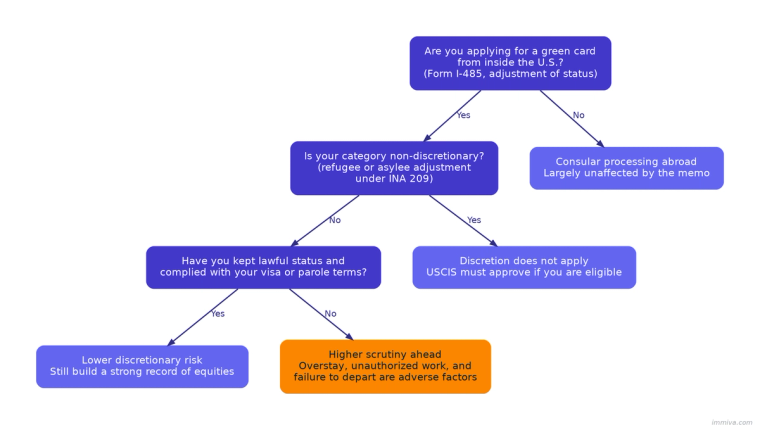
A breakdown of the most common groups:
People with a clean compliance record are in the strongest spot. If you kept lawful status the whole time and followed the terms of your visa, your history gives officers little to count against you. You still want to document your positive equities, but you are not the target of the memo.
Dual-intent visa holders get a specific mention. The memo confirms that applying to adjust status is not inconsistent with holding a category that allows dual intent, like H-1B or L-1. So adjusting from H-1B status is still a normal, accepted path. The catch is that being in a dual-intent category, by itself, is not enough to earn a favorable exercise of discretion. You still need a clean record behind it.
People who overstayed or worked without authorization face more scrutiny. This is the group the memo most clearly puts on notice. If you fell out of status, adjusted after an overstay, or worked without permission, those facts are now treated as adverse factors that you may need to offset. Under the Matter of Blas standard, offsetting them can require a showing of "unusual or even outstanding equities," and the memo stresses that having no negatives is not the same as having strong equities.
Refugees and asylees are not affected by the discretion analysis at all. Some categories are non-discretionary by law. The memo itself notes that refugee and asylee adjustment under INA section 209, along with a few other special programs, must be approved when the applicant meets the requirements. There is no discretionary balancing for those cases.
Immediate relatives are a gray area. Spouses, parents, and minor children of U.S. citizens are exempt from several of the section 245(c) bars. But the memo does not exempt them from the discretionary analysis itself. Immigration attorneys have flagged this as the sharpest open question, because the memo's main adverse factor, staying to adjust instead of departing, can describe exactly this group.
If you are filing a family-based case and you are unsure where you stand, our I-130 eligibility checker is a free way to confirm the petition side before you get into the adjustment step.
Adjustment of status vs consular processing now
The press release framed the memo bluntly: people in the U.S. temporarily who want a green card should generally return home to apply, except in extraordinary cases. That makes consular processing sound like the safe default. The reality is more complicated.
If you have always held lawful status, leaving for a consular interview is usually fine and may even be straightforward. If you overstayed or entered without inspection, departing the country can trigger the three-year or ten-year unlawful presence bars. So "just go do it abroad" can be the riskier choice, because the act of leaving sets off a penalty that does not apply while you stay.
That is why the decision is so case-specific. The same memo that makes adjustment harder to win does not automatically make consular processing better. Some applicants will need a provisional waiver before they can safely leave. Others will be better off staying and building the strongest discretionary record they can. If you are weighing the two routes, our comparison of the I-130 and I-485 paths and the consular processing timeline walk through the tradeoffs.
What and who the memo does not cover
Some perspective is useful here, because plenty of people are worried who do not need to be. The memo is about adjustment of status under section 245, which means it governs Form I-485. It does not reach immigration processes that are not adjustment of status.
If you already have a green card and you are removing conditions with Form I-751, renewing your card, or applying for citizenship with Form N-400, this memo does not change how those cases are decided. Those are separate filings with their own rules. The one knock-on effect we are watching is timing: if officers spend more time on discretionary adjustment reviews, processing times on other case types could shift. We will update this guide if that pattern shows up in the data.
What to do if you are planning or have a pending I-485
The memo is unsettling, but most people should not panic or make sudden moves. A practical approach looks like this.
First, do not withdraw a pending I-485 just because of the news. Withdrawing or abandoning a case can leave you worse off, especially if you would then have to depart and face a bar. The application process and current processing times have not changed.
Second, build your equities into the record now, before USCIS asks. We expect more requests for evidence on pending cases, because the memo pushes officers to run the discretion analysis even when the basic requirements are met, and a lot of filings were never built to make that argument. Waiting for an RFE puts you on the back foot. It is better to put your positive factors in the original package.
What counts as a positive factor? In a discretionary case, the things that tend to help include:
- Long-standing family ties in the U.S., especially a U.S. citizen or permanent resident spouse, children, or parents who depend on you
- The length of time you have lived in the country and built a life here
- A steady work history, a clean tax record, and proof you have paid what you owe
- Community ties such as property, a business, long-term employment, or volunteer work
- Hardship that would fall on U.S. citizen or permanent resident family members, or on a U.S. employer, if your case were denied
- A clean record with no immigration fraud and evidence of good moral character
For people whose departure would cause real harm, the memo leaves room to argue that the circumstances are extraordinary. A business owner whose company depends on them, or an employee in a role that cannot easily be filled, can document that with detailed affidavits and supporting statements from the people affected. There is no guarantee, because the outcome turns on officer discretion and the specific facts. A well-documented argument is still far stronger than saying nothing.
Third, get the weak spots reviewed. If there is an overstay, a gap in status, or any past unauthorized work in your history, those facts need to be addressed directly and honestly, with evidence that outweighs them. This is the part that trips up self-prepared filings, because applicants often do not realize a fact is an adverse factor until USCIS treats it as one.
A lot of people respond to news like this by assuming they now need to spend three to five thousand dollars on an attorney. Immiva walks you through the I-485 question by question, builds the form from your answers, and runs automated checks on each one before you file. Our pricing is a flat fee rather than an open-ended hourly bill. If your history includes removal proceedings, an arrest or conviction, or a prior denial, a consultation with an immigration attorney is still worth it.
Finally, keep your records straight while you wait. Know your A-Number, keep your I-94 and status documents organized, and stay current on related changes like the enhanced security checks USCIS rolled out earlier in 2026. Clean, complete records are part of building a favorable discretionary case.
The bottom line
The 2026 adjustment of status memo is a real shift in tone, but a shift in how discretion is exercised, not a change to the law. If you have a clean immigration history, you are not the target. If you have an overstay or a gap in status, your case now needs to be argued and documented, not just filed. Either way, a complete, well-supported application is your best protection, and on a complicated history, getting expert input is money well spent.