
USCIS officers were ordered last week to stop approving most pending cases until enhanced FBI background checks are run. The rule took effect April 27, 2026. It's the latest in a string of 2026 policy shifts that have slowed legal immigration to a crawl.
If you have an application sitting at USCIS right now, this matters. Below is what changed, who it touches, and what you can do about it.
What the new USCIS enhanced security checks actually do
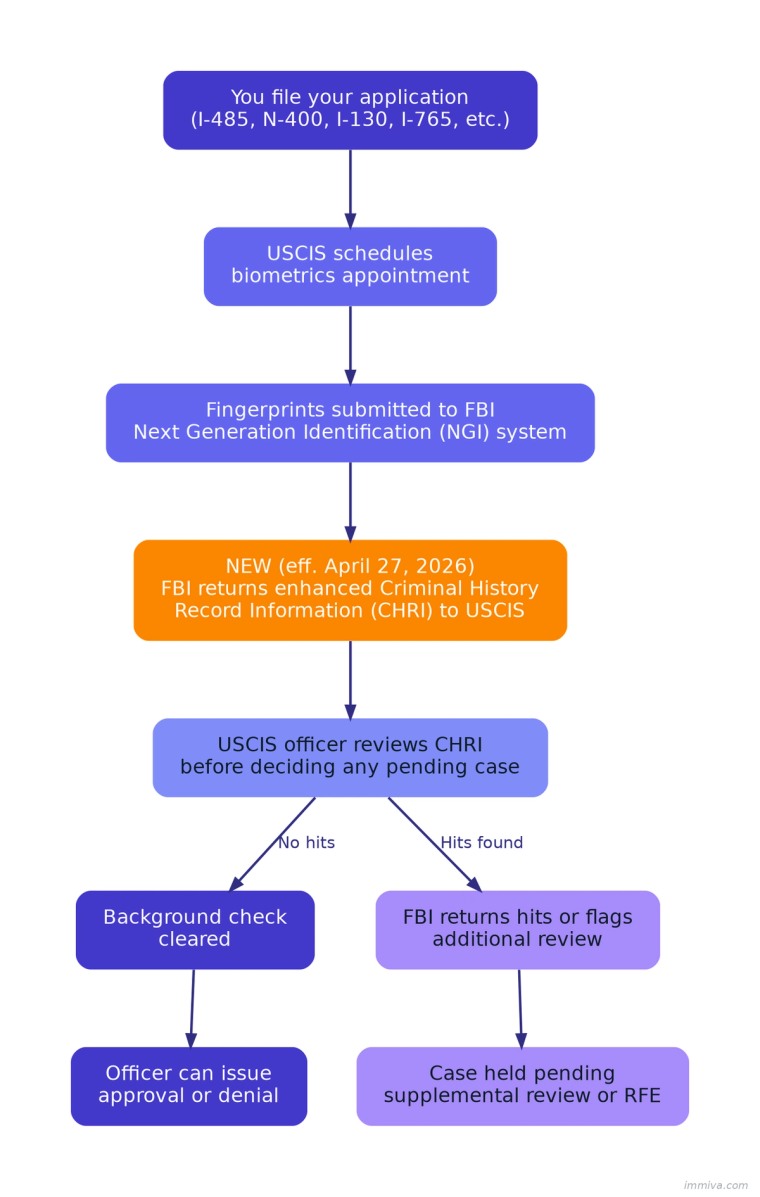
According to internal USCIS guidance reported by CBS News and Reuters, USCIS distributed an internal memo telling officers to resubmit pending applications for asylum, green cards, and U.S. citizenship to enhanced FBI background checks. Officers were told not to approve any pending case that has not gone through the new check.
The change itself is small on paper. As an internal USCIS email seen by Reuters put it, the agency began receiving "enhanced criminal history record information (CHRI) for all fingerprint-based background checks" submitted to the FBI's Next Generation Identification (NGI) system. That gives USCIS officers more data on every fingerprint set they submit, including criminal history records they could not previously see.
The change traces back to a presidential executive order signed in February 2026 directing the Justice Department to give USCIS access to FBI criminal databases "to the maximum extent permitted by law."
So every fingerprint-based application now goes through a deeper FBI screen before a USCIS officer can approve it.
A USCIS spokesperson told CBS News that "any delay in decision issuance should be brief and resolved shortly." Whether that holds up in practice depends on how many cases get re-routed for resubmitted checks and how quickly the FBI returns the new data.
Who's affected
The new rule applies to any pending application for which USCIS takes fingerprints. That covers a wide chunk of the agency's caseload, including:
- Form I-485 applications for green cards through adjustment of status
- Form N-400 applications for U.S. citizenship
- Form I-130 family-based sponsorship petitions where biometrics are taken from the petitioner or beneficiary
- Form I-765 applications for employment authorization (EAD)
- Form I-751 petitions to remove conditions on a green card
- Asylum applications
If your case was already in the queue and the FBI returned your fingerprint results before April 27, 2026, USCIS officers were told to resubmit your fingerprints for the enhanced check. The only stated exception is if an officer was already going to deny the case, in which case no resubmission is required.
If you're filing fresh, your fingerprints automatically go through the new system at your biometrics appointment. Nothing extra is required from you, but the queue ahead of you is now longer.
How this stacks on top of the existing 11.6-million-case backlog
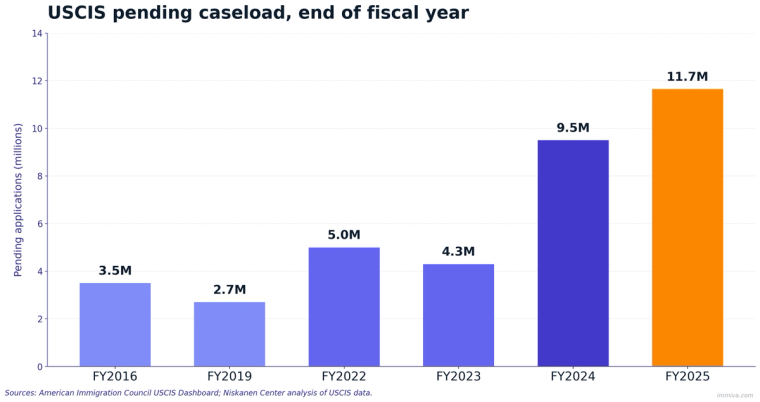
The new check arrives on top of a USCIS backlog that's already at historic highs.
According to a new USCIS data dashboard published April 29, 2026 by the American Immigration Council, the agency's pending caseload has more than tripled over the last decade, from 3.5 million cases in the first quarter of fiscal year 2016 to 11.6 million by the end of fiscal year 2025. Separate analysis from the Niskanen Center found that completions in the fourth quarter of FY2025 dropped 22 percent year over year, while the net backlog inside USCIS's control rose by more than 800,000 cases.
There's also what USCIS calls the "frontlog": applications that arrived but haven't been opened or assigned yet. That number tripled inside one quarter, from roughly 60,000 to about 248,000 cases the agency hasn't even logged.
For ordinary applicants, this means longer waits, more requests for evidence, and more cases that look stuck for no obvious reason. Our USCIS backlog guide covers what that means for individual cases and what tools you have to push back when your case sits too long.
This is the kind of system where small filing mistakes get expensive. A single missing document or contradiction can trigger a Request for Evidence, and an RFE can add four to six months to your timeline at a moment when timelines are already stretched. That's part of why we built Immiva's guided filing the way we did: it flags missing documents and contradictory answers before USCIS ever sees the application, so you don't end up in the RFE loop for something preventable.
The 39-country travel ban pause: 5 months in, no end date
Separately, a freeze tied to last year's travel proclamation is now five months old. Beginning in late 2025, USCIS paused processing of applications from people born in 39 countries that the administration designated as high-risk under Presidential Proclamation 10949. Our Trump travel ban guide covers which countries are on the list and the difference between a full and partial restriction.
NPR reporting from April 28, 2026 put faces to the numbers. A clinical research lead from Myanmar lost a promotion when her work permit renewal froze. A Nigerian medical school graduate matched into a surgical residency program in Oregon and may not be able to start because her work authorization is on hold. A Nigerian engineering master's graduate has turned down multiple job offers because his EAD is paused.
A separate State Department freeze on immigrant visa issuance for 75 countries is running in parallel and affects consular processing abroad.
According to immigration attorney Zachary New, who represents more than 500 affected clients in litigation, roughly half of all immigration applications currently at USCIS are touched by the travel-ban-related pauses in some way. There are at least 33 active lawsuits challenging the freeze, and on April 17 a federal judge in the Northern District of California issued a preliminary injunction ordering USCIS to decide work authorization applications for 31 Iranian and one Sudanese applicant by May 18, 2026. Other suits are moving more slowly.
If you paid for premium processing on a case that ended up in the pause, you're not getting a refund. The Cato Institute's David Bier estimates the federal government has collected over $1 billion in premium processing fees on cases that aren't being decided.
What you can do right now
There's no single fix for any of this, but a few practical things help.
Pull up your case status and your priority date. Check your case at my.uscis.gov and look at the most recent notice. If your last status update is more than 90 days old, that's worth tracking. If you're on a visa-bulletin-controlled green card path, our visa bulletin guide explains how to read the May 2026 bulletin.
Tighten up the filing itself. With every application now going through deeper review, the cost of a sloppy filing has gone up. Common errors that trigger RFEs and denials include inconsistent travel histories on Form N-400, unsigned forms, missing translations, and outdated edition numbers. Our N-400 mistakes guide walks through the most common ones for naturalization applicants. Green card applicants should look at the I-130 RFE response guide.
Look up your form-specific timeline. Median processing times vary widely by form. Check the form-specific posts for current numbers: N-400 processing time, I-130 processing time, I-485 processing time, H-4 EAD processing time, and J-2 EAD processing time.
Watch your status. If your work authorization is about to expire and your renewal is stuck, talk to a qualified immigration attorney about your options. For some categories, automatic extensions kick in when a renewal is filed on time. For others, they don't.
File well before your deadline if you can. With the new check adding processing time across the board, the old "file 90 days before your conditional residence ends" advice for I-751 holders, and the 90-day early-filing window for N-400, matter more now than they used to. Use the full window.
For applicants who qualify but don't want to spend $2,500 to $5,000 on an attorney to walk through a form, Immiva's guided self-filing builds the forms from your answers, checks every one before filing, and produces the document checklist for your case. It won't change USCIS processing speed, but it can keep your case out of the easily preventable RFE pile.