
What consular processing is and who needs it
Consular processing is the path a beneficiary takes to get an immigrant visa when they live outside the United States. Instead of filing Form I-485 to adjust status inside the country, they go through the National Visa Center (NVC) and then attend an interview at a U.S. embassy or consulate abroad. The official process is described in the USCIS consular processing overview.
Two groups use consular processing: beneficiaries who are outside the U.S., and beneficiaries who are in the U.S. but cannot or choose not to file I-485. Our I-130 approved next steps guide covers that branching decision in more depth, and our complete I-130 guide walks through the petition itself if you have not filed yet.
The 9 stages from I-130 approval to green card entry
Every consular case passes through the same nine stages. Individual durations shift over time, but the sequence does not.
Stage 1: USCIS approves the I-130 and transfers the file to NVC (2 to 6 weeks)
USCIS mails the Form I-797 approval notice to the petitioner and forwards the approved petition to the National Visa Center. As of April 20, 2026, NVC is creating cases from files received from USCIS on April 15, 2026, a roughly 5-day case-creation turnaround after NVC receives the file, per the weekly-updated NVC Timeframes page. USCIS transit time to NVC adds on top of that.
Stage 2: NVC welcome letter and CEAC account setup (1 to 3 weeks)
NVC creates the visa case, issues a Case Number and Invoice ID, and sends a welcome letter. Those numbers let you log into the CEAC portal and manage everything from there.
Stage 3: Pay the NVC fees (2 to 3 business days)
Two fees post through CEAC: the $325 Immigrant Visa Application Processing Fee (family-based) and the $120 Affidavit of Support Fee. Both must be paid by ACH from a U.S. bank account, one at a time. Fees typically show as "PAID" within a couple of business days (State Dept fee payment guide).
Stage 4: Submit DS-260 and upload supporting documents (applicant dependent)
This is where most people lose time. Once fees clear, each immigrant (principal applicant and any derivatives) completes Form DS-260 online through CEAC and uploads civil documents, the Form I-864 Affidavit of Support, and translations. The State Department estimates 155 minutes per applicant for the form itself, but gathering birth certificates, police certificates, and certified translations can take weeks.
One often-missed step: in some family-based cases, NVC may instruct the applicant to complete DS-261 (Choice of Address and Agent). But this is not a blanket prerequisite stated on the current NVC step-by-step process for every case; applicants should follow the specific CEAC and NVC instructions shown in their case.
Stage 5: NVC document review and "documentarily qualified" (about 12 days as of April 20, 2026)
NVC reviews everything you submitted. If it is complete, the case is tagged "documentarily qualified" (DQ) and forwarded to the embassy for scheduling. If anything is missing, NVC sends a checklist notice and the clock restarts when you resubmit.
Being documentarily qualified means you are in a queue, not that your interview is next week. Many applicants misread DQ status as a green light.
Stage 6: Interview scheduling at the embassy (2 months to 2+ years)
This is the single biggest variable in the whole process. NVC schedules cases first-in, first-out at each consular post, and wait times vary enormously:
- London, Warsaw, and several European posts often schedule 2 to 3 months out
- Current wait times vary sharply by post and category. As of the State Department's latest IV Scheduling Status Tool update, immediate-relative scheduling was around October 2025 documentarily-complete cases in Manila and Mumbai, around April 2025 in Ciudad Juárez, around March 2025 in Abu Dhabi, around September 2025 in Dhaka, and around February 2024 in Accra.
For preference categories (F1, F2B, F3, F4), interviews cannot be scheduled until the priority date is current on the monthly Visa Bulletin. The State Department's IV Scheduling Status Tool, launched in April 2025, shows which documentarily-complete month each post is currently working on.
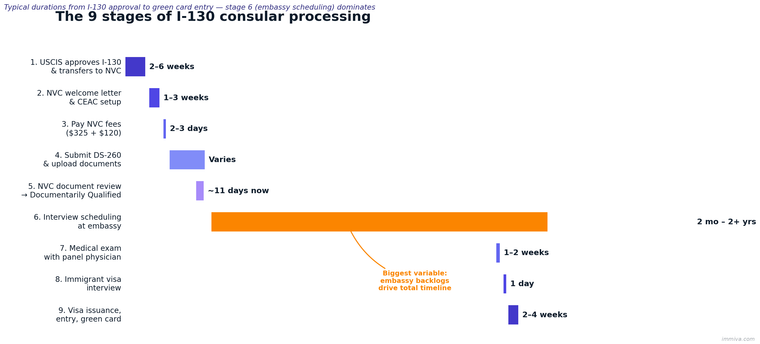
Stage 7: Medical exam with a panel physician (2 to 4 weeks before the interview)
Once you have an interview date, schedule a medical exam with an embassy-approved panel physician in the beneficiary's country. Panel physicians abroad are not the same as civil surgeons used for adjustment of status in the U.S., and exams done by the wrong provider are rejected.
The medical exam FAQs cover required components and vaccinations. The exam is valid for 6 months, and the immigrant visa cannot outlast the medical. Costs typically run $150 to $600 by country, plus vaccinations.
Stage 8: The immigrant visa interview (one day)
The principal applicant and all derivatives age 14 and older attend at the assigned embassy. The consular officer reviews documents, takes digital fingerprints, and announces one of three outcomes: approved, refused under INA 221(g) for missing documents or administrative processing, or denied on ineligibility grounds.
Bring the NVC interview letter, an unexpired passport, the DS-260 confirmation page, and the original or certified copies of the civil documents you uploaded to CEAC. Follow your embassy or consulate's interview-preparation instructions for any required medical packet delivery method and any post-specific financial evidence, including whether updated I-864 supporting documents are needed. Any document requiring English translation must be accompanied by the translation.
Stage 9: Visa issuance, USCIS Immigrant Fee, and entry (2 to 4 weeks)
Approved visas are placed in the passport and returned according to the embassy or consulate's delivery process. Before traveling, pay the $235 USCIS Immigrant Fee online. The immigrant visa is usually valid for up to 6 months, but it can be shorter if the medical exam expires sooner. The principal applicant must enter the United States before or at the same time as any derivatives. CBP admits the immigrant as a lawful permanent resident at the port of entry, and USCIS mails the Green Card to the U.S. address on file after admission; USCIS says to submit an inquiry if the card has not arrived within 90 days of paying the immigrant fee or entering the United States, if the fee was paid before arrival.
Current NVC processing times in 2026
NVC updates its processing snapshot weekly. As of the April 20, 2026 update:
| NVC stage | Current turnaround |
|---|---|
| Case creation from USCIS receipt | About 5 days (cases received April 15, 2026) |
| Document review after submission | About 12 days |
| Public inquiry response | Around 5 days in recent updates |
| Interview scheduling (after DQ) | 2 to 3 months notice; actual wait varies by embassy |
These numbers shift weekly. Always check the NVC timeframes page right before you submit anything. For I-130 stage durations before consular processing even starts, see our I-130 processing time breakdown.
Consular processing vs. adjustment of status
If your beneficiary is physically in the U.S. and eligible for adjustment, both paths are technically possible. They differ in ways that matter:
| Factor | Consular processing | Adjustment of status |
|---|---|---|
| Where the beneficiary is | Outside the U.S. | Inside the U.S. |
| Agency | State Dept (NVC + Embassy) | USCIS |
| Work permit while waiting | No | Yes, with Form I-765 |
| Travel permission while waiting | No | Yes, with Form I-131 |
| Typical timeline | 4 to 12+ months from I-130 approval to interview | 8 to 14 months total with concurrent filing |
| Key form | DS-260 | I-485 |
| Medical exam | Panel physician abroad | Civil surgeon in U.S. |
Our side-by-side I-130 vs I-485 guide explains when each path is actually available and when it is not.
Total fees from I-130 to green card
For a single immediate relative beneficiary using consular processing:
| Stage | Fee | How paid |
|---|---|---|
| I-130 filing | $625 online / $675 paper | Petitioner, USCIS |
| NVC IV application | $325 | CEAC, U.S. bank |
| NVC Affidavit of Support | $120 | Per case, CEAC |
| Panel physician medical exam | $150 to $600 | Direct to physician |
| USCIS Immigrant Fee | $235 | After visa issued |
| Total minimum | $1,455 to $1,955+ |
Translations, photos, courier fees, and police certificate fees add more. Full breakdowns are in our I-130 filing fee guide and the USCIS fee payment guide.
How to avoid common delays
Most consular processing delays come from a short list of predictable mistakes:
- Incomplete or incorrect I-864. The sponsor's household income must meet 125% of the federal poverty line, and supporting documents (tax transcripts, W-2s, pay stubs) have to match what is on the form. I-864 errors are the leading cause of NVC checklists.
- Missing translations. Every non-English document needs a certified English translation. CEAC rejects uploads that include only the original.
- Medical exam scheduled too early or too late. Two to four weeks before the interview is the sweet spot. Too early and it expires before travel. Too late and the interview gets rescheduled.
- Missing the one-year response window. Under INA 203(g), a petition can be terminated if the applicant fails to respond to NVC within a year of visa availability.
If NVC issues a checklist, respond with everything they asked for in one submission rather than piecemeal. Each new upload restarts the review clock.
2025 to 2026 policy changes affecting consular processing
The past year has reshaped consular timelines for a large number of nationalities:
- December 16, 2025 travel ban expansion covered 39 countries plus Palestinian Authority documents, effective January 1, 2026. Notably, it removed immediate relative immigrant visa exceptions that existed under the earlier ban.
- January 21, 2026 immigrant visa freeze announced an indefinite pause on visa issuance for nationals of 75 countries. Interviews continue to be scheduled, but visas are not being issued pending resolution.
- July 2025 State Department staffing cuts eliminated over 1,300 positions including 246 foreign service officers, which has slowed interview scheduling at multiple posts.
- November 1, 2025 embassy assignment rule now requires NVC to schedule interviews in the applicant's country of residence, with limited exceptions.
Check the State Department travel advisories for current status before making major financial commitments.