
The I-130 filing fee is $625 if you file online or $675 if you file by paper in 2026. That's the fee to petition for a family member to get a U.S. green card, paid directly to USCIS when you submit Form I-130.
But the I-130 fee is just the first of many payments. The total cost from filing I-130 to receiving a green card ranges from about $1,305 to $3,005 in government fees alone, depending on whether your family member is inside or outside the U.S. Add a medical exam, document translations, and optional attorney help, and the real number climbs higher.
This guide gives you the complete picture, fee by fee, with a timeline of when each one comes due.
What Is the I-130 Fee in 2026?
The current I-130 filing fee is:
- Online filing: $625
- Paper filing: $675
These fees have been in effect since April 1, 2024, when USCIS raised the I-130 fee from $535, a rate that had been unchanged since 2016 (89 FR 6386, USCIS Final Fee Rule). If a site or guide still shows $535, the information is outdated.
A few things worth knowing upfront:
No separate biometrics payment applies to Form I-130. The current Form I-130 filing fee is $625 online or $675 by paper, and USCIS's 2024 fee rule generally folded biometric-services costs into form fees where biometrics apply.
One fee per person. You must file a separate I-130 and pay a separate fee for each family member you're sponsoring. Sponsoring a spouse and two children means three separate forms and three fees.
Online filing saves $50. The 8 CFR § 106.1(g) online discount applies to I-130. Filing through the USCIS online portal is the simplest way to save $50 and get faster case number confirmation.
The fee is non-refundable. USCIS keeps the filing fee regardless of whether the petition is approved or denied (USCIS Filing Fees).
USCIS changed paper-payment rules on October 28, 2025. For most paper filings, USCIS now requires electronic payment by card using Form G-1450 or by ACH debit using Form G-1650. Online filers still pay through Pay.gov. Limited exceptions exist: if a filer qualifies for an exemption, USCIS allows paper-based payment with Form G-1651.
Total Cost Breakdown: Adjustment of Status vs. Consular Processing
The I-130 fee is the same regardless of where your family member lives. But the rest of the costs split into two different paths based on whether your relative is inside or outside the U.S.
Path 1: Adjustment of Status (Relative Already in the U.S.)
If your family member is already in the United States in valid immigration status, they can generally stay here throughout the green card process through adjustment of status (AOS). You typically file I-130 and I-485 concurrently, or the I-485 shortly after I-130 approval.
Filing does not guarantee approval. A 2026 USCIS memo widened officers' discretion to deny adjustment of status, so a complete, well-documented package matters more than it used to.
Here's what the government fees look like:
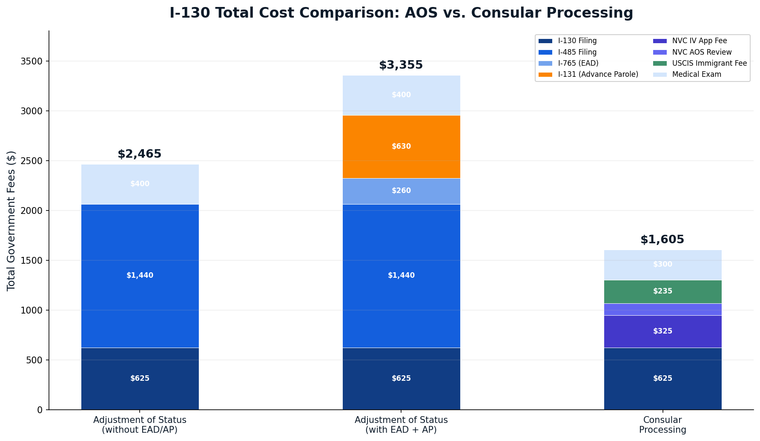
| Fee | Amount | When Due |
|---|---|---|
| I-130 filing fee | $625 online / $675 paper | At petition filing |
| I-485 filing fee | $1,440 (includes biometrics) | At I-485 filing |
| I-765 (Employment Authorization / EAD) | $260 | Optional, at I-485 filing |
| I-131 (Advance Parole for travel) | $630 | Optional, at I-485 filing |
| Medical exam (I-693) | $200-$500 | Before filing I-485 |
| Gov't fees (without EAD/AP) | $2,065-$2,115 | |
| Gov't fees (with EAD and AP) | $2,955-$3,005 |
The EAD/AP change: Before April 1, 2024, you could file the I-765 (work permit) and I-131 (travel document) for free when submitted concurrently with I-485. That's no longer the case. These two documents now cost $260 and $630 respectively, adding $890 to the AOS package if you want to work or travel while your green card is pending (USCIS Fee Rule FAQ).
Your family member will also need a biometrics appointment as part of the I-485 process. The biometrics cost is included in the I-485 fee since April 2024, so there's no separate charge for it.
Once you're in the system, you can track your case at any time. Our guide to 5 ways to check your EAD application status covers what to look for while you wait.
Path 2: Consular Processing (Relative Living Abroad)
If your family member is outside the United States, they'll go through consular processing after I-130 approval. Government fees are lower overall because there's no I-485 filing. But you'll pay additional State Department fees at the NVC stage, and a USCIS fee after visa approval.
| Fee | Amount | When Due | Paid To |
|---|---|---|---|
| I-130 filing fee | $625 online / $675 paper | At petition filing | USCIS |
| NVC Immigrant Visa Application Fee (DS-260) | $325 per applicant | At NVC stage | State Dept. via CEAC |
| NVC Affidavit of Support Review Fee | $120 per case | At NVC stage | State Dept. via CEAC |
| USCIS Immigrant Fee | $235 per applicant | After visa approval | USCIS via my.uscis.gov |
| Medical exam (panel physician) | $200-$500 | Before embassy interview | Panel physician |
| Government fees total | $1,305-$1,355 |
The NVC fees catch many people off guard. They're paid to a completely different agency (the State Department) through a different system (CEAC), typically a year or more into the process, long after you've stopped thinking about the initial I-130 cost.
The USCIS Immigrant Fee ($235) is another one that surprises people. It's required after the visa is approved but before the physical green card is produced. There's no fee waiver option for it (USCIS Immigrant Fee).
When the physical card arrives, the green card number on the front is what airlines ask for at check-in and what you'll copy onto Form I-9 later.
Whether your family member qualifies for consular processing, and how long the wait will be, depends on their immigrant visa category. Immediate relatives of U.S. citizens have no wait. Other family preference categories can face years of backlog. The June 2026 Visa Bulletin shows current priority dates, and our complete guide to how the Visa Bulletin works explains what those dates mean for your case.
Costs Beyond Government Fees
Government fees are the predictable part. Here's what else to budget for:
Medical exam: typically $200-$500
A medical exam by a USCIS-designated civil surgeon (for AOS) or panel physician (for consular processing abroad) is required for all green card applicants. As of December 2, 2024, the I-693 medical exam report must be submitted at the same time as the I-485 for AOS cases. You can no longer defer it (USCIS I-693).
The exam includes a physical, blood tests, and proof of required vaccinations. Vaccines are the wildcard. If your family member needs several updated vaccinations, the cost can push past $500. Insurance rarely covers immigration medical exams.
Translation fees: $30-$250
Every foreign-language document submitted to USCIS needs a certified English translation. Common documents include birth certificates, marriage certificates, and divorce decrees. At roughly $30-$50 per page, translating 3-5 documents adds $100-$250 to your total.
Attorney fees: $0-$5,800
You're not required to use an attorney. Many couples file the full AOS package on their own successfully. If you hire an immigration attorney, expect to pay $800-$1,800 for I-130 alone, or $2,000-$5,800 for a full AOS package.
You do not have to pay an attorney $5,800 to get this right. Immiva's guided application service builds the full green card package from one set of answers, checks every answer before you file, and charges a flat fee at a fraction of attorney rates. Check our pricing page for current rates, and see how Immiva works.
The I-751 fee you'll pay two years later: $750 by paper, $700 online
If your family member receives a conditional green card (because the marriage was under 2 years old at the time of approval), they'll need to remove conditions on their green card two years later with Form I-751. The I-751 filing fee is $750 by paper or $700 if you file online.
This cost rarely comes up during initial I-130 budgeting, but it's real and mandatory. Our guide to I-751 processing time in 2026 covers what to expect when that filing window opens, and you can use Immiva's I-751 eligibility checker to get ahead of the process. If you'd like to use Immiva to file I-751, see our I-751 landing page.
Full cost summary:
| Cost Category | Low Estimate | High Estimate |
|---|---|---|
| Gov't fees (AOS, no EAD/AP) | $2,065 | $2,115 |
| Gov't fees (AOS, with EAD + AP) | $2,955 | $3,005 |
| Gov't fees (consular processing) | $1,305 | $1,355 |
| Medical exam | $200 | $500 |
| Translations | $0 | $250 |
| Mailing and copies | $20 | $110 |
| Attorney fees | $0 | $5,800 |
| Total (AOS, no attorney) | $2,285 | $3,865 |
| Total (AOS, with attorney) | $4,285 | $9,665 |
| Total (consular processing, no attorney) | $1,525 | $2,215 |
| Future I-751 (conditional green card) | $700 | $750 |
Can You Get an I-130 Fee Waiver?
The direct answer: No. The I-130 filing fee cannot be waived for most petitioners.
The USCIS G-1055 fee schedule notes that "certain applicants may be eligible" for a waiver on I-130. That language causes confusion. It refers specifically to VAWA self-petitioners, T visa victims, and U visa victims, per 8 CFR § 106.3(a)(3)(iii). If you're a U.S. citizen sponsoring a spouse, or a green card holder sponsoring a family member, you cannot get a fee waiver on the I-130.
The Form I-912 fee waiver applies to a different set of forms. Here's which forms in the green card journey are and are not waivable:
| Form | Fee Waiver Eligible? |
|---|---|
| I-130 Petition | No (except VAWA/T/U victims) |
| I-485 Adjustment of Status | Yes, with conditions |
| I-765 Employment Authorization | Yes, when filed with eligible I-485 |
| I-131 Advance Parole (humanitarian) | Yes |
| I-131 Advance Parole (standard travel) | No |
| USCIS Immigrant Fee | No |
If you're wondering about cost relief for the I-485, that is not generally available for standard family-based adjustment applicants. USCIS currently allows Form I-912 fee-waiver requests for Form I-485 only in limited categories listed on the Form I-912 page, such as certain asylum-based, registry, Cuban Adjustment Act, or HRIFA-related cases.
How to Pay: What Changed in 2025
USCIS updated its payment system in late 2025. Here's what is currently accepted:
Online filing (myUSCIS portal): Pay via Pay.gov using a credit card, debit card, or bank account. Payment is made at submission.
Paper filing: As of October 28, 2025, USCIS no longer accepts checks or money orders for paper filings. In most cases, you must use:
- Form G-1450 (Authorization for Credit Card Transactions), or
- Form G-1650 (ACH bank debit authorization)
If you submit a check or money order with a paper filing that is not covered by a USCIS exemption, USCIS may reject the entire package and return it to you. See our complete guide to paying USCIS filing fees for a full walkthrough of current payment methods.
When You Pay: A Fee Timeline
Getting a clear timeline of when each cost comes due helps you budget accurately instead of being surprised a year into the process.
Stage 1, Filing the petition:
- I-130 fee ($625-$675) paid to USCIS at submission
Stage 2A, If your relative is in the U.S. (Adjustment of Status):
- Medical exam paid to civil surgeon before filing I-485
- I-485 fee ($1,440), I-765 ($260 if filing), I-131 ($630 if filing) paid to USCIS at submission
Stage 2B, If your relative is abroad (National Visa Center stage):
- NVC fees ($325 IV application + $120 AOS review) paid to State Department via CEAC, typically 6-18+ months after I-130 approval
Stage 3, Embassy interview (consular processing only):
- Medical exam paid out of pocket to panel physician in your relative's country
Stage 4, After visa approval (consular processing only):
- USCIS Immigrant Fee ($235) paid at my.uscis.gov before the green card is mailed
Stage 5, Two years after conditional green card:
- I-751 filing fee ($750 by paper, $700 online) if your relative received a 2-year conditional green card
Processing delays don't change the fee amounts, but they do shift your timeline significantly. The USCIS processing backlog context is worth keeping in mind when planning your budget.
What the April 2024 Fee Increase Changed
Questions about the "current" I-130 fee trace back to the April 2024 USCIS fee increase. Here's a quick summary of what changed for family-based green card applicants:
| Item | Before April 1, 2024 | After April 1, 2024 |
|---|---|---|
| I-130 fee (paper) | $535 | $675 |
| I-130 fee (online) | Same as paper | $625 ($50 discount) |
| I-485 fee | $1,225 + $85 biometrics | $1,440 (biometrics included) |
| I-765 with I-485 | Free | $260 |
| I-131 with I-485 | Free | $630 |
| Separate biometrics fee | $85 | Eliminated (absorbed into form fees) |
The I-130 fee remains $675 by paper or $625 online under the current USCIS G-1055 fee schedule. USCIS also announced on July 18, 2025 that H.R. 1 added new statutory fees for some benefit requests, but those added fees did not change the Form I-130 filing fee.