
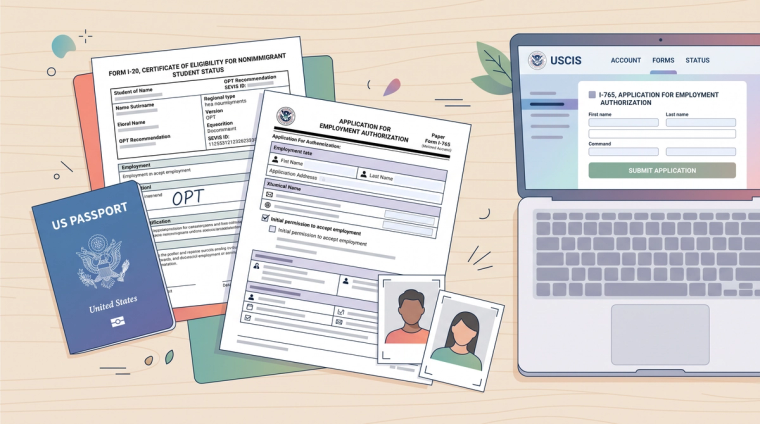
A 2026 walkthrough of the 12-month F-1 work authorization, with the fee, deadline, and policy details most other guides still get wrong.
Post-completion OPT lets F-1 graduates work in the US for up to 12 months, in a job related to their major. The application itself is short. What trips students up is the timing, and most guides online are still quoting fees that haven't been current in over a year. So here's where things actually stand in 2026.
What post-completion OPT actually is
Post-completion OPT is the version of Optional Practical Training that starts after you finish your degree. It's authorized under 8 CFR 274a.12(c)(3)(i)(B), which is why USCIS asks you to write category code (c)(3)(B) on Form I-765. Write (c)(3)(A) instead, that's pre-completion OPT, and your application can be rejected or denied because it points to the wrong OPT eligibility category.
Every higher degree level you finish comes with its own 12-month OPT allowance. If you used pre-completion OPT while you were studying, that time gets subtracted from the 12 months: part-time at half rate, full-time at full rate. STEM graduates can later apply for a separate 24-month extension on top of the initial 12. For a wider view of how OPT fits in with curricular practical training and the other F-1 work options, see our general OPT guide.
Are you eligible
To qualify under 8 CFR 214.2(f)(10), you need to meet all of the following:
- You are in valid F-1 status at an SEVP-certified school
- You have been a full-time student for at least one full academic year (about nine months)
- The work you plan to do is directly related to your major field of study
- You have not used 12 months or more of full-time CPT at the same degree level (any amount disqualifies you only if it was 12+ months full-time)
- You have OPT time left on your bank for this degree level
- Your Designated School Official (DSO) recommends OPT in SEVIS and issues you an updated Form I-20
- You file Form I-765 inside the proper window (more on that next)
You don't need a job offer to apply. USCIS will issue your EAD whether you have an employer lined up or not. The catch: the 90-day unemployment clock will eventually start running either way. When your filing window opens, you can apply for OPT with Immiva.
the filing window: 90 days before to 60 days after
This is where students lose the most sleep. Two overlapping deadlines, and you have to hit both.
For post-completion OPT, USCIS must receive Form I-765 no earlier than 90 days before your program end date and no later than 60 days after it. The September 2026 rule that would have shortened the later deadline was postponed, so the previous window remains in effect.
The separate 30-day DSO rule also applies: USCIS must receive the application within 30 days after your DSO enters the OPT recommendation in SEVIS. A recommendation more than 30 days old can make the application late even when you are still within the program window, from 90 days before through 60 days after completion. You must meet both limits.
The outer deadline has not changed to 30 days. On September 14, 2026, a federal court postponed the fixed-admission final rule. USCIS says it is applying the previous regulations, including the 60-day deadline after program completion. The separate 30-day DSO recommendation rule still applies.
There's also a 14-month outer deadline: all of your OPT employment has to be completed within 14 months of your program end date. That cushion is there so a late USCIS adjudication doesn't wipe out your 12 months entirely, but it caps how long you can defer your OPT start date.
The requested post-completion OPT start date cannot be more than 60 days after the program end date. The SEVIS Help Hub explains the start-date entry. The postponed rule's 30-day cap is not the current limit. You must still meet both filing deadlines, even with a valid start date.
Filing Form I-765 in 2026
Once your DSO has recommended OPT in SEVIS and issued the new I-20 with the OPT endorsement, you put together the I-765 package.
As of September 30, 2026, use the accepted 08/21/25 Form I-765 edition, not the unaccepted 09/15/26 edition. Enter eligibility category (c)(3)(B) for post-completion OPT. Check the current USCIS form page and your DSO-endorsed I-20 before filing.
Fees. $470 if you file Form I-765 online, $520 if you file by paper, unless a specific fee exemption or reduced-fee rule applies to you. Optional premium processing using Form I-907 costs $1,780 for eligible Form I-765 OPT requests postmarked on or after March 1, 2026, and obligates USCIS to take adjudicative action within 30 business days.
Payment. For paper filings, USCIS generally stopped taking paper checks and money orders after October 28, 2025, unless an exemption applies. Pay by credit or debit card using Form G-1450, or by ACH debit using Form G-1650. Online filings still use the USCIS online payment process through Pay.gov. For more on how USCIS payment methods work now, see our filing fees guide.
Supporting documents. Your new I-20 with the OPT recommendation, copies of prior I-20s showing any previously authorized CPT or OPT, the passport biographic page, your F-1 visa stamp (or change-of-status approval), your most recent I-94, any prior EADs front and back, two 2-by-2 inch passport-style photos, and proof of payment if you're filing by paper. USCIS's current Form I-765 still asks about Social Security numbers, so follow the current form instructions when deciding whether to request an SSN through the I-765. If you don't already know your A-Number, it might be on any prior EAD or I-797 notice.
Filing online is usually more convenient and avoids mail-delivery delays, but I-765 processing times shift, and you should check USCIS's processing-times tool for your specific form category and service center. Under USCIS Policy Alert PA-2025-29 (December 12, 2025), USCIS no longer accepts the photo you upload with Form I-765 for the EAD card, so OPT applicants should expect a biometrics appointment notice to have the photo taken at an Application Support Center, unless USCIS reuses a biometrics photo it already has on file from the last 36 months.
After approval: the EAD, the 90-day rule, and what counts as work
USCIS will mail you an Employment Authorization Document (EAD) card with your authorized start and end dates printed on it. You can't legally work until that physical card is in your hand and the start date printed on it has passed. An "Approved" status online is not enough.
Once your EAD start date hits, the 90-day unemployment clock under 8 CFR 214.2(f)(10)(ii)(E) starts running. Students may not accumulate more than 90 aggregate days of unemployment during initial post-completion OPT. The clock pauses when you have qualifying work. If you later move to STEM OPT, the total unemployment limit goes up to 150 days across the initial post-completion OPT period and the STEM OPT extension.
What counts as "work" on OPT is broader than most students think. Allowed employment can include W-2 jobs with one or more employers, contract or freelance work, self-employment, paid internships, and qualifying unpaid roles, as long as the work is directly related to your degree and meets the applicable post-completion OPT hour requirement. E-Verify is not required for the initial 12 months, but it is required for the STEM OPT extension. You have to report each employer and any change of employer to your DSO or in the SEVP Portal within 10 days.
Travel, cap-gap, and what comes next
Traveling while OPT is pending can be risky, especially after your program end date; talk to your DSO before you leave the United States. Once OPT is approved, re-entry typically requires a valid passport, a valid F-1 visa stamp, your physical EAD, an I-20 with a travel signature dated within the last six months, and evidence of employment or a job offer.
If your employer files a timely cap-subject H-1B petition asking for change of status for FY 2027 while you're eligible for cap-gap, the cap-gap extension can stretch your F-1 status and, if applicable, your OPT employment authorization through April 1 of the relevant fiscal year, or until the approved H-1B validity start date if that comes earlier. Selection in the lottery alone is not enough. And once your initial 12 months are running, STEM graduates can look ahead to the 24-month STEM extension, which can be filed up to 90 days before the current OPT employment authorization expires and within 60 days after the DSO enters the STEM OPT recommendation in SEVIS.
Checking on a pending I-765 is the easy part: you can track your case online once you have your receipt number. For the school recommendation and SEVIS record, work with your DSO. Immiva prepares OPT and STEM OPT Form I-765 applications with the applicable checks, document list, and filing instructions. USCIS makes the decision.