
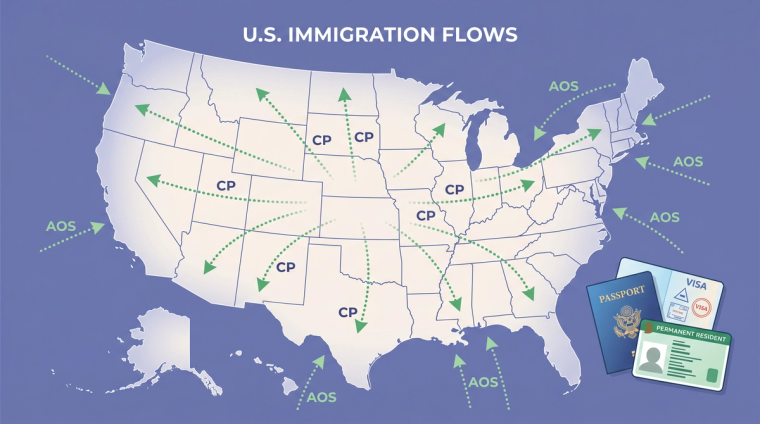
If you have an approved immigrant petition (or you can file one concurrently), you generally have two routes to a green card. You can file Form I-485 with USCIS to adjust status from inside the United States, or you can do consular processing through Form DS-260 at a U.S. embassy or consulate abroad. The right choice has always come down to where you are, what category you fall under, and what tradeoffs make sense given your timeline, budget, and risk tolerance.
What changed in 2025 and 2026 is that "the right choice" is no longer just a personal preference for many applicants. Presidential Proclamation 10998 now suspends immigrant visa issuance for nationals of 39 countries (with limited exceptions and only for people outside the United States who did not hold a valid visa on January 1, 2026), and the Department of State separately paused immigrant visa issuances on public-charge grounds for nationals of 75 listed countries effective January 21, 2026. At the same time, USCIS says it is again more readily issuing Notices to Appear after unfavorable decisions for removable applicants. Some people have only one practical path open. Others still have two paths but a much more consequential choice to make.
This guide covers the 2026-current comparison: eligibility rules under INA § 245, sourced filing fees and processing times, the benefits and risks of each path, and a decision tree for ten common scenarios.
The 30-second answer
| Factor | Adjustment of Status (Form I-485) | Consular Processing (Form DS-260) |
|---|---|---|
| Where you file | Inside the U.S., with USCIS | Abroad, with NVC and a U.S. consulate |
| Statutory basis | INA § 245 | INA §§ 221-222 |
| Typical timeline (April 2026) | 9.8 to 22 months | 13 to 24-plus months |
| Total government fees (principal) | About $1,440 base, $2,330 with EAD plus advance parole | About $680 |
| Realistic all-in cost | About $2,780 with medical | About $2,530 once travel is included |
| Work authorization while pending | Yes, via I-765 EAD (2026 caveats apply) | No, until visa is issued and you enter |
| Travel while pending | Only with I-131 advance parole | No restriction (you are abroad) |
| Interview | Often required at field office | Required at consulate |
| Appeal rights if denied | Limited (motion to reopen, federal review) | None (consular nonreviewability) |
| Key 2026 risk | NTA on denial, EAD gaps, discretion | Travel ban, 75-country freeze, 221(g) holds |
For most applicants in 2026, the question is not which path is faster or cheaper. It is which path is actually open to you and which risks you can live with.
How the 2026 policy landscape changed the decision
The AOS vs consular processing comparison shifted significantly in the past 12 months, mostly because of three specific policy moves.
Travel restrictions closed consular processing for many applicants, but not for everyone. As of January 1, 2026, DOS says Presidential Proclamation 10998 fully suspends visa issuance for nationals of 19 countries, partially suspends visa issuance for nationals of 19 additional countries, and separately suspends immigrant-visa issuance for nationals of Turkmenistan, with limited exceptions. DOS also states that PP 10998 removed prior categorical exceptions for IR-1/CR-1, IR-2/CR-2, and IR-5 visas. But the proclamation applies only to foreign nationals who were outside the United States on January 1, 2026 and who did not already hold a valid visa at that time, so it should not be described as a blanket bar for all nationals of those countries.
The State Department froze immigrant visa issuance for 75 countries. On January 21, 2026, DOS paused immigrant visa issuance for nationals of 75 countries on public-charge grounds, pending a comprehensive review. Nonimmigrant visas were unaffected. We have a dedicated breakdown of the 75-country freeze covering which countries are listed and what affected applicants can do. For anyone covered by both the travel ban and the freeze, AOS is now the only realistic path to a green card if they are already in the U.S.
USCIS tightened AOS adjudication in some respects. USCIS announced in 2025 that it had returned to a more enforcement-oriented NTA posture and was generally defaulting toward issuing NTAs after unfavorable decisions where the noncitizen is removable. The agency also pulled back the EAD safety nets: renewals filed on or after October 30, 2025 get no automatic extension, and new adjustment-based EADs are capped at 18 months instead of five years. Our breakdown of the 2026 adjustment of status memo covers what officers now weigh when they exercise discretion.
AOS became more fragile in 2025, and CP became unavailable for many applicants who would otherwise have used it. Neither path is a clear winner anymore.
Who can adjust status?
The core rule is in INA § 245(a) (8 U.S.C. § 1255). To file Form I-485, you must:
- Have been inspected and admitted or paroled into the U.S.
- Have an immigrant visa immediately available at the time you file.
- Be admissible for permanent residence under INA § 212.
That sounds straightforward, but most of the complexity sits in three sets of bars and exceptions.
The 245(c) bars
INA § 245(c) lists eight categories of applicants who cannot use AOS, even if they meet § 245(a). The most common bars in practice:
- § 245(c)(2): You were in unlawful status when you filed, you failed to continuously maintain status since entry, or you accepted unauthorized employment. This is the bar most overstayers hit.
- § 245(c)(7): You are an employment-based applicant who is not in lawful nonimmigrant status when you file.
- § 245(c)(8): You worked without authorization or violated the terms of your admission.
Other bars cover D crewmen, transit-without-visa entries, certain Visa Waiver Program admissions, S-visa witnesses, terrorism-deportable individuals, and others. The full list is in USCIS Policy Manual Volume 7, Part B.
The immediate-relative exception
This is the carve-out that surprises most people. INA § 245(c)(2), (7), and (8) do not apply to immediate relatives of U.S. citizens (spouses, unmarried children under 21, and parents of adult U.S. citizens). That means an overstayed spouse of a U.S. citizen who entered with a B-2 tourist visa and worked without authorization can still adjust status, as long as the original entry was a lawful admission. The same exception covers VAWA self-petitioners, certain physicians, G-4 and NATO-6 employees, special immigrant juveniles, and certain armed forces members. Our guide to filing I-485 after an overstay walks through who can use this path and who cannot.
INA § 245(i) grandfathering
If you were the beneficiary of an immigrant petition or labor certification filed on or before April 30, 2001 (and physically present in the U.S. on December 21, 2000 if the petition was filed after January 14, 1998), you can adjust despite an entry without inspection, an overstay, or unauthorized work. The price is a $1,000 statutory sum on Form I-485 Supplement A, on top of all other fees. The qualifying petitions are 25 years old now, so this is rare in practice.
INA § 245(k) for employment-based applicants
If you are an EB-1, EB-2, EB-3, or certain EB-4 (religious worker) applicant, INA § 245(k) forgives violations of § 245(c)(2), (7), and (8) as long as, since your most recent lawful admission, you have not been out of status, worked without authorization, or violated admission terms for more than 180 days in the aggregate. This is why H-1B, L-1, and O-1 workers can sometimes adjust even after a brief period of unauthorized work or status lapse.
If none of these exceptions applies and you trigger a 245(c) bar, you cannot adjust status. You will need to consular process, generally with an I-601 or I-601A waiver if you have unlawful presence.
Who can consular process?
CP eligibility is structurally simpler. You need an approved immigrant petition (Form I-130 for family-based, Form I-140 for employment-based, or one of the special immigrant categories), a current priority date on the monthly visa bulletin, and admissibility under INA § 212. There is no 245(c)-style bar list for CP, because you are entering as an immigrant rather than changing status from inside the U.S.
The catch is that grounds of inadmissibility hit harder at the consulate than at USCIS. If you have unlawful presence, you usually need an I-601A provisional waiver before you depart, otherwise you will trigger a three- or ten-year bar the moment you leave the U.S. for your visa interview. Travel-ban-affected nationals and applicants from one of the 75 public-charge-freeze countries cannot get an immigrant visa at all in the current environment.
Timelines: the "CP is faster" myth in 2026
Older articles routinely tell readers that consular processing is faster than adjustment of status. That claim was defensible a decade ago. It is not anymore.
I-485 family-based processing times range from about 7.5 months at the Boston field office to 20 to 22 months at the New York field office, according to the USCIS processing times tool. Immediate-relative cases (IR-1, CR-1, IR-2, IR-5) avoid visa bulletin waits but still queue at the local field office.
I-485 employment-based processing times by service center:
| Service Center | Median EB I-485 |
|---|---|
| Nebraska Service Center (NSC) | About 9.8 months |
| Texas Service Center (TSC) | About 13.5 months |
| National Benefits Center (interview cases) | 15 to 17 months |
| Potomac Service Center (YSC) | Mid-range |
EB-1 cases process fastest. EB-2 and EB-3 are in the middle. EB-5 and any case routed for an interview through the National Benefits Center trends longest. Premium processing is not available for I-485, even after the January 2026 USCIS rule that added it for pending I-140s.
Consular-processing timelines are driven by NVC case creation and document review, visa availability where applicable, and post-specific immigrant-visa interview capacity. DOS now publishes an Immigrant Visa Scheduling Status Tool by post, so nonimmigrant visa wait times should not be used as the main proxy for immigrant-visa scheduling. NVC's page showed on April 20, 2026 that it was creating cases received from USCIS on April 15, 2026 and reviewing documents submitted on April 8, 2026, while the IV Scheduling Status Tool showed widely different interview backlogs by post and visa class. Any post-specific timing claim should therefore be dated and sourced to the IV Scheduling Status Tool or NVC Timeframes page rather than to B1/B2 wait times.
This matters because the original "CP is faster" framing was driven by F-2A and EB-2 cases where AOS sat behind a two-year visa-bulletin queue. In immediate-relative and current-date EB cases in 2026, AOS often finishes first.
True all-in cost
Fees are where most articles get things wrong. The answer is messier than the "CP is cheaper" shorthand suggests.
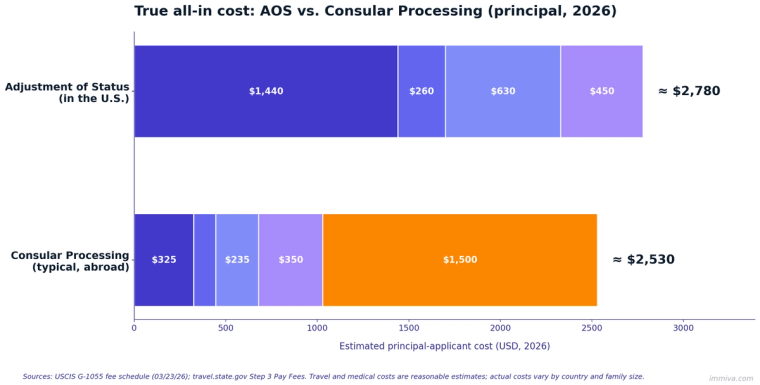
Side-by-side government fees and realistic ancillary costs for a single principal applicant. AOS looks more expensive on filing fees, but international travel and lodging close most of the gap on the CP side.
On filing fees alone, CP is cheaper. The principal-applicant government fees for AOS are $1,440 for the I-485 ($950 if the applicant is a child under 14 filing with a parent), $260 if you add an I-765 EAD, and $630 if you add an I-131 advance parole. Biometrics is folded into the I-485 fee since the April 1, 2024 fee rule (89 FR 6194). For CP, the fees are $325 for the DS-260 (family-based), $120 for NVC's I-864 review, and $235 for the USCIS Immigrant Fee paid after visa issuance. The underlying I-130 or I-140 petition costs the same on both sides; if you are filing family-based, see our I-130 fee breakdown for the petition-stage numbers.
Once you add what each path actually requires, the gap narrows. AOS adds a civil-surgeon medical exam (typically $200 to $700), your largest non-fee cost. CP requires a panel-physician medical exam abroad, plus international travel and often lodging for the interview. For most applicants, those travel costs run $1,000 to $3,000 per family. Stack everything up and a typical AOS file runs about $2,330 in government fees plus medical, while a typical CP file runs $680 in fees plus medical, travel, and lodging.
If 245(i) applies, add a $1,000 statutory sum to the AOS side. If you would otherwise pay an attorney $4,000 to $8,000 to handle a complex AOS case, that is a much bigger swing than any difference in government fees. Immiva's guided self-filing prepares the same filing for a flat fee and runs automated checks on every answer. The attorney fee is the part of the bill you can remove.
The "CP is always cheaper" line in older articles is wrong. CP has lower filing fees, but the all-in comparison depends entirely on whether you would have to travel anyway, whether your family will be separated, and whether you have to pay attorneys in two countries.
The benefits of choosing AOS
AOS has real advantages that held up even through the 2025 policy changes.
You stay in the United States. Family does not separate. You keep your job (assuming your underlying nonimmigrant status remains valid). You do not have to take time off work for international travel and a consulate interview. You will still need a biometrics appointment at a local Application Support Center, but it is a 20-minute visit close to home. For employment-based applicants, you preserve AC21 portability under § 106(c), which means after 180 days of pending I-485, you can change employers in the same or similar occupation without losing your priority date.
You can also seek interim work and travel authorization. A pending adjustment applicant may file Form I-765 for employment authorization and, if eligible, Form I-131 for advance parole. Plan around the 2025 cutbacks, though: renewals filed on or after October 30, 2025 get no automatic extension, and new C09 EADs are capped at 18 months. Travelers should also verify the current I-131 filing rules and fees before relying on advance parole.
There is recourse if something goes wrong. A denied I-485 can be reopened with a motion to reconsider or, in some cases, challenged in federal court. CP denials at the consulate offer no appeal route.
The benefits of choosing CP
That said, CP has some real advantages in 2026, particularly for applicants in certain situations.
Lower upfront filing fees. $325 plus $120 plus $235 is materially less than $1,440 plus $260 plus $630, even if travel costs erode the difference.
It is often required anyway. If you are abroad and have an approved I-130 or I-140, CP is your default route. If you are in the U.S. but trigger a 245(c) bar that is not cured by 245(i) or 245(k), CP is your only option, sometimes with an I-601A waiver.
A cleaner administrative record. You are not waiting two years on a pending I-485 with EAD renewals, RFEs, and the threat of an NTA on denial. You go to your interview, you get the visa or you do not, and if you get it you enter the U.S. as an LPR.
Predictable end state. Once a consular officer issues your immigrant visa, your green card status is settled the moment you enter the U.S. The USCIS Immigrant Fee triggers production of the physical card, which arrives in the mail.
No detention risk at the AOS interview. Reports of detention at adjustment interviews have increased under the 2025 enforcement environment for applicants with prior removal orders or criminal records. CP avoids that exposure if you make it to your visa interview.
Risks you must weigh
Real risks exist on both sides in 2026.
AOS risks. A denied I-485 can result in an NTA and removal proceedings if USCIS determines the applicant is removable. Travel without valid advance parole can be treated as abandonment of the I-485 under 8 C.F.R. 245.2(a)(4)(ii)(A), subject to the usual nonimmigrant exceptions. Automatic EAD renewal extensions ended in October 2025 and new cards run 18 months at most, so plan around a possible gap in work authorization.
CP risks. Section 221(g) administrative processing can pull a case off the standard track for 60 to 90 days at minimum, sometimes for years. There is no formal appeal of a consular denial, only re-application or a State Department Advisory Opinion request. The I-601A provisional waiver process adds 12 to 24 months of waiting before the applicant departs for the consular interview, and a denial after departure can leave the applicant stranded abroad for the duration of a three- or ten-year unlawful-presence bar. Travel-ban applicants are denied issuance at the post. Public-charge questioning has expanded across all 75 freeze-list countries, and DOS has been issuing 221(g) refusals based on it.
Can you switch between paths?
Yes, with caveats.
AOS to CP. If you started AOS and want to switch to CP, you generally withdraw the I-485 and forfeit the filing fees. If needed, you may then file Form I-824 to ask USCIS to send the approved petition to the National Visa Center. The current USCIS fee schedule lists Form I-824 at $590. NVC timing also changes frequently: as of April 20, 2026, DOS said it was creating cases received from USCIS on April 15, 2026 and reviewing documents submitted on April 8, 2026, so any additional-delay estimate should be dated and sourced rather than stated as a fixed 5-to-10-month rule.
CP to AOS. This is more common but can be legally fraught. You can pursue AOS only if you independently qualify to adjust status in the United States, including admission or parole and any applicable visa-availability and admissibility requirements. If you decide to proceed with AOS, you generally ask NVC to stop consular processing and file a new Form I-485 with USCIS, paying the required filing fees. Be careful with tourist-visa entries followed by rapid AOS filing: USCIS can examine whether there was fraud or willful misrepresentation, but there is no USCIS categorical rule that filing within 90 days automatically bars adjustment.
In short: switching is possible, but the fees and time you lose typically exceed any benefit unless your circumstances have changed in a fundamental way.
Special scenarios and decision tree
The decision tree above covers the most common situations. Find the scenario closest to your case and follow the corresponding rules in this guide.
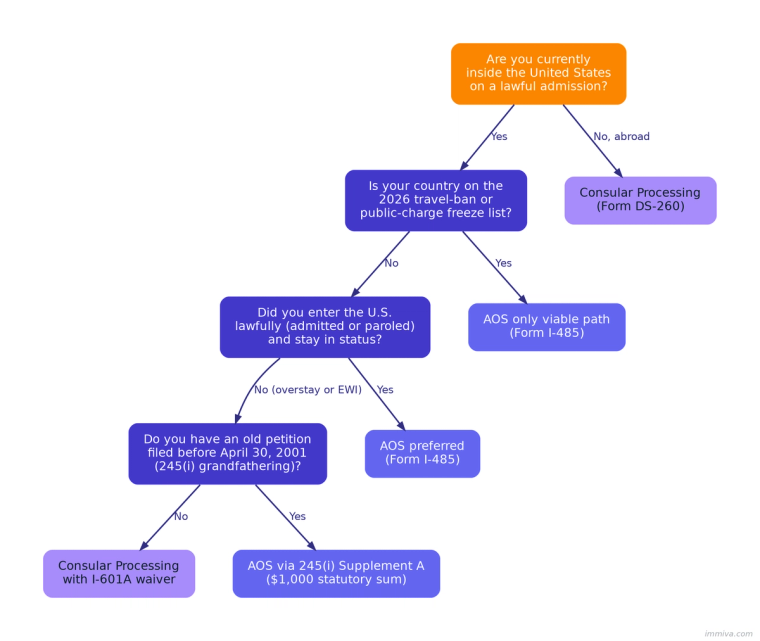
A simplified path through the 2026 AOS vs consular processing decision. The 2026 country lists and the 245(i) grandfathering provision change the answer for many applicants who would otherwise default to CP.
Ten common scenarios.
- U.S. citizen spouse plus beneficiary in the U.S. on a valid visa. AOS may usually be filed concurrently with the I-130 petition if the beneficiary is otherwise eligible to adjust. Immediate relatives of U.S. citizens do not wait for Visa Bulletin cutoffs because immigrant visas in that category are always immediately available.
- U.S. citizen spouse plus beneficiary abroad. CR-1 or IR-1 consular processing. K-3 has no real time advantage in 2026.
- U.S. citizen spouse plus beneficiary in the U.S. with an overstay. AOS, using the immediate-relative exception to § 245(c).
- LPR spouse plus beneficiary with an overstay. This often means consular processing, sometimes with an I-601A provisional unlawful presence waiver if unlawful presence applies. Another possible strategy is to wait for the LPR petitioner to naturalize, because once the petition converts to the immediate-relative category, some beneficiaries who were lawfully admitted may become eligible to adjust despite the overstay. If an I-130 is already pending or approved, it is typically upgraded upon naturalization rather than "refiled" from scratch.
- Beneficiary entered without inspection plus a qualifying petition filed before April 30, 2001. AOS via 245(i) Supplement A with a $1,000 statutory sum.
- Beneficiary entered without inspection with no 245(i) qualifying petition. CP plus I-601A. VAWA, U, or T visa categories may also apply if there has been abuse, criminal victimization, or trafficking.
- EB-2 India with approved I-140 and current Dates for Filing. AOS for the EAD, advance parole, and AC21 portability. Even if final action takes years, you keep working and changing jobs.
- EB-1A from a non-backlogged country. CP is often faster, since you do not need EAD or advance parole, and CR/IR processing at non-bottleneck consulates can finish in under a year.
- Asylee one year after grant. AOS under INA § 209. CP is not available for asylee adjustment.
- National of one of the 75 public-charge freeze countries. AOS is the only viable path, assuming the applicant is in the U.S. on a lawful admission. CP is paused.
For more on the petition stage of any of the family-based scenarios above, see our I-130 vs I-485 explainer on the difference between the petition and the application, and our I-130 processing time breakdown.