
If you are getting ready to file Form N-400, the question on your mind is probably just: what are my odds? Most applicants are approved, and the ones who get denied usually trip over a small set of problems they could have avoided. The latest USCIS data adds something most guides leave out, though. The N-400 denial rate is not a single national number. It moves around a lot depending on which field office gets your case. This post walks through what the newest quarterly figures say, shows how far apart offices really are, and lays out why denials happen so you can cut your own risk. If you want the full filing walkthrough first, start with our step-by-step N-400 guide.
What the latest USCIS data shows
USCIS publishes naturalization receipts, approvals, denials, and pending cases by field office every quarter. For the first quarter of fiscal year 2026, covering October 1 to December 31, 2025, the agency reported 252,190 N-400 applications received, 147,200 approved, 18,311 denied, and 620,920 still pending at the end of the quarter (USCIS N-400 field office data, FY2026 Q1).
Here is the part people get wrong. A denial rate only means something when you measure it against the cases that actually got a decision. USCIS decided roughly 165,500 applications that quarter, and about 11 percent of those ended in denial while 89 percent were approved. The big pending pile of 620,920 does not belong in that math at all. Those applicants are still waiting, not denied. So a "11 percent denial rate" works out to about one in nine decided cases, not one in nine of everyone who applied. Flip it around: for every nine people USCIS gave an answer to that quarter, eight came away approved. If your nerves are telling you the deck is stacked against you, that is the number to hang onto. It is not.
A couple of other things jump out. The backlog kept growing, simply because USCIS took in far more applications than it decided during the quarter. Our explainer on the wider USCIS backlog gets into why. And an 11 percent denial rate sits on the higher side of recent history, which lines up with a broader pattern of rising denials across many USCIS form types in 2025 and 2026. More on that at the end.
Why a single national average hides what matters
The 11 percent figure makes a fine headline, but it averages together hundreds of offices that operate very differently. Break the data out by field office and the spread gets wide fast. Among offices that decided at least 500 cases in the quarter, the median denial rate was about 11 percent, more or less the national mark. The range, though, ran from under 3 percent at the most lenient office to more than 26 percent at the strictest. Two applicants with nearly identical cases could face very different odds for no reason other than where they live. About a quarter of the busy offices came in above 15 percent, and another quarter below 7 percent, so the average barely describes either end.
This matters because your case goes to the field office that covers your home address. You do not get to shop for a lower-denial office, so the ranking is not a menu. What it is good for is calibration. If your local office runs hot on denials, treat that as a reason to file a tight, complete application, not a reason to panic. Most denials, as you are about to see, come from things you can spot and fix before you ever hit submit.
The field offices with the highest N-400 denial rates
Santa Ana, California sat at the top, denying about 26.6 percent of its decided N-400 cases in the quarter, more than double the national rate. Louisville, Kentucky came next at 20.6 percent, then New Orleans at 19.8 percent, Mount Laurel, New Jersey at 19.3 percent, Providence at 19.1 percent, and Newark at 18.5 percent. New Jersey shows up more than once, and so does Florida, with West Palm Beach at 18.2 percent and Oakland Park at 16.0 percent.
A high local rate does not mean the officers there are unfair. Denial rates say as much about the mix of cases an office sees as about how it rules on them. An office covering an area with more applicants who have complicated histories, older criminal records, tax problems, or limited English will post a higher rate, because those are the things that actually lead to denials. Security-check and vetting delays, which have grown in 2026, can also tip more cases toward denial in certain locations. Read the number as a signal about case difficulty and local conditions, not as evidence of bias.
The most lenient offices, and what the gap really means
At the other end, several offices denied only a sliver of their cases. Montgomery, Alabama came in lowest at about 2.9 percent, then Albuquerque at 3.5 percent, San Francisco and St. Louis both at 3.6 percent, and San Jose at 3.7 percent. Notice that California lands at both extremes: Santa Ana is the strictest office in the country while San Francisco and San Jose rank among the most lenient. That by itself should kill the idea that denial rates line up neatly with states or regions.
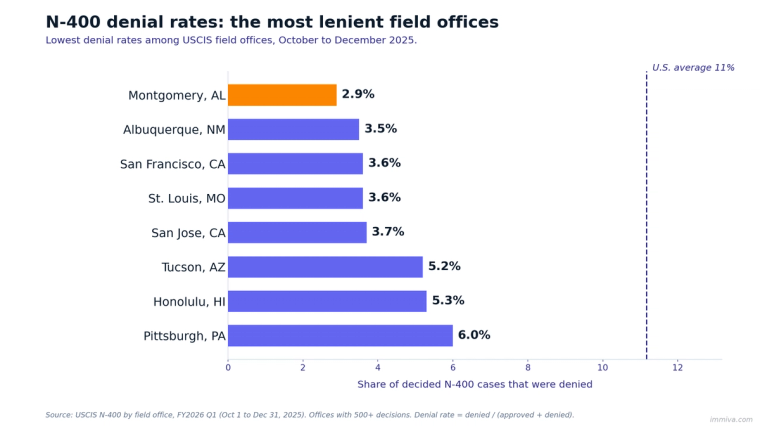
These office figures can only tell you so much, and it is worth saying plainly. The rate counts cases decided during the quarter, and some of them were filed in earlier periods, so it is a snapshot of recent decisions rather than the long-run outcome for any one batch of applicants. International offices are left out, and so are offices that decided very few cases or had data withheld for privacy. Take the office numbers as a rough read on local conditions, not a precise forecast for your own case.
Why N-400 applications actually get denied
Geography makes the headline, but it is not the cause. When USCIS denies an N-400, it is almost always for one of a short list of reasons, and most of them are visible before you file. Learning them is the best thing you can do to keep your case out of the denial column.
Good moral character problems. This is the biggest single driver. A criminal record, even old or seemingly minor offenses, can sink an application, and so can a recent DUI. Unpaid taxes or unfiled returns are another common one, since falling behind on tax obligations can be treated as a good moral character issue. Our guide to a criminal record and citizenship eligibility walks through what is disqualifying and what is not.
Continuous residence and physical presence gaps. Long trips abroad can break the continuous residence requirement, and applicants who have not been physically present in the United States for enough days get denied as not yet eligible. Our breakdown of the continuous residence rules explains how to count correctly before you file.
Failing the English or civics test. You get two attempts, but failing both means a denial. USCIS rolled out a revised civics test in late 2025, so study the current material: see our 128 civics questions study guide and our overview of the English language test.
Incomplete or inaccurate applications. Mistakes on the form, missing documents, answers that do not match what you say at the interview, or filing on an outdated form edition all lead to denials or rejections. Our roundup of the most common N-400 mistakes collects the errors that get applications denied. This is exactly the category Immiva is built to head off: it walks you through each question, flags the answers that raise red flags, and builds a document checklist so the package is complete before it goes in.
Not responding to a Request for Evidence. If USCIS asks for more documentation and you miss the deadline, the case often gets denied. Our guide on how to respond to an N-400 RFE covers what to do if one shows up.
How to lower your own denial risk before you file
You cannot change your assigned field office, but you can control almost everything that actually leads to a denial. A handful of habits do most of the work.
Start by confirming you are even eligible, including the continuous residence and physical presence math, before you spend the filing fee. Use the current form edition and answer every question accurately, even the uncomfortable ones, because an inconsistency caught at the interview hurts far more than an issue you disclosed and handled up front. Deal with good moral character problems before they come up: bring tax transcripts if you have had tax trouble, and certified court dispositions for any arrest or citation, including ones that were dismissed. Study for the interview and the updated civics test instead of betting you will pass on instinct, and our list of what to bring to the interview and our interview questions guide help with that. And if an RFE lands, answer it completely and on time. None of this is hard, but it is the difference between landing in the 89 percent that gets approved and the 11 percent that does not.
You do not need a lawyer to get the N-400 right. Immiva runs the same checks on every answer, every time, on the current form edition, and flags the answers that most often lead to a denial. The fee is flat instead of hourly. Some cases do call for an attorney: an arrest or conviction, a prior denial, or a misrepresentation finding. Our breakdown of whether you need a lawyer for the N-400 walks through those situations.
Why denials are rising in 2026
The 11 percent figure did not appear in a vacuum. The N-400 denial rate has climbed over the past year, from about 8 percent in late 2024 to roughly 11 percent by the end of 2025, and it reached about 13 percent in January 2026. Naturalization is not alone: denial rates have edged up across a range of USCIS form types over the same period, as adjudication and security review tightened. For naturalization specifically, processing slowed sharply in late 2025 and into 2026, and extra scrutiny now reaches applicants with complicated immigration histories or a lot of foreign travel. Our coverage of the enhanced USCIS security checks introduced in 2026 and the climbing N-400 processing times puts the denial trend in context. The takeaway matches what the field office data already tells you: in a stricter environment, a clean, well-documented, accurate application counts for more than it used to.