
On June 23, 2026, the Department of Homeland Security published a proposed rule that would raise what it costs to apply for U.S. citizenship by about 75 percent (91 FR 37500). The same rule would end fee waivers and the reduced fee, which are the two things that currently make citizenship affordable for lower-income applicants.
What matters most: this is a proposed rule, not a final one. The current fees are still the fees, and if you file before a final rule takes effect, you pay today's amount. That window is open right now, and nobody can tell you exactly how long it stays open.
Filing now is the right move for some applicants and a costly mistake for others. Here's how to tell which one you are. If you are still working out whether you qualify at all, start with the citizenship requirements, our complete guide to applying for U.S. citizenship, or a free N-400 eligibility check.
What DHS actually proposed
The proposal covers Form N-400, the naturalization application, and Form N-336, which you file to request a hearing if your N-400 is denied.
For Form N-400, the paper fee would go from $760 to $1,330, an increase of $570 or about 75 percent. The online fee would go from $710 to $1,280, the same $570 increase, which works out to about 80 percent because the starting point is lower. Form N-336 would rise from $830 to $1,475 on paper and $780 to $1,425 online.
The $50 discount for filing online survives the proposal (8 CFR 106.1(g)), so online filing stays cheaper either way.
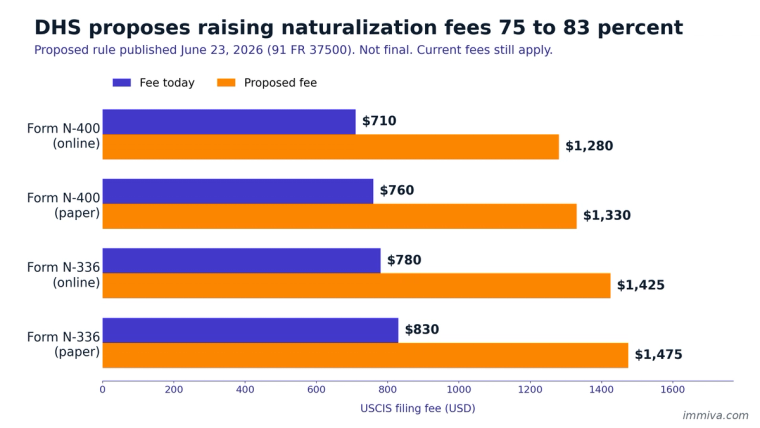
Current versus proposed USCIS filing fees for Form N-400 and Form N-336, based on the proposed rule published June 23, 2026.
DHS frames this as a shift in principle rather than a response to inflation. USCIS has kept naturalization fees below what the applications cost to process, and covered the shortfall by charging more for other forms. The agency puts that gap at about $636 million a year for Form N-400 alone. Under what it calls the beneficiary-pays principle, DHS argues the people receiving the benefit should cover its full cost.
One group is unaffected. Current and former armed forces members naturalizing under sections 328 or 329 of the Immigration and Nationality Act stay exempt, because that exemption is statutory and DHS cannot change it by regulation (8 U.S.C. 1439(b)(4)). If you are filing through military naturalization, nothing here changes your cost.
The fee waiver and the reduced fee would both disappear
For many applicants the headline number is not the real story. The bigger change is that the rule would eliminate two forms of fee relief outright.
Today you can request a full fee waiver if you receive a means-tested benefit, if your household income is at or below 150 percent of the Federal Poverty Guidelines, or if you can show extreme financial hardship (8 CFR 106.3(a)(1)). Separately, there is a $380 reduced fee for households at or below 400 percent of the guidelines. That ceiling is high: DHS notes a four-person household in the lower 48 states qualifies at income up to $128,600.
The proposed rule removes both.
Run the arithmetic. Someone who qualifies for a full waiver today pays $0. If the rule is finalized as written, that same person pays $1,280 or $1,330. These are the applicants with the most at stake in the timing, and the least able to absorb the increase if they miss the window. Our guide to who qualifies for the N-400 fee waiver covers the current criteria, which are still in force.
When the N-400 fee increase could take effect
Nobody knows, and anyone giving you a date is guessing.
What is on the record: the rule was published June 23, 2026, and the comment period closed August 24, 2026 with roughly 2,250 comments. DHS published a correction on July 8, but it only adjusted paperwork burden estimates and changed no fees.
From here DHS reviews the comments and publishes a final rule with an effective date. There is no deadline forcing it to act by any particular date. For scale, the last comprehensive USCIS fee rule was proposed in January 2023, finalized January 31, 2024, and took effect April 1, 2024 (89 FR 6194). Treat the window as open but not indefinite.
A proposed rule can also change or never take effect. DHS can revise the fees in response to comments, and rules like this are often challenged in court. Filing now is a hedge, not a prediction.
Which fee you pay depends on your postmark date
This is the detail that decides whether you actually catch the current fee, and most coverage skips it.
USCIS does not use the date it opens your envelope. It uses the postmark. Under the USCIS Policy Manual, the postmark on the envelope determines whether you submitted the correct form version and filing fee (USCIS Policy Manual, Vol. 1, Part B, Ch. 6). USCIS uses the received date for something different: meeting regulatory and statutory deadlines.
That works in your favor. If a final rule takes effect on a given date and your package was postmarked before it, you pay the old fee even though USCIS receives it later.
Commercial couriers are where people get caught out. For FedEx, UPS, or DHL, USCIS uses the date on the shipping label. If the label has no shipping date, USCIS uses the date the label was printed. If neither appears, USCIS assumes the postmark was 10 calendar days before the package arrived, which can easily put your filing on the wrong side of a cutoff.
So do not print a courier label and then sit on the package, because the printed date is what counts. And keep a dated receipt as proof.
Online filing avoids all of this. A myUSCIS submission is receipted when you complete every step and pay, so the date is unambiguous, and it is $50 cheaper. Get the fee wrong in either direction and USCIS rejects the filing, costing you the time you were trying to save (USCIS Fee Schedule, Form G-1055). Our guide to paying USCIS filing fees covers accepted payment methods.
Should you file now?
The deciding factor is not the fee. It is whether you are actually eligible today.
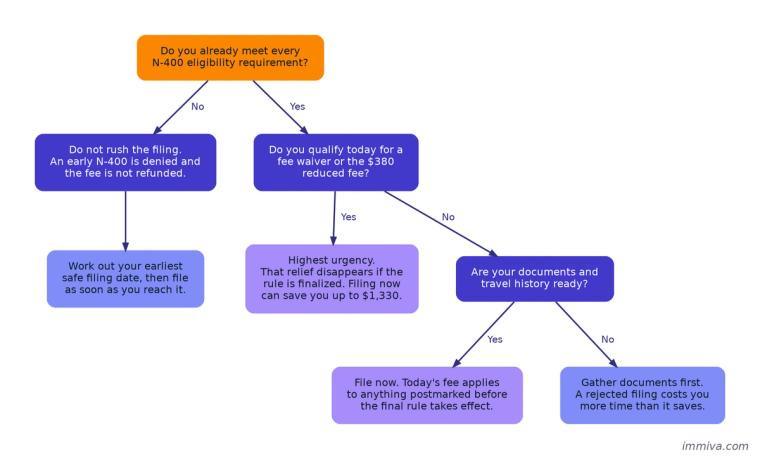
A short decision path for deciding whether to file your N-400 now or wait, based on eligibility, fee relief, and document readiness.
You qualify for a fee waiver or the reduced fee today. You have the most to gain. Filing now can be the difference between paying nothing and paying $1,330. Note that a reduced fee request has to be filed on paper, using Part 10 of the N-400 plus household tax returns.
You are eligible and your documents are ready. File. There is no advantage to waiting and a concrete $570 downside. Work through the N-400 document checklist and go.
You are eligible but your paperwork is scattered. Do not panic-file. A rejected or denied application costs the entire fee plus months of delay, which is worse than the increase you are avoiding. Spend two weeks assembling your travel history, then file properly. This is where guided preparation pays for itself: Immiva checks physical presence, continuous residence, good moral character, and address gaps before you file, for $199 rather than the $1,500 to $10,000 attorneys charge for form preparation.
You are close to eligible but not there yet. You can file up to 90 days before completing the continuous residence requirement (8 CFR 334.2(b)), which pulls the date forward for people who assume they must wait the full five years. That allowance covers continuous residence only. Our continuous residence guide explains the difference, and the free residence calculator works out your earliest safe filing date from your actual travel dates.
You are not eligible yet, or you have an issue in your history. The increase is not a reason to file. USCIS denies premature applications and does not refund the fee, so you would pay $760 for nothing and the new fee later. Arrests, unfiled taxes, or long trips abroad need assessing first. A denial is more expensive than a fee increase, and Form N-336 is rising too.
The bottom line
The N-400 fee increase 2026 proposal is real, substantial, and not final. Today's fees apply to anything postmarked before a final rule takes effect, which makes this a genuine window rather than a manufactured deadline. If you are eligible and prepared, filing now protects you from a $570 increase and, if you qualify for fee relief, potentially the whole $1,330. If you are not eligible yet, no fee schedule justifies filing an application that will be denied.