
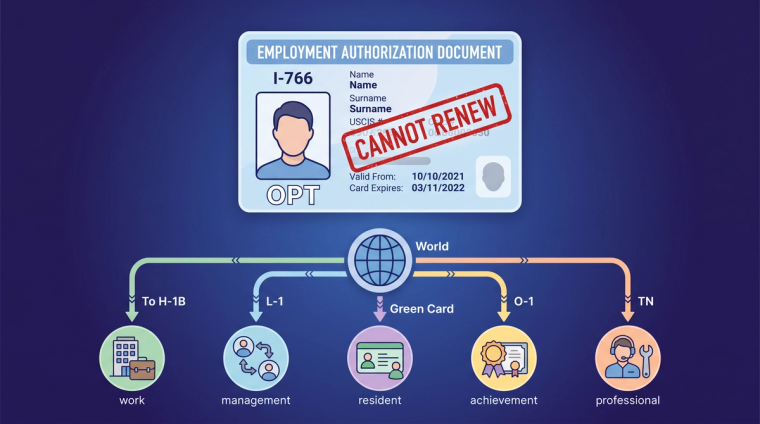
You probably typed "OPT EAD card renewal" into a search bar because your work authorization is running out. The short answer is the one nobody wants to read first: post-completion OPT EADs do not renew. Federal regulation caps practical training at 12 months per education level, and once your card expires, no Form I-765 filing brings it back. What HR or another student is calling a "renewal" is usually one of five different processes: a STEM extension, cap-gap, a change of status, a new OPT tied to a higher degree, or the departure period after OPT ends. Each one has its own rule, and this guide goes through them.
Why OPT EADs do not renew like other EADs
This is where most F-1 students get confused, and it is a reasonable place to get stuck. Plenty of EAD categories use the same Form I-765 and genuinely can be renewed. H-4 spouses, J-2 dependents, applicants with a pending I-485, and asylum-pending applicants all submit Form I-765 marked "Renewal." Immiva has separate guides for those, including the J-2 EAD renewal walkthrough and the H-4 EAD complete guide.
OPT is built differently. Under 8 CFR 214.2(f)(10), an F-1 student gets a maximum of 12 months of practical training at each higher education level. The post-completion EAD under category (c)(3)(B) is the document that proves the cap was used. Once the 12 months are gone, the regulation does not give USCIS a way to "renew" the card. The "Renewal EAD" option on I-765 is a real option for other categories, but it does not apply to (c)(3)(B) OPT.
The three OPT subcategories on Form I-765:
| I-765 code | CFR cite | Type | Filing window |
|---|---|---|---|
| (c)(3)(A) | 8 CFR 274a.12(c)(3)(i)(A) | Pre-completion OPT | After 1 academic year, during studies |
| (c)(3)(B) | 8 CFR 274a.12(c)(3)(i)(B) | Post-completion OPT (12 months) | 90 days before to 60 days after program end; within 30 days of DSO recommendation |
| (c)(3)(C) | 8 CFR 274a.12(c)(3)(i)(C) | STEM OPT extension (24 months) | Up to 90 days before (c)(3)(B) EAD expires |
Moving from (c)(3)(B) to (c)(3)(C) is an extension under a different category code. It is not a renewal of the same card.
The five things "OPT renewal" actually means
STEM OPT extension: the closest thing to a renewal
If your most recent qualifying degree is on the DHS STEM Designated Degree Program List and your employer is enrolled in E-Verify, you can file a new Form I-765 under (c)(3)(C) for a 24-month extension. The filing window opens 90 days before your (c)(3)(B) EAD expires. The fee is $470 online or $520 paper, with no biometrics fee, and you have to include a completed Form I-983 training plan signed by your employer.
If you file before your current EAD expires, you get a 180-day automatic extension of work authorization under 8 CFR 274a.12(b)(6)(iv). That auto-extension survived the October 30, 2025 IFR that killed the 540-day extension for most other EAD categories. For more on that rule, see Immiva's H-4 EAD renewal 2026 guide.
H-1B cap-gap: automatic, no I-765 needed
If your employer files a timely cap-subject H-1B petition with a change-of-status request while you are in valid F-1 status, and you are selected in the registration lottery, your F-1 status and current OPT employment authorization are automatically extended through April 1 of the H-1B fiscal year. The April 1 cutoff replaces the older October 1 cutoff under the H-1B Modernization Final Rule, effective January 17, 2025. No new EAD card gets issued. Your DSO updates your I-20 to document the extension. For broader H-1B context, see Immiva's FY 2026 H-1B cap recap.
Watch out for this trap: if your OPT EAD already expired before the H-1B petition was filed, cap-gap covers your F-1 status during the gap but does not give you work authorization.
Change to another nonimmigrant status
If you qualify, you can move into O-1 (extraordinary ability), L-1 (intracompany transferee with prior foreign employment), TN (USMCA professionals for Canadians and Mexicans), E-2 (treaty investor), or another status through a separate petition. B-2 is technically possible during the departure period if you are winding things down, but USCIS looks at it closely as a job-search bridge and often denies it. None of these is a renewal. Each one is its own filing.
Starting a new degree at a higher level
Enrolling at a higher level (for example, moving from a bachelor's program into a master's program) resets your OPT eligibility once you finish the new program. You do not "renew" the prior EAD. You file a new (c)(3)(B) I-765 tied to the new degree and a new I-20.
The grace period after OPT ends: 60 days or 30
Eligible F-1 students who maintained status generally have a 60-day grace period after completing post-completion OPT or STEM OPT. They can use this time to prepare to depart, transfer, or seek another qualifying status. The September 2026 fixed-admission rule and its 30-day departure period were postponed by the September 14 court order. You cannot work during the grace period.
What if my OPT EAD already expired
If your EAD has expired and you did not obtain a timely STEM OPT extension or qualifying cap-gap protection, you cannot keep working. Eligible students who maintained F-1 status generally have a 60-day grace period after OPT ends; a status violation can change that. Filing a fresh I-765 marked "Renewal" does not create another period of ordinary post-completion OPT at the same education level. Confirm any departure, transfer, or change-of-status plan with your DSO or an attorney.
2026 updates F-1 students should know
The 180-day extension for timely STEM OPT filings is separate from the general EAD renewal extension rules. The H-1B cap-gap rule is also separate. For Form I-765, the current USCIS notice says the 08/21/25 edition remains accepted and the 09/15/26 edition is not accepted while the September fixed-admission rule is postponed. Check premium processing fees and processing times separately on current USCIS pages.