
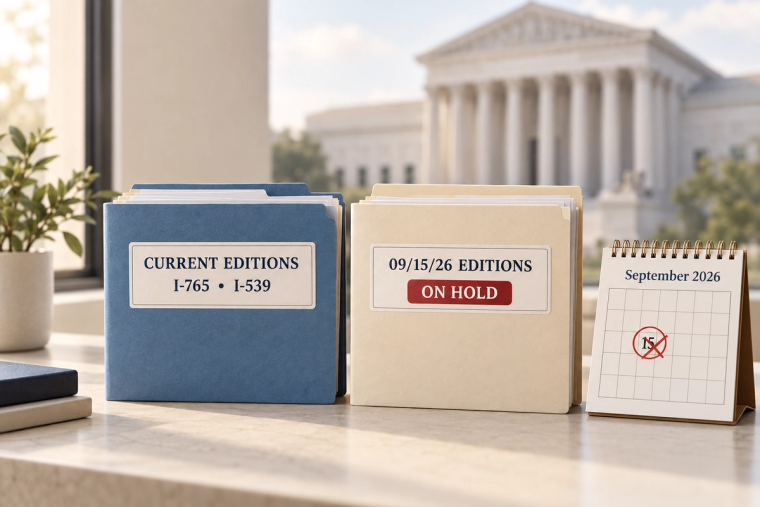
The USCIS changes scheduled for September 15, 2026 would have replaced two widely used forms and introduced a new admission system for many students and exchange visitors. A federal judge postponed the underlying rule on September 14, one day before it was due to take effect. USCIS then updated its Form I-765 page and Form I-539 page to say it is not accepting the planned 09/15/26 editions.
Use Form I-765 edition 08/21/25 or Form I-539 edition 08/28/24, depending on what you are filing. Download the form directly from USCIS on the day you prepare or submit it. Do not use a saved preview of the 09/15/26 edition.
USCIS Changes September 15, 2026: No New Forms Released
In August, USCIS announced that it would publish 09/15/26 editions of Form I-765, Application for Employment Authorization, and Form I-539, Application to Extend/Change Nonimmigrant Status. The agency said there would be no grace period because both forms were needed to implement a new federal rule. USCIS has since moved that announcement from its active newsroom to its archive (archived USCIS announcement).
On September 15, USCIS updated its live form pages to say that a federal court had postponed the rule's effective date and preliminarily stopped DHS from implementing it. USCIS says it will continue under the previous regulatory provisions while the court order remains in place (USCIS Form I-765).
The current position is:
| Form | Edition USCIS currently accepts | Edition USCIS says it is not accepting |
|---|---|---|
| Form I-765 | 08/21/25 | 09/15/26 |
| Form I-539 | 08/28/24 | 09/15/26 |
Both live form pages give the same instruction. USCIS last reviewed the I-765 page and the I-539 page on September 15, 2026.
These edition notices apply to filers beyond F-1 students. Many employment authorization categories use Form I-765, including H-4 and J-2 work permit requests. Form I-539 covers certain extensions and changes of nonimmigrant status. If you are preparing either form, follow the live USCIS edition notice. Older articles, emails, downloaded previews, and social media posts may still describe the planned change.
Why the September 15 change stopped
The planned forms would implement a DHS final rule called Establishing a Fixed Time Period of Admission and an Extension of Stay Procedure for Nonimmigrant Academic Students, Exchange Visitors, and Representatives of Foreign Information Media. DHS published the rule in July 2026, with a scheduled effective date of September 15 (Federal Register, 91 FR 44976).
On September 14, the U.S. District Court for the District of Massachusetts issued an order postponing the rule's effective date. USCIS identifies the case as Presidents' Alliance on Higher Education and Immigration, et al. v. DHS, No. 26-cv-13799. The agency says DHS is preliminarily barred from taking further steps to implement the rule while the order remains in force (USCIS Form I-539).
USCIS did not put the planned editions into use because they were designed to implement the postponed rule. The agency says it disagrees with the court's order and may act to implement the rule if the order is lifted. The rule could therefore still take effect later (USCIS Form I-765).
The July final rule and August form announcement describe what DHS planned to change. For the editions USCIS accepts today, check the live form pages.
Articles published before September 15 may still say the new editions became mandatory with no grace period. That was the August announcement's position, but the court order changed it. Check when a source was updated and whether it links to the live form page. If a dated screenshot of a preview form conflicts with USCIS's current Edition Date section, follow the current USCIS notice.
Which form edition should you use now?
If you are filing Form I-765 now, use the 08/21/25 edition. USCIS lists that edition in the Form Details section and links the active PDF from the same page (USCIS Form I-765). If you need help with a category-specific application, Immiva has separate guides for H-4 EAD Form I-765, J-2 Form I-765, and OPT Form I-765.
If you are filing Form I-539 now, use the 08/28/24 edition. The live USCIS page lists that edition and links the active form and instructions (USCIS Form I-539). Our Form I-539 guide for H-4 status explains where the form fits in an H-4 filing.
Use this five-step check before you submit either form:
- Open the live USCIS page for your form.
- Read the alert at the top and the Edition Date section.
- Download a fresh copy of the form and instructions.
- Confirm the edition date and page numbers at the bottom of every page.
- Check the form page again on the day you file.
If you completed the 09/15/26 preview but have not submitted it, do not try to convert the packet by swapping only the first page. Start again with the active form from USCIS and transfer your answers carefully. Form editions can change question numbers, certifications, instructions, and page order. Mixing pages from two editions can create a packet that USCIS cannot accept. The live form pages specifically warn filers to use pages from the same edition (USCIS Form I-539).
If you are filing I-539 and I-765 together, check each form separately. The planned versions shared the 09/15/26 edition date. The accepted versions have different dates: 08/28/24 for I-539 and 08/21/25 for I-765. One correct form does not tell you whether the other is current. Open both USCIS pages and check each footer before assembling the packet.
If you already submitted an accepted edition, the September 15 notice does not tell you to withdraw the case or file a duplicate. Track the filing you made and respond if USCIS sends a notice. Sending a second application without a case-specific reason can create extra fees and confusion. If you are unsure whether USCIS received the filing or whether a deadline is at risk, use your receipt information and get advice based on your case rather than guessing from the form date.
USCIS warns that missing pages or pages from different editions may cause a rejection. The agency also tells paper filers to keep the edition date and page numbers visible at the bottom of every page (USCIS Form I-765).
A larger filing packet can easily contain PDFs from different editions: one saved last month, another sent by a friend, and a freshly downloaded copy. Check that every page of each form belongs to the same accepted edition. If you are preparing an H-4 work permit, the H-4 EAD document checklist can help you organize the supporting evidence separately from the form.
What the court order means for the underlying rule
USCIS says it will follow the previous regulatory provisions while the final rule is postponed (USCIS Form I-539). The fixed-admission system described in the July rule therefore did not take effect on September 15.
For F, J, and I nonimmigrants, the announced switch away from the existing duration-of-status framework is on hold. Our Form I-94 explainer covers the document that records how long someone is admitted. Do not apply the previously announced September 15 deadlines as though the rule had taken effect.
The postponement applies to this specific final rule and the related 09/15/26 forms. Your existing status, EAD expiration date, filing window, category requirements, and any case-specific deadline still matter. H-4 and J-2 EAD renewals, for example, still need careful timing. Our guides to H-4 EAD renewal and J-2 EAD renewal cover those separate requirements.
Immiva's form preparation process tracks current USCIS editions so users can avoid relying on a PDF saved before the court update. You still need to check your personal deadlines and get legal advice if your situation requires it.
What to watch next
USCIS says the postponement will remain in place pending a further court order or a decision on the merits. DHS may take steps to implement the rule if the order is lifted (USCIS Form I-765). There is no confirmed new effective date.
Watch three places:
- The live Form I-765 page.
- The live Form I-539 page.
- The USCIS Forms Updates page.
If USCIS later publishes new editions, check the acceptance dates on the live pages before switching. Do not assume the 09/15/26 previews will automatically become valid on a later date. USCIS may keep those editions, revise them, or issue new instructions; the current pages do not say what the agency will do.
Keep any 09/15/26 preview you downloaded out of the packet you are mailing now. Download the accepted edition from USCIS again so you can use the correct version without comparing two long PDFs from memory.