

When a friend of my wife moved from F-2 to H-4, the hardest part was not the form. It was working out which advice online was still true.
Two rules changed between 2025 and now, and a lot of the advice still circulating describes the world before them. Every fee below is checked against the current USCIS schedule.
Quick reference for 2026
- The Form I-539 fee is $470 by mail or $420 online (USCIS Fee Schedule)
- There is no biometric services fee for I-539
- File at least 45 days before your current status expires (Form I-539 Instructions)
- No premium processing exists for H-4, no matter what you are willing to pay
- The current form edition is 08/28/24. Older editions get rejected.
- Leaving the U.S. while it is pending abandons your application
- H-4 EAD renewals filed on or after October 30, 2025 get no automatic extension
What changed since the 2025 rules
Two things: one about work permits, one about how officers weigh discretion.
The EAD auto-extension is gone. DHS published an interim final rule on October 30, 2025 adding 8 CFR § 274a.13(e). For any H-4 EAD renewal filed on or after that date, work authorization ends the day after the date printed on your card, even with a renewal pending, and resumes only when USCIS approves the new one.
That safety net used to run up to 540 days, and it is gone. If USCIS received your renewal before October 30, 2025, the old rules still cover you. Our H-4 EAD renewal guide covers the timing.
A court struck down the country-based discretion guidance. In Dorcas International Institute of Rhode Island v. USCIS, the U.S. District Court for the District of Rhode Island vacated USCIS Policy Alert PA 2025-26 and two related memos, with final judgment entered June 11, 2026.
That guidance had told officers to treat nationality-linked factors as significant negatives in discretionary requests, naming change of status and extension of stay specifically. That is exactly what Form I-539 asks for. USCIS says it disagrees but will follow the ruling, that the vacatur applies agency-wide, and that the guidance should be treated as not in effect (USCIS Policy Manual Updates). Our post on what the travel ban ruling means for your case covers the wider picture.
What did not change: the $100,000 H-1B payment from September 2025 does not apply to H-4 dependents. It shapes whether your spouse should risk international travel, but it is not a fee you pay.
What H-4 status actually is
H-4 is the status for spouses and unmarried children under 21 of H-1B workers, and it is tied to your spouse's. If their H-1B ends, yours ends with it.
It also does not renew itself. When your spouse extends their H-1B, your H-4 does not follow automatically. You file separately, every time. This catches more families than any other single issue, and our H-4 visa guide for H-1B spouses covers the status rules in full.
H-4 runs as long as the H-1B, usually up to six years, and if your spouse has an approved I-140 you can both keep extending past that while you wait on a priority date.
When you need to file Form I-539
Two situations: a change of status, where you are in the U.S. in some other status such as F-2, L-2, or B-2 and your spouse now holds an approved H-1B, or an extension, where you already hold H-4 and it is about to expire.
You cannot file until your spouse's H-1B is approved, unless you are filing the whole package together.
Children go on Form I-539A rather than their own I-539. The day a child turns 21 or marries they lose H-4 eligibility, so families with a teenager near that birthday should line up an alternative early.
Who qualifies, and what trips people up
You need a valid H-1B spouse, proof of the relationship, and lawful status right now. Proof means a marriage certificate or a birth certificate, translated into English if it is in another language. Untranslated certificates are one of the most common reasons a package comes back.
Three things cause real trouble. Criminal history has to be disclosed and explained, even minor matters, and even an arrest that never led to a conviction. Past status violations surface too, whether that is unauthorized work or a broken student visa condition, because USCIS has the records. And overstaying makes a change of status much harder: narrow exceptions exist for delays beyond your control, but this is the point to talk to an attorney rather than file and hope.
Your filing routes, and what each costs
Three routes, and the one that fits depends on what your spouse's employer is doing and whether children or a work permit are involved.
Bundle it with the I-129. If your spouse's employer is filing an H-1B petition now, your I-539 can go in the same package, with Form I-765 if you want an EAD. The Edakunni settlement used to guarantee joint adjudication, but it expired on January 18, 2025, so USCIS no longer has to process them together. Bundled cases still tend to move faster. Our guide to filing I-539 and I-765 together covers the tradeoffs.
File online. This route is open only if you are the sole applicant with no co-applicants on Form I-539A. It saves $50 and gets you a faster receipt.
File on paper. You need this if children are on the application, or if you are filing for an H-4 EAD. Category (c)(26) has no online option.
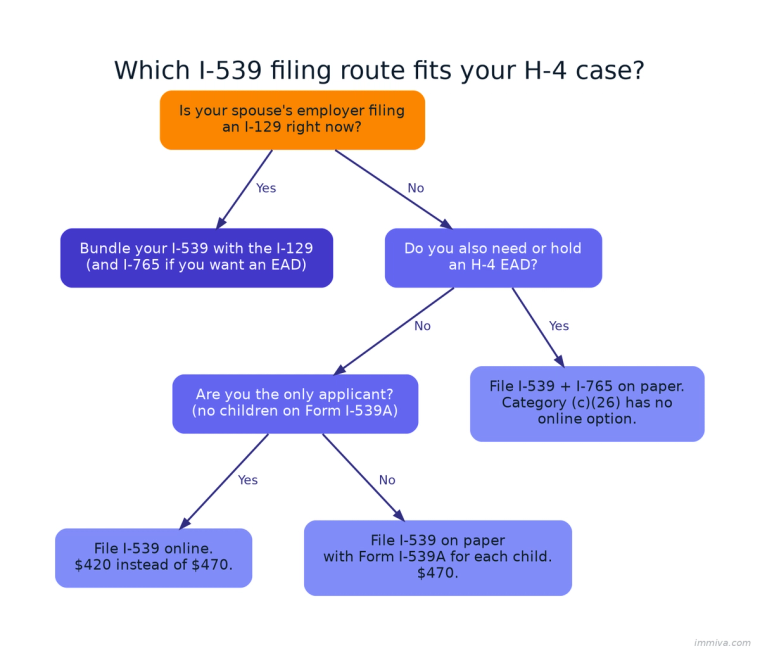
Which filing route applies depends on whether your spouse has a petition in flight, whether you need a work permit, and whether any children are included.
On payment: USCIS stopped taking checks, money orders, and cashier's checks in late October 2025. Paper filers pay by card using Form G-1450 or by bank transfer using Form G-1650, as our post on how to pay USCIS filing fees explains.
What you will need to gather
Nothing exotic, but everything has to be there:
- Passport copies, photo and visa pages
- Your Form I-94 from the CBP site
- Marriage or birth certificate, with certified English translation if needed
- Your spouse's H-1B approval notice, Form I-797
- Your spouse's last three months of pay stubs
- Your spouse's passport and visa copies
The form is mostly transcription. Two parts carry the weight: Part 2, where you pick change of status or extension, and Part 3, where you enter your spouse's H-1B receipt number. Our complete guide to filling out Form I-539 goes field by field, and the H-4 EAD document checklist covers the work permit paperwork.
This is where Immiva fits. Missing documents and mis-ticked boxes are what generate evidence requests, and the platform flags those before you mail anything.
How long it takes and what you can do meanwhile
Timing varies enough that any single number you read online is probably wrong. It moves with the service center and with whether you bundled the filing. Check the USCIS processing times tool for Form I-539 on the day you file, and see our H-4 EAD processing time data for the work permit queues.
There is no way to buy speed. USCIS offers I-539 premium processing only for F, M, and J classifications, and I-765 premium processing only for OPT and STEM OPT. H-4 appears on neither list.
While you wait, you can stay. Filing before your status expired puts you in a period of authorized stay, so you are not building unlawful presence. What you cannot do is leave, because departing abandons a pending I-539, so do not book anything you cannot cancel. If you hold an EAD, read traveling while your H-4 EAD is pending first. You also cannot work on the I-539 alone. Status and work authorization are separate things.
The work permit question
Only H-4 spouses can get an EAD, never children, and only when the H-1B spouse has an approved I-140 or has extended past the sixth year through a pending green card process. The I-140 connection is what most people get wrong.
If you qualify, file Form I-765 in category (c)(26), on paper, for $520. USCIS will not touch the EAD until the H-4 is approved, so the waits stack.
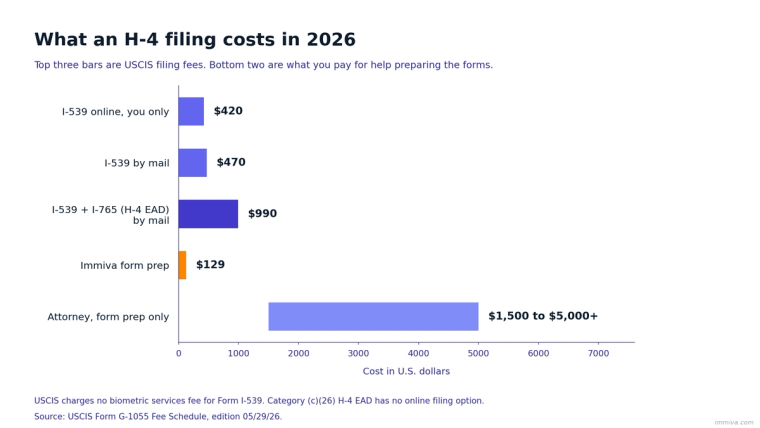
The 2026 cost picture, separating what USCIS charges from what you pay for help preparing the forms.
Once it arrives, an H-4 EAD is open-ended. Unlike your spouse, you are not tied to one employer, and you can switch jobs, freelance, or start a business without filing anything new. The complete H-4 EAD guide covers the process.
Mistakes that cost people months
Filing late is the obvious one. The instructions say 45 days, though three to four months is better if you can manage it. Sending the wrong fee or an old form edition means rejection rather than review, so confirm the fee on the USCIS schedule and check that every printed page shows edition 08/28/24. And missing documents are the leading cause of evidence requests, which add months.
If USCIS does send a Request for Evidence, it is not a denial. Send exactly what they asked for, well before the deadline on the notice.
Do you need a lawyer
Sometimes, yes. Attorneys charge $1,500 to $5,000 for form preparation, and for some cases that is money well spent: any criminal history, any prior visa violation, an existing overstay, or a previous denial.
For a clean case, where you are in valid status and your documents are in order, the work is careful transcription rather than legal judgment. That is the gap Immiva fills at $199, covering the I-539 and I-765 together as one application.
The short version
Form I-539 for H-4 is simple to fill in and easy to get rejected on. The fee is $470 by mail or $420 online, the edition is 08/28/24, and there is no way to pay for speed.
File early, translate everything, and stay in the country while it is pending. If you also need a work permit, let the October 2025 auto-extension change drive your calendar, because your card no longer carries you through the wait.