
If your USCIS case has been stuck for months with no decision, a ruling handed down on June 5, 2026 could be the reason that changes. A federal judge struck down a set of USCIS policies that had paused decisions on applications filed by people from 39 countries covered by the latest travel ban. The hold reached green cards, work permits, asylum, and citizenship, and it left a lot of people waiting without answers.
This is a fast-moving legal story, and the practical picture is still settling. Below is a plain-language breakdown of what the court actually decided, who it affects, and what the USCIS travel ban ruling means for your case right now. For background on the underlying restrictions, our 2025 Trump travel ban explainer and our earlier write-up on the USCIS enhanced security checks walk through how the holds were built.
What the court ruled on June 5, 2026
Chief U.S. District Judge John McConnell Jr., who sits in Providence, Rhode Island, struck down a series of USCIS policies in a 135-page opinion (court opinion, D.R.I.). The decision came in a lawsuit that a coalition of immigrant service organizations and labor unions filed back in March.
The ruling reached four connected policies that USCIS had adopted starting in late 2025:
- A pause on asylum adjudications at USCIS.
- A hold on benefit applications, including work permits, green cards, and naturalization.
- A comprehensive re-review of cases that had already been approved.
- Country-specific guidance telling officers to treat applicants from certain countries as higher risk.
The judge wrote that these policies threw the lives of many immigrants into what he called "indeterminate legal limbo." He found that USCIS claimed authority it did not have, acted without the reasoned explanations the law requires, and leaned on national security concerns that he described as masking anti-immigrant sentiment. In legal terms, he held the actions were contrary to law and arbitrary and capricious.
One point the judge stressed is worth repeating, because it speaks to who was affected: the people caught by the hold had followed the legal process. They filed the right forms, paid the fees, and waited. The delay, he wrote, traced back to their country of birth rather than anything they did wrong.
How the travel-ban holds came about
The holds did not appear overnight. They grew out of a series of policy moves over about seven months, and it helps to see them in order.
The original June 2025 travel ban (Presidential Proclamation 10949) restricted entry for citizens of 19 countries. In late November 2025, after a shooting in Washington, D.C. that prosecutors have linked to an Afghan national, the administration signaled it would tighten immigration further. On December 2, 2025, USCIS issued a memo (PM-602-0192) placing a hold on benefit requests for people from the travel-ban countries and pausing asylum decisions. A second proclamation in December (10998) expanded the list, and as of January 1, 2026 the hold applied to all 39 countries. The lawsuit followed in March, and the June 5 ruling closed the loop.
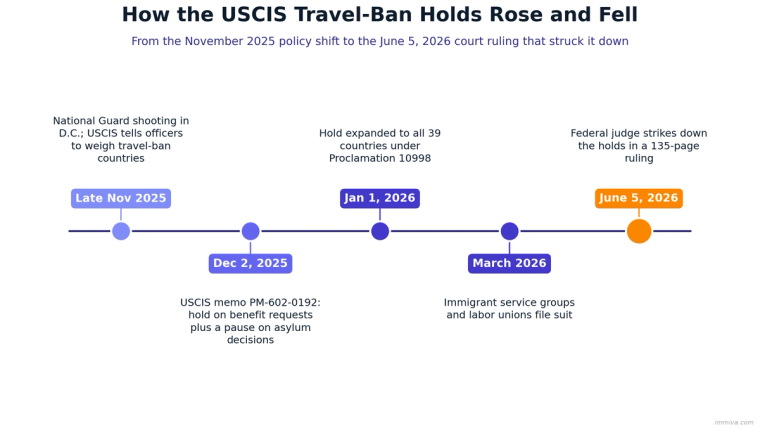
How the USCIS travel-ban holds developed from the November 2025 policy shift to the June 5, 2026 ruling that struck them down.
Who was affected: the 39 countries and the frozen applications
The hold applied to people who were born in, or are citizens of, one of the 39 countries named in Presidential Proclamation 10998. That list grew out of the earlier 19-country ban and includes nations across Africa, Asia, Latin America, and the Middle East. Countries under full restrictions included Afghanistan, Iran, Haiti, Somalia, Sudan, Venezuela, and Yemen, among others.
What the hold did and did not do is easy to get wrong. It was not a ban on applying. People could still file within their normal deadlines and windows. What stopped was the decision at the end. USCIS would accept the application and then sit on it.
The freeze touched a wide range of cases:
- Green card applications, including adjustment of status through Form I-485.
- Work permit applications and renewals filed on Form I-765 for an Employment Authorization Document.
- Affirmative asylum cases handled by USCIS.
- Citizenship through Form N-400.
- Family petitions, such as an I-130 for a relative, where the beneficiary fell under the proclamation.
The hold also reached people who thought they were already done. One of the struck-down policies called for a fresh review of cases that USCIS had already approved, going back several years. For someone who had received an approval and built a life around it, the idea that the agency might reopen the file was its own kind of stress. The court's order addressed that re-review along with the holds on new and pending cases.
One nuance matters for asylum. The ruling concerns USCIS, which handles affirmative asylum for people already inside the country. It does not cover asylum decided by immigration judges for people stopped at the border. Those are separate systems. The State Department's parallel pause on visa processing abroad is also a different track, which we cover in our piece on the immigrant visa freeze for 75 countries.
What the USCIS travel ban ruling means for your pending case
Here is the honest answer: the ruling works in your favor, but it is not a switch that instantly clears your case. The court found the holds unlawful and directed USCIS to stop applying them. In practice, that means the agency is supposed to resume adjudicating the applications it had parked.
A few things follow from that.
First, your case should move back into the normal queue. That does not make it fast. USCIS was already working through a historic backlog before any of this, so "resumed" means your file rejoins a long line rather than jumps to the front. Agencies also need time to update internal guidance and retrain officers after a ruling like this, so you may not see movement on your specific case the moment the decision lands.
Second, the legal situation can still shift. We expect the government to appeal, or at least to ask for the ruling to be paused while an appeal plays out. If that happens, timelines could change again. We are watching the docket and will update this guide as the picture develops.
Third, this is a good moment to make sure your application is actually ready to be decided. A case that resumes processing only to hit a Request for Evidence loses more time. If you are not certain your filing is complete and accurate, Immiva walks you through your form question by question, checks every answer, and flags the gaps that lead to RFEs and denials. That is the difference between a clean file and another round of delay.
What to do now
You cannot control how fast USCIS reacts, but you can control your own file. A short checklist:
- Check your case status. Pull up your receipt number and confirm where your case stands. Our guides on checking your EAD or case status and tracking an N-400 online show you how.
- Keep your address current. If USCIS resumes work on your case, you want any notice, interview letter, or RFE to reach you. Update your address with USCIS promptly after any move. Form AR-11 takes a few minutes to file online.
- Make sure your filing is complete. Gather the supporting documents your form requires before USCIS asks. A typical attorney charges $1,500 to $4,000 to prepare and review an application. Immiva's guided filing builds a personalized document checklist from your answers for a flat fee, so your file is ready when your case comes up.
- Do not refile blindly. Filing a duplicate application rarely speeds things up and can create confusion. If your case is already pending, the usual move is to keep it pending.
- Watch for updates. The legal story is not over. Court rulings like this can be appealed, and agency guidance can change. Keep an eye on official USCIS notices and our blog for updates in plain English.
If you have not filed yet and you think you may now be able to move forward, you can check whether you qualify for citizenship, or start a naturalization application when you are ready.
Will the government appeal, and what happens next?
A ruling from a federal district judge is significant, but it is rarely the final word in a case the government cares about. The administration defended the policies in court and has criticized the decision publicly, with a senior Department of Homeland Security lawyer calling the reasoning flawed. That signals the government is likely to keep fighting.
As Immiva, we expect a period of mixed signals. USCIS may resume adjudications while also seeking review of the ruling. You could see your case start to move even as the legal fight continues in the background. Treat the ruling as real and act on it: get your file in order now. Just do not assume the matter is permanently settled. If a higher court pauses or narrows the decision later, the practical effect on your case could shift again. That is why staying current on official notices matters more than reacting to any single headline.