

Your I-94 is running out, or your plans changed and you need a different status. Either way you now have to fill out Form I-539, and it is not obvious where to start.
The form itself is not hard. It is mostly transcription. What trips people up is everything around it: whether you are even allowed to use this form, which edition to download, what fee to send, and which supporting documents USCIS expects. Get any of those wrong and the package comes back unopened, with your status clock still running.
This guide covers who qualifies, what it costs in 2026, how to fill out Form I-539 part by part, what to attach, and what happens once it is in the queue. Every figure is checked against the current USCIS fee schedule and the form instructions rather than repeated from older articles, because a lot of what is still circulating about this form is out of date.
What changed for Form I-539 in 2026
Two things, and one of them has a hard deadline.
The form gets replaced on September 15, 2026. USCIS is publishing a revised Form I-539 with edition date 09/15/26 that replaces the 08/28/24 edition (USCIS Form I-539). There is no grace period, which is unusual. USCIS normally lets you use an old edition for a few weeks after a new one appears. Not this time, because the new edition is what the agency needs to apply a new regulation that starts the same day.
The rule works on filing date, not on when you printed the form:
- The 08/28/24 edition is accepted only if postmarked or submitted electronically before September 15, 2026
- The 08/28/24 edition is rejected if postmarked or submitted on or after September 15, 2026
- The 09/15/26 edition is accepted only on or after September 15, 2026, and will be rejected if you file it early
For paper filings the postmark controls. For online filings the electronic submission date controls. Preview copies of the new edition are already posted, so you can read ahead, but you cannot file one yet.
The reason behind it. DHS published a final rule on July 17, 2026 that ends duration of status for F academic students, J exchange visitors and I foreign media representatives (91 FR 44976). Instead of staying as long as their program lasts, those groups now get a fixed Admit Until Date printed on their I-94, and they file to extend when it runs out. That pushes a large new population toward Form I-539 for the first time. Our briefing on the September 15, 2026 USCIS changes covers the admission-period rules and the transition relief in detail.
What to do about it: if your filing window straddles mid-September, decide early. Filing before the 15th with the 08/28/24 edition is the simpler path. If you will not be ready in time, wait and use the new edition rather than rushing an incomplete package out the door.
Who can use Form I-539, and who cannot
This is the first thing to settle, because filing on the wrong form means rejection or denial, and USCIS does not refund the fee on a denial.
You can use Form I-539 if you are:
- A B-1 or B-2 visitor asking for more time
- An F-1 or M-1 student seeking reinstatement, or changing to another status
- A dependent such as H-4, L-2, J-2, E-2 or O-3
- Someone moving between certain nonimmigrant categories, for example B-2 to F-1
- A K-3 or K-4 nonimmigrant extending status while a permanent resident case is pending
- A CNMI resident applying for an initial grant of status, or a V nonimmigrant
You cannot use Form I-539 if you are:
- The principal worker on an H-1B, L-1, O-1, P, R-1, TN or E visa. Your employer files Form I-129 instead
- In the United States on ESTA through the Visa Waiver Program
- In C, D, K-1, K-2, S or certain other classifications
- A J-1 subject to the two-year home residency requirement who has not obtained a waiver
The dependent versus principal distinction catches the most people. An H-1B worker and an H-4 spouse are on completely different forms even when they file in the same envelope. If you are the H-4 spouse, our guide to Form I-539 for H-4 status covers the category-specific rules, and the H-4 visa guide for H-1B families explains how the two statuses are tied together. J-2 dependents should start with J-2 work authorization.
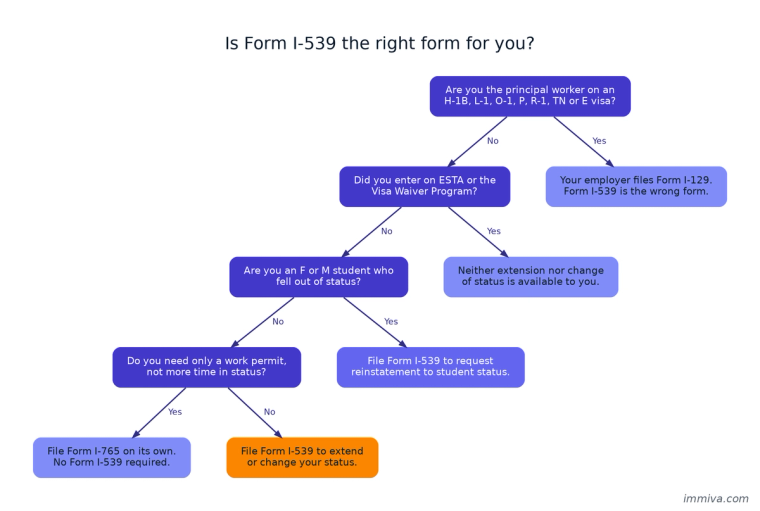
Principal workers, ESTA entrants and work-permit-only filers all belong on a different form. This routes you to the right one before you pay anything.
What Form I-539 costs in 2026
The base fee depends only on how you submit it (USCIS Fee Schedule, Form G-1055):
- Online: $420
- By mail: $470
There is no biometric services fee for Form I-539. USCIS removed that line from the schedule, so if a source tells you to add $85 or $30, it is working from an outdated page. Sending the wrong total is one of the most common reasons a package gets returned. USCIS can still require you to appear for fingerprints and a photo, and after September 15 the F and J extension filings come with biometrics as standard. The appointment is free. Only the fee went away.
Premium processing exists, but the slice of filers it covers is narrower than most articles suggest. Form I-907 is available only if you are requesting a change of status to F-1, F-2, M-1, M-2, J-1 or J-2 (USCIS premium processing). It is not available for an extension of stay, in any classification. That distinction is about to matter a great deal, because the September 2026 rule pushes F and J nonimmigrants into filing extensions, and those extensions cannot be upgraded at any price.
The fee is $2,075, raised from $1,965 on March 1, 2026 as an inflation adjustment (Federal Register, Adjustment to Premium Processing Fees). The guarantee is a USCIS action within 30 business days, not calendar days, and an action can be a request for evidence rather than a decision. The clock does not start until you and every co-applicant have given biometrics. If you are H-4, L-2, B-2 or any other category outside that list, premium processing is not an option.
One fee covers the family. If your spouse and children are included on the same application using Form I-539A, you pay once. Each co-applicant needs their own I-539A supplement, but not their own fee.
Some categories pay nothing. The fee schedule lists $0 for anyone filing into or out of A, G or NATO nonimmigrant status, for T nonimmigrants, for U nonimmigrants, and for B-1 United Nations Mission Observers and their B-2 dependents. A fee exemption is automatic. You do not file Form I-912 or make any formal request to claim one, which is what separates an exemption from a fee waiver.
How you pay changed in late 2025. USCIS stopped accepting personal checks, cashier's checks and money orders on October 28, 2025. Paper filers now pay by card using Form G-1450, or by bank transfer using Form G-1650. Our post on how to pay USCIS filing fees walks through both, and we covered the day the check rule took effect when it happened.
Pay for each form separately. This one kills whole packages. If you send the I-539 with an I-765 or an I-129, each form needs its own payment instrument, because USCIS processes them in different systems. Combine them into one payment and the agency can reject everything you sent (USCIS Filing Fees). The same trap catches people who add a biometric services fee out of habit: on a paper filing, a combined payment that includes it gets the I-539 rejected outright. There is no biometrics fee to add.
For comparison, attorneys typically charge $1,500 to $5,000 to prepare this form. Immiva charges $149 flat, checks every answer before you file, and always builds on the form edition USCIS accepts today.
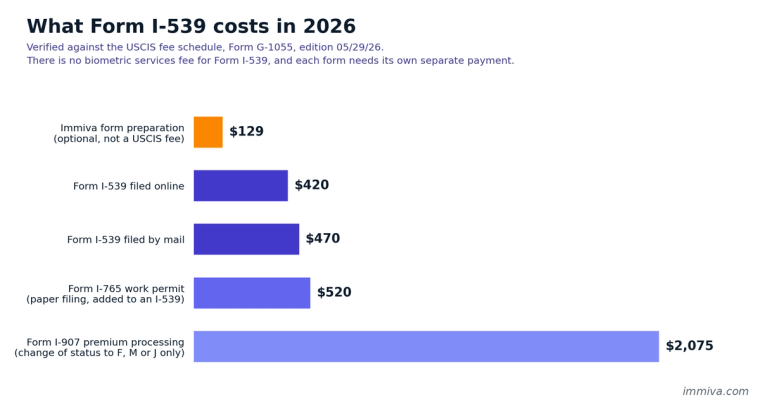
The full 2026 cost picture, separating the mandatory USCIS fees from the optional ones most filers never need.
How to fill out Form I-539, part by part
Both the 08/28/24 and 09/15/26 editions run in eight numbered parts. Item numbering shifts slightly between them, so read the label next to each box rather than working from memory or an old printout.
Part 1: Information about you
Straight transcription, and the place where small errors do real damage.
Enter your full legal name exactly as it appears on your passport. If you have two middle names, include both. A name that does not match your travel document is a reliable way to generate a request for evidence.
Your A-Number is usually blank. It is assigned when someone files for a green card or is placed in removal proceedings, so most nonimmigrants have never had one. If you are unsure, our explainer on the alien registration number covers where it appears. The USCIS Online Account Number is also blank unless you have already created an account.
Your mailing address matters more than it looks. USCIS sends receipt notices, evidence requests and decisions to this address, and a missed notice can sink an otherwise fine application. Use an address you will still control in a year. Add your phone number and email so the agency can reach you quickly.
Part 2: Application type
This is where you tell USCIS what you actually want.
First, pick one: an extension of stay in your current status, a change of status to a new one, or reinstatement to student status. Then, if you are changing, name the classification you are requesting. Be specific. Writing "student" instead of "F-1" creates ambiguity that an officer has to resolve, and they will not resolve it in your favor.
Next, state how many people are on the application, including yourself. Every additional person needs a Form I-539A.
The 09/15/26 edition adds a request that did not exist before: if you are filing a change of status to, or an extension of stay in, F or J status, you list all SEVIS ID numbers associated with you. If you have studied on more than one I-20, gather those numbers before you start.
Part 3: Processing information
Your immigration history and current situation.
You need your I-94 number, which you get from the CBP I-94 website rather than from your passport stamp. The record also shows your admission date and the date your authorized stay ends. That end date, not your visa expiry, is the deadline you are working against. Our I-94 explainer covers how to read it and what to do when it disagrees with your stamp.
Add your passport details and, where asked, your visa information. The visa number is the red digits on the visa page, not the passport number.
Then give the date you are requesting. Be realistic and tie it to something concrete: an I-20 end date, a treatment schedule, a spouse's approval notice.
The yes or no questions in this part ask about your immigration history. Have you applied for an immigrant visa. Have you filed for adjustment of status. Have you been arrested. Answer every one honestly. USCIS already holds most of these records, and an answer that conflicts with the file is far more damaging than the underlying fact usually is. An immigrant petition filed on your behalf, even one denied or withdrawn, still counts as yes.
Part 4: Additional information about the principal applicant
If your current passport details differ from what you entered earlier, correct them here. This part also carries the longer background questions covering criminal history, status violations and unauthorized employment. Anything you answer yes to gets explained in Part 8, not in the margin.
Part 5: Statement, contact information, declaration and signature
You are signing under penalty of perjury, so read the declaration before you sign it.
Sign it and date it. An unsigned Form I-539 is rejected outright, every time, no exceptions, and USCIS puts a reminder arrow next to the signature box on the fillable version because the mistake is so common. An undated form can be rejected too. Someone else may help you prepare the form, but you still have to understand what you are signing.
Part 6: Interpreter's contact information and signature
Leave this blank unless someone translated the form for you. If they did, they complete and sign it.
Part 7: Preparer's contact information, declaration and signature
For an attorney or accredited representative who prepared the form on your behalf. If you answered the questions yourself using a software tool, you are the preparer and this part stays empty.
Part 8: Additional information
Overflow space. For each entry, write the part number and item number you are continuing, then your answer. Use it properly rather than cramming text into a box that was not built for it.
This is the point where a second pass pays for itself. The rejections that hurt most are not legal judgment calls, they are a missing signature, a mismatched fee, or a yes that should have been a no. Immiva asks the questions in plain English, checks the answers against each other, and produces the completed form, which is a different job from giving you a blank PDF and wishing you luck.
The documents that go with your form
The form is half the package. The evidence is the other half.
Everyone includes:
- Form I-94. Print the record for every person on the application from the CBP site.
- Passport copy. The biographic page with your photo, plus the visa page and your most recent entry stamp.
- Current status documents. Your visa, and any approval notice such as Form I-797 that shows the status you hold now.
- A cover letter. Not required, but it works. State plainly who you are, what you are asking for, how long you need it, and what is enclosed.
- Proof you can support yourself. Bank statements, pay stubs, or an affidavit from whoever is supporting you.
Then add what your category needs:
- B-1 or B-2 visitors: a written explanation of why you need more time, evidence that the stay is still temporary such as ties at home or a return ticket, and medical records if treatment is the reason
- F-1 and M-1 students: your Form I-20, proof you can cover tuition and living costs, and enrollment records
- Dependents such as H-4, L-2 or J-2: proof of the relationship, meaning a marriage or birth certificate, plus the principal's approval notice and I-94
- Every co-applicant: their own Form I-539A, fully completed
Two practical rules. Send clean photocopies, never originals. USCIS rarely returns originals, and it will ask if it wants them. And translate anything that is not in English, with a certified translation attached. Untranslated civil documents are one of the most common triggers for a request for evidence.
Leave out anything unrelated. A thicker envelope does not read as a stronger case, it just takes longer to open.
Filing online or by mail
Online filing is available for many I-539 categories and saves you $50, gets you a receipt number immediately, and lets you track the case in your USCIS account. The system also flags blank required fields before you submit.
You cannot file online if any of the following apply:
- You have co-applicants on Form I-539A
- You are filing an I-765 work permit alongside the I-539 in a category that has no online option
- You have a large volume of physical evidence to submit
Paper is the right call in those situations. Our guide to filing the I-539 and I-765 together covers how bundling changes the sequencing. F-1 students filing for OPT should start with the I-765 OPT application guide instead, since that is a separate track.
If you mail it, confirm the address on the USCIS Form I-539 direct filing addresses page on the day you send it. Addresses differ by classification and by whether you use regular mail or a courier, and they change without much warning. The wrong address means the package comes back.
What happens after you file
File early. USCIS recommends submitting at least 45 days before your current stay expires (Form I-539 Instructions). Three to four months is better if you can manage it. Filing after your I-94 expires is a different and much weaker application: USCIS can excuse a late filing for extraordinary circumstances beyond your control under 8 CFR 214.1(c)(4) and 8 CFR 248.1, but that is a discretionary favor, not a right.
A timely filing protects you while you wait. If you filed before your I-94 expired and the application is not frivolous, you are in a period of authorized stay for as long as it is pending. You are not accruing unlawful presence, even after your original end date passes. If USCIS denies the application, unlawful presence generally starts the day after the denial.
Correcting something you may have read elsewhere: there is no 240-day rule for Form I-539. The 240-day provision at 8 CFR 274a.12(b)(20) lets certain employees keep working while a timely Form I-129 extension is pending. It is about employment authorization in employment-based categories, and it gives an I-539 applicant no 240-day cushion of any kind. Plenty of articles say otherwise.
Do not leave the country. Departing the United States abandons a pending I-539. You would need a new visa from a consulate to come back in the status you were asking for.
Do not start working. Status and work authorization are separate. An approved I-539 gives you status, not a work permit. If you need one, it comes from a separate Form I-765, and since October 2025 a pending renewal no longer extends an expired card, so filing early matters more than it used to.
On timing. Processing times for Form I-539 vary widely by classification and service center, and any single number you read online is probably stale. Check the USCIS processing times tool for your specific case on the day you file. For context on what those published estimates actually measure, see our explainer on how USCIS calculates average processing time and the current picture of the USCIS backlog. Expect the F and J extension filings created by the September 2026 rule to land in the same queue.
Some applicants are scheduled for a biometrics appointment. Go. Missing it can get your application denied as abandoned.
The short version
You can fill out Form I-539 in an afternoon. Getting it accepted is the part that takes care. Confirm you belong on this form rather than I-129 or I-765, file at least 45 days before your I-94 expires, send $420 online or $470 by mail with no biometrics fee, sign it, and stay in the country while it is pending.
The one thing that is genuinely new this year is the edition rule. From September 15, 2026 the 09/15/26 edition of Form I-539 is the only one USCIS will accept, and the old edition gets rejected the same day. Check the date at the bottom of the page before you file. It takes five seconds and it is the cheapest mistake you will ever avoid.