

Sponsoring a relative for a green card comes with a financial promise. You sign Form I-864, the Affidavit of Support, and agree to keep the person you sponsor above a set income line. So the first thing almost everyone asks is: how much income do you need to sponsor a green card, and do I make enough? The answer depends on your household size, where you live, and who you're sponsoring, so a flat number off a chart rarely fits your case.
That's why we built a free Green Card Sponsor Income Calculator that does the math for you. You answer a few questions, and it tells you the income line for your situation, whether you clear it, and how big any gap is. This guide walks through how to use it and what each result means. For the full rules behind the form, our complete guide to the I-864 Affidavit of Support covers sponsor eligibility, joint sponsors, and household size in depth.
What "enough" means for a green card sponsor
The requirement comes from a single rule: most sponsors must show income at or above 125% of the Federal Poverty Guidelines for their household size. USCIS publishes the exact dollar figures every year on Form I-864P, and the 2026 numbers took effect on March 1, 2026.
For the 48 contiguous states and D.C., a household of two needs $27,050, a household of four needs $41,250, and the line rises by $7,100 for each additional person. Alaska and Hawaii use higher tables. There's one discount: if you're on active duty in the U.S. Armed Forces and sponsoring your spouse or child, you only need to reach 100% of the guidelines, not 125%.
Immiva charges $249 for I-485 adjustment-of-status preparation, including Form I-864 for family cases when it applies.
What the calculator asks you
The inputs are short, and you already have the answers to all of them.
First, you pick whether you're a U.S. citizen or a green card holder. Both can be the main sponsor; the choice only changes how much your assets need to be worth if your income falls short. Next, you choose who you're sponsoring: a spouse, child, parent, sibling, or other relative. That matters because the asset rule and the military discount only reach their best terms for a spouse or child.
Then you answer whether you're on active duty in the armed forces, which switches the line to the lower 100% level for a spouse or child. You select your state, since Alaska and Hawaii sit higher than everywhere else. Last, you enter your household size, your current annual income, and, if they apply, a household member's income and the cash value of any significant assets. One detail worth getting right: use your current income, what you earn now, not just the total from last year's tax return.
See where you stand in under a minute
As soon as you fill in your income, the right side of the screen updates. It shows the income line for your exact household and location, your own income next to it, and a clear verdict on whether you're above or below the line. There's nothing to submit and no account to create.
The line it shows is the same one a USCIS officer will use, because the calculator reads from the current I-864P table. The number you see for a household of two in Texas or a household of five in Hawaii matches what the officer pulls up. It's a self-screening estimate rather than a decision, but it's built on the official figures.
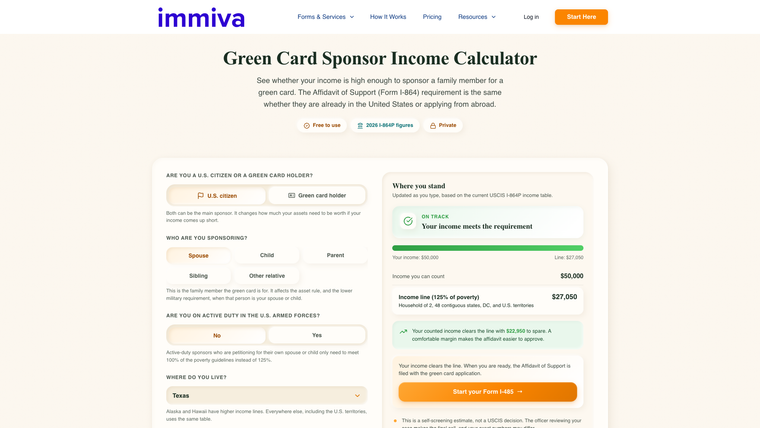
The Green Card Sponsor Income Calculator. Enter your details on the left, and the income line, your standing, and any shortfall update on the right.
Above or below the line, line by line
A result has three numbers worth reading together. Your income is what you entered. The income line is 125%, or 100% for active-duty military sponsoring a spouse or child, of the poverty guideline for your household. The gap, if there is one, is how far short you are.
If your income clears the line, the calculator says so, and you're likely in good shape on the income test, though the officer still reviews your full file. If you're below it, the tool shows the exact shortfall and turns to the next question: how to make up the difference.
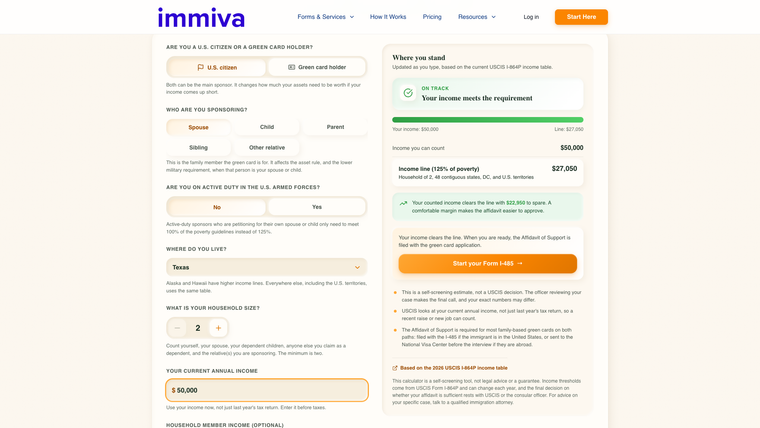
A result for a sponsor whose income clears the 2026 line for their household size.
If you come up short, three ways to close the gap
A low income doesn't end your case. The calculator lays out the same three options USCIS allows, with the dollar amounts worked out for your gap.
The first is a joint sponsor. Someone who meets the full requirement on their own income files a separate Form I-864 alongside yours. Their income isn't combined with yours; they have to clear the line by themselves.
The second is a household member's income. A relative who lives with you can add their income on Form I-864A, and that income is combined with yours. The tool shows how much more counted income you'd need.
For family-based adjustment of status, Form I-864 is included with Immiva's I-485 preparation when it applies. The preparation fee is $249, with government filing fees separate.
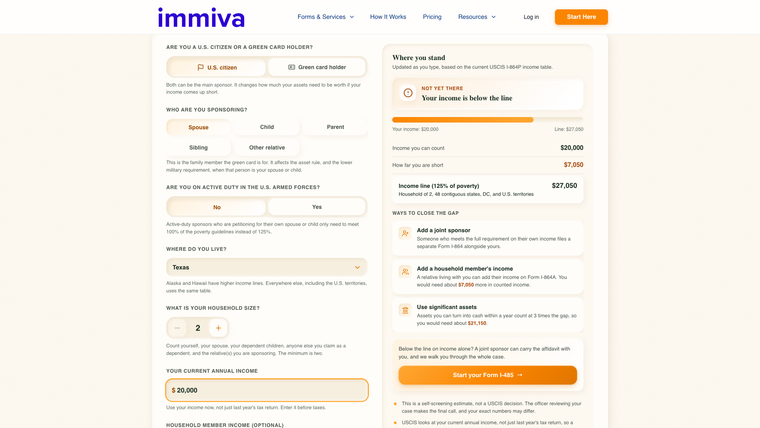
A below-the-line result, with the shortfall and the three ways to close it: a joint sponsor, a household member's income, or assets.
The same income line applies if your relative is abroad
It doesn't matter whether your relative is already in the United States or waiting overseas. The Affidavit of Support is required on both paths, and the income line is identical. If your relative adjusts status inside the country, the I-864 goes in with Form I-485. If they're abroad, it goes to the National Visa Center before the consular interview, and the NVC charges a one-time $120 review fee. Our guide on adjustment of status versus consular processing covers how the two paths differ.
Bottom line
The income you need to sponsor a green card is whatever 125% of the poverty guideline works out to for your household size this year, or 100% if you're active-duty military sponsoring a spouse or child. The quickest way to find your number is to run it through the income calculator. If you still need to start the petition, our I-130 family petition guide covers that first step.