
Losing a family member is devastating on its own. When that family member was the person who filed your I-130, the grief often comes with a second fear: that your green card case died with them. The short answer is that it usually didn't. Immigration law includes specific remedies, written in after Congress saw too many families broken twice over, that can keep a case moving even after the petitioner passes. This guide walks through what actually happens to your I-130 petition, which pathway fits your situation, and what to do first.
The default rule: automatic revocation, with two big exceptions
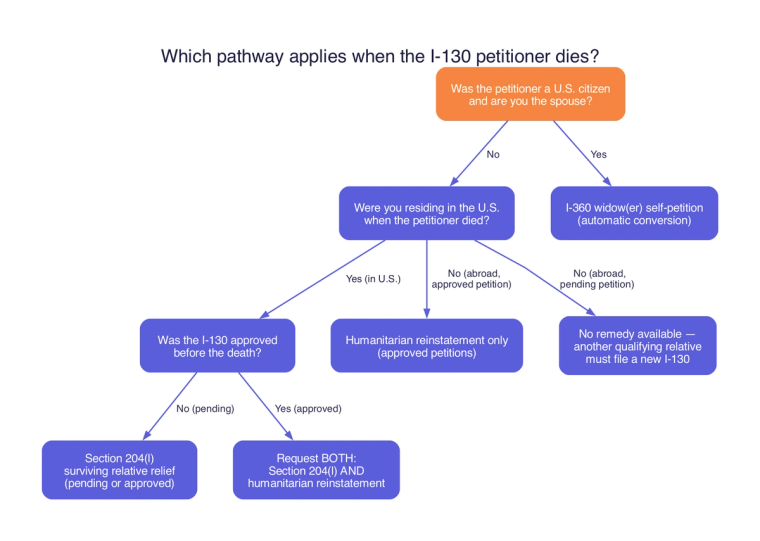
The starting point is that an approved I-130 is automatically revoked when the petitioner dies. If the petition was still pending, USCIS generally cannot approve it unless a survivor-protection provision applies. Three legal pathways may keep the case moving after a petitioner's death: a widow(er)'s automatic I-360 conversion or self-petition in qualifying U.S.-citizen-spouse cases, relief under Section 204(l) of the Immigration and Nationality Act, and discretionary humanitarian reinstatement. Which one applies depends on who died, where you live, and whether the petition was already approved.
The three pathways at a glance
The flowchart below maps the decision. If you already know your situation, skip to the matching section.
Section 204(l): relief for surviving relatives inside the U.S.
Section 204(l) of the INA is the main reason the I-130 doesn't just vanish when a petitioner dies (8 USC § 1154(l)). Congress added it in October 2009 to stop a practice where beneficiaries who had lived in the U.S. for years, sometimes decades, lost everything the moment their sponsor passed. The relief covers both pending and approved petitions, which is its biggest advantage over humanitarian reinstatement. It applies to principals and derivatives and extends to several family-based petitions, including the I-130.
There's one big catch: you must have been residing in the United States when the petitioner died and must continue residing here (USCIS Policy Manual, Vol. 7, Part A, Ch. 9). "Residing" means your principal dwelling place, not physical presence, so being temporarily abroad doesn't disqualify you if the U.S. is home. There's no lawful-status requirement. And if several family members are on the same petition, the rule is forgiving: if one meets the residency test, the whole family benefits.
To request relief, you don't file a form or pay a fee. You send a written letter to the USCIS office handling the case, attach the death certificate and proof of U.S. residence, and mark the envelope "INA 204(l)." USCIS does not issue a receipt notice, which can be unnerving. Most beneficiaries also need a substitute sponsor to file a new Form I-864. If you're already thinking about the green card itself, our I-130 vs. I-485 guide shows how the pieces fit together.
Humanitarian reinstatement: the lifeline for approved petitions abroad
Humanitarian reinstatement lives in the same regulation that revokes the petition in the first place, 8 CFR § 205.1(a)(3)(i)(C)(2). It's a discretionary safety valve that exists only for already-approved I-130 petitions. The test isn't a checklist; it's whether humanitarian factors weigh in favor of bringing the case back to life. Those factors typically include impact on U.S. citizen or permanent resident relatives, advanced age or health, long lawful residence, significant government delay, and letters attesting to good moral character.
The most important thing humanitarian reinstatement does, and 204(l) does not, is cover beneficiaries living abroad. If your I-130 was already approved before the petitioner passed and you were overseas, this is usually the only pathway available. USCIS suggests requesting both remedies in the same letter when both could apply. Send it to the office that originally approved the petition. No form, no fee, no receipt notice. If USCIS denies, you cannot appeal, though a motion to reopen or reconsider may still be available.
Widow(er) of a U.S. citizen: automatic conversion to I-360
If your spouse was a U.S. citizen who died while their I-130 for you was pending or approved, your case automatically converts to an I-360 self-petition. You don't have to ask, and the original filing date (your priority date) is preserved. If no I-130 was ever filed, you have two years from the date of the citizen's death to file an I-360 on your own. There's no substitute sponsor requirement. There's no U.S. residence requirement. The old two-year-marriage threshold was eliminated in 2009. You just can't have remarried.
This pathway is unique in how forgiving it is, but it only applies to surviving spouses of U.S. citizens. Surviving spouses of lawful permanent residents do not qualify for widow(er) I-360 treatment; depending on the case, they may seek Section 204(l) relief if they meet the U.S.-residence requirement, or humanitarian reinstatement if the I-130 was already approved before the petitioner's death. For context on how marriage-based petitions are reviewed, see our I-130 for spouse guide.
Finding a substitute sponsor (Form I-864)
In every pathway except the widow(er)'s self-petition, someone has to replace the deceased petitioner on the affidavit of support. This substitute sponsor files a new Form I-864 and takes on all the legal obligations the original petitioner would have had. The rules are narrow: a U.S. citizen or permanent resident, at least 18, domiciled in the United States, and a specific relative of the intending immigrant (spouse, parent, child 18+, sibling, in-law, grandparent, grandchild, or legal guardian) (INA § 213A(f)(5)(B)). A family friend cannot step in.
The substitute sponsor must meet 125% of the Federal Poverty Guidelines. If their income is short, a joint sponsor can help, but the joint sponsor only supplements, they don't replace the family-member substitute. Our I-130 document checklist covers the surrounding paperwork.
What to do immediately after the petitioner dies
First, do not assume the case is closed. Families regularly abandon viable cases because nobody told them otherwise. Start by ordering certified copies of the death certificate, you'll need several. Pull together proof that you were residing in the U.S. at the time of death if that applies (lease, utility bills, tax records, school enrollment). Grab your I-130 receipt number. Identify a possible substitute sponsor early, because the income requirement is often the longest pole in the tent.
Then send USCIS a letter citing both Section 204(l) and 8 CFR § 205.1(a)(3)(i)(C)(2), with the death certificate, proof of residence, and a draft I-864 from your substitute sponsor. If the petition was pending, send it to the office handling the case; if it was approved, send it to the office that approved it. Keep certified-mail tracking for your own records, since USCIS does not send a receipt notice for these requests.
How policy shifts in 2025 and 2026 make these cases harder
Recent USCIS policy changes can still affect these cases. On August 1, 2025, USCIS issued family-based immigration guidance emphasizing screening and vetting, clarifying interview and adjudication procedures, and stating that USCIS may issue a Notice to Appear if the beneficiary is otherwise removable. Because Section 204(l) and humanitarian reinstatement requests are evidence-driven, complete documentation remains especially important.