
The I-485 packet does not forgive much. USCIS has tightened intake rules over the past 18 months, and the lockbox now rejects packages that would have come back as a Request for Evidence two years ago. The big one: as of December 2, 2024, if Form I-693 is required in your case, you must submit the sealed I-693 medical exam with Form I-485. If it is missing, USCIS may reject the Form I-485 as improperly filed.
This is the only I-485 document checklist you will need for 2026 filings. It covers family-based and employment-based applicants, walks through every recent rule change, and tells you how to assemble the packet so the lockbox accepts it the first time. There is a free downloadable version at the end you can print and check off. For the wider process beyond document assembly, see our I-485 adjustment of status guide.
Three rule changes in 2026 that could get your application rejected
Before you assemble anything, check that you are filing under current rules. Three changes since late 2024 are responsible for most rejected packets we see.
The I-693 medical exam is now mandatory at filing. Before December 2, 2024, you could file I-485 without I-693 and submit the sealed medical envelope later in response to an RFE. That option is gone. If Form I-693 is required in your case, the I-485 packet must include a sealed I-693 envelope from a USCIS-designated civil surgeon, or USCIS may reject the Form I-485 as improperly filed. When that happens, you lose your filing date and have to refile everything.
For paper-filed USCIS benefit requests, USCIS generally requires payment by credit/debit card using Form G-1450 or ACH using Form G-1650 as of October 28, 2025. However, USCIS still provides limited exceptions through Form G-1651, Exemption for Paper Fee Payment, and certain in-person emergency advance parole payments may still be accepted by check. For step-by-step electronic payment instructions, see our USCIS filing fee payment guide.
File Form I-485 edition 01/20/25 if your packet is postmarked before September 18, 2026. From September 18 USCIS accepts only the 09/18/26 edition, with no grace period. The edition date is printed in the bottom-left corner of the form. Download the current version directly from the USCIS I-485 page right before you file.
The complete I-485 checklist: documents every applicant needs
Every applicant submits the 12 items below regardless of category. Family-based and employment-based applicants then add category-specific documents on top.
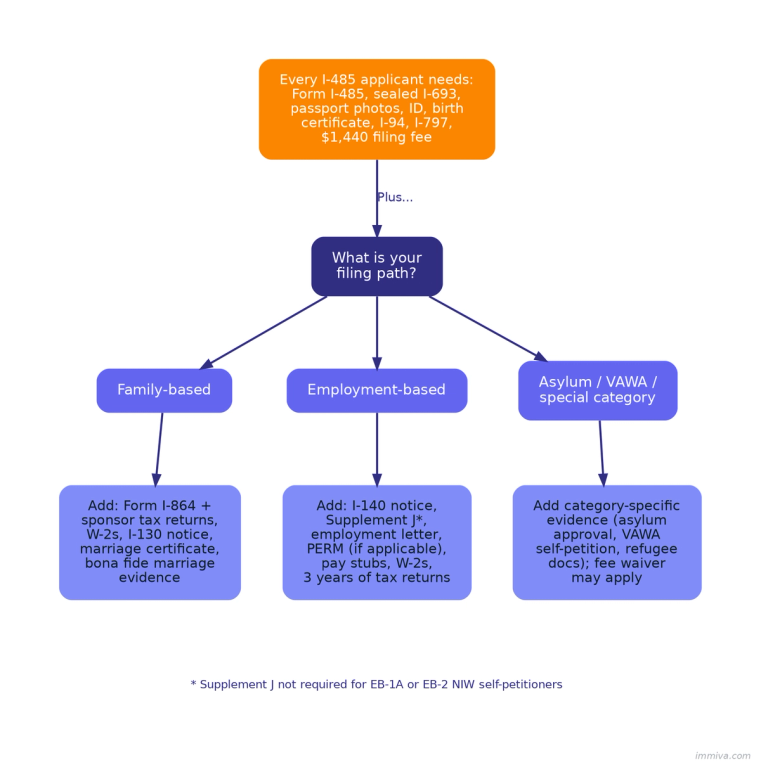
A high-level view of the I-485 document path. Every applicant submits the universal package, then adds documents based on their filing category.
1. Completed Form I-485, edition 01/20/25. Sign in black ink. USCIS announced that starting April 3, 2025, it would accept only the 01/20/25 edition.
2. Sealed Form I-693 medical examination. In the unopened envelope sealed by your USCIS-designated civil surgeon. Edition 01/20/25 is required for any I-693 signed on or after July 3, 2025.
3. Two passport-style photographs. Taken within 30 days of filing, 2×2 inches, plain white background, full face frontal view, neutral expression, no glasses or headwear (except for religious purposes). Write your name lightly in pencil on the back of each photo.
4. Copy of government-issued photo ID. The passport biographical page is the cleanest option. A driver's license or national ID also works.
5. Long-form birth certificate. Must show both parents' names. If it is not in English, include a certified translation. Short-form birth certificates are routinely rejected.
6. Copy of your Form I-94. Print the most recent record from the CBP I-94 website. For background on what this record is and why USCIS wants it, see our I-94 explainer.
7. Copies of all passport pages with admission stamps, visas, and entry/exit records. Include any expired passports that show your immigration history.
8. Form I-797 receipt or approval notice for your underlying petition. This is your I-130, I-140, I-360, or other qualifying petition.
9. Evidence of continuously maintained lawful status. Past I-94s, visa stamps, EAD cards, or status-extension approval notices. If you have a status gap that qualifies for an exemption, document the exemption.
10. Court and police records for any arrest, charge, or conviction. This applies even if the case was dismissed, expunged, or sealed. Failing to disclose old records is one of the fastest ways to trigger an I-485 RFE or denial.
11. Filing fee of $1,440 (or $950 if filing as a child under 14 with at least one parent). If filing by mail, pay using Form G-1450 (credit/debit card) or Form G-1650 (ACH bank transfer), unless you qualify for an exemption to the electronic-payment requirement. Biometrics are included in this fee, so no separate biometric payment is needed.
12. Form G-1145 (optional but recommended). Requests email or text notification when USCIS accepts your filing. Costs nothing and gets you a receipt number one to two weeks faster than waiting for the paper Notice of Action.
Additional documents for family-based applicants
If you are adjusting through a family relationship (spouse, parent, child, or sibling of a U.S. citizen or permanent resident), you also have to prove the qualifying relationship and show your sponsor can support you financially.
Form I-864, Affidavit of Support. Required for most family-based I-485 cases unless the applicant qualifies for an exemption. Your petitioner is usually the sponsor by default. The sponsor's package needs:
- The most recent federal tax return (an IRS tax transcript works and is usually easier to pull than a copy of the return)
- W-2s or 1099s for the most recent tax year
- Recent pay stubs (last six months)
- Employment verification letter on company letterhead
- Proof of U.S. citizenship or LPR status (passport, naturalization certificate, or green card copy)
If income is below 125% of the Federal Poverty Guidelines: the sponsor needs either a joint sponsor (with their own complete I-864 and supporting documents) or qualifying assets worth at least five times the income shortfall (three times for a spouse or child of a U.S. citizen). As of April 27, 2026, USCIS still points to the 2025 Form I-864P, under which the household-of-two minimum for the 48 contiguous states and D.C. is $24,650 per year.
If counting household member income: add Form I-864A signed by each contributing household member.
Form I-130 receipt or approval notice (Form I-797). If you are filing concurrently, include the I-130 in the same packet. For more on what comes after I-130 approval, see next steps after I-130 approval.
Marriage certificate (for spouse-based cases), plus evidence that any prior marriages ended: divorce decrees, annulment orders, or death certificates for prior spouses.
Bona fide marriage evidence (for marriage-based cases). USCIS wants a thick stack of joint life evidence: joint bank statements, lease or mortgage in both names, joint tax returns, joint insurance policies, photographs across multiple years and events, affidavits from friends and family, joint utility bills, and correspondence addressed to both spouses at the same address. The evidence checklist for a related form, I-751 bona fide marriage evidence, is a useful reference for what convincing marriage proof looks like.
Proof of qualifying relationship for non-spouse cases: birth certificates establishing the parent-child or sibling relationship, adoption decrees if applicable, and any name-change documents that explain discrepancies.
Incomplete I-864 documentation is the single biggest reason family-based I-485 cases pick up an RFE. Sponsors mail the I-864 form alone, without the tax transcript, the W-2s, or the proof of citizenship. Send all of it the first time.
Additional documents for employment-based applicants
If you are adjusting based on an approved I-140 or a concurrent I-140 filing, your packet also documents your job offer and your qualifications.
Form I-140 receipt or approval notice (Form I-797). Concurrent filers (EB-1 priority date current, EB-2 in some categories) include both the I-140 and I-485 in the same packet. For background on whether to file concurrently or wait, our I-130 vs I-485 comparison covers the timing tradeoffs (the same logic applies on the I-140 side).
Form I-485 Supplement J. Confirms a valid job offer, or requests AC21 portability to a new employer. Required when (a) you are filing I-485 based on a previously approved I-140, or (b) you are porting to a new employer after I-485 has been pending 180 days or more. Not required for EB-1A extraordinary ability or EB-2 NIW self-petitioners (USCIS Supplement J page).
Employment verification letter. On company letterhead, dated within 30 days of filing, and signed by someone authorized at the company. It needs your name, exact job title, detailed duties, start date, salary, and explicit confirmation that the position is permanent and full-time.
Approved labor certification (PERM) if your category requires it (most EB-2 PERM and EB-3 cases). EB-1 and EB-2 NIW skip this.
Pay stubs from the past three to six months, W-2 forms for the past three years, and federal tax returns for the past three years with all schedules. Together these establish that you are currently employed in the offered position and have been earning the prevailing wage.
Priority date evidence. A copy of the approved or pending I-140 receipt notice with your priority date, plus a copy of the relevant Visa Bulletin page showing your category and chargeability area as current. Not strictly required, but it cuts down on back-and-forth.
To confirm your category and chargeability area are current before you file, check your priority date in our Visa Bulletin Checker.
Your I-693 medical exam: what to know in 2026
More I-485 packets get rejected over the medical exam than anything else, so it earns its own section. For the full walkthrough of the exam, the vaccination list, and the validity rules, see our I-693 medical exam guide.
Find a USCIS-designated civil surgeon through the official civil surgeon locator. Family doctors and urgent care clinics cannot do the exam. Only doctors USCIS has specifically designated qualify. Most charge between $200 and $500. Health insurance usually does not cover the exam itself, though some of the required vaccines may be covered separately.
The exam includes a physical examination, the QuantiFERON-TB Gold blood test (the older skin test has not been accepted since October 2018), a syphilis blood test, a gonorrhea urine test for ages 18 to 24, a vaccination history review, and a brief mental health assessment.
Vaccinations. All CDC-required vaccines for adjustment of status are still in effect, except COVID-19. As of January 22, 2025, USCIS waived all COVID-19 vaccination documentation requirements for I-485 applicants. Civil surgeons no longer assess or record COVID-19 status, and USCIS does not issue RFEs for missing COVID-19 proof.
Validity rule (single-use, since June 2025). Any I-693 signed on or after November 1, 2023 is valid only for the specific I-485 it accompanies. If your I-485 is denied or withdrawn, the I-693 cannot be reused for a future application. You will need a new exam. One exception: if the lockbox rejects your packet at intake and returns the sealed I-693 envelope, you can resubmit that same I-693 with a copy of the rejection notice.
Form edition. If your civil surgeon signed your I-693 on or before July 2, 2025, either edition 03/09/23 or 01/20/25 is accepted. If signed on or after July 3, 2025, only edition 01/20/25 is accepted.
Timing. Schedule the exam 30 to 60 days before you plan to file. You usually need one to three weeks to get an appointment, and another one to two weeks for the completed sealed form to be ready for pickup. Do not open the envelope under any circumstances. An opened envelope means a redo.
Companion forms to file with your I-485
Most applicants file three forms together: I-485 itself, plus I-765 for an Employment Authorization Document (EAD) and I-131 for Advance Parole travel permission. Each form has its own filing fee and its own G-1450 or G-1650.
A full filing package for a single applicant who wants to work and travel while waiting looks like this:
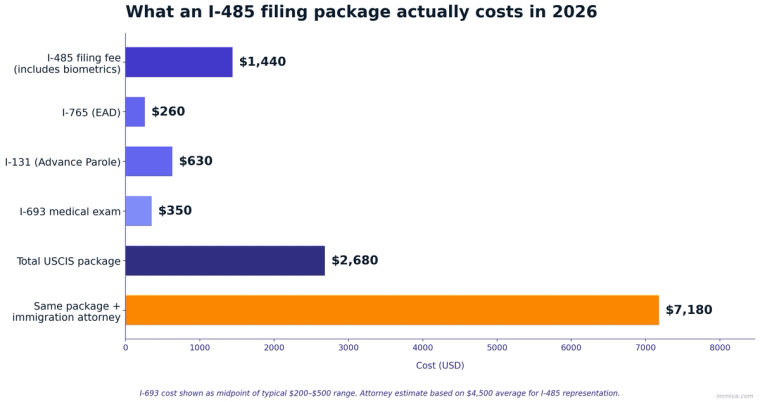
A typical single-applicant I-485 filing package (with I-765 and I-131) costs about $2,680 in USCIS fees and medical exam costs, before any legal help. Adding an immigration attorney typically pushes the total to $7,000+.
Form I-765 (EAD), $260 when filed while a fee-paid Form I-485 remains pending. Processing times vary by category and office. For adjustment applicants in category (c)(9), EADs issued on or after December 5, 2025 are valid for a maximum of 18 months, and renewals filed on or after October 30, 2025 no longer receive an automatic extension.
Form I-131 (Advance Parole), $630. Generally, if you leave the United States while Form I-485 is pending without advance parole, USCIS will consider the I-485 abandoned, but there are narrow exceptions for certain nonimmigrants, including some people returning in valid H, L, V, or K-3/K-4 status. Processing times vary by form type and office, so applicants should check the current USCIS processing-times tool.
Form I-864 (Affidavit of Support), no fee when filed with the I-485. Required for all family-based cases and a few employment-based ones.
Combo card status. USCIS often issues the EAD and Advance Parole as separate documents now, so plan for two documents arriving on separate timelines: a plastic EAD card for work and a paper Advance Parole document for travel.
Traditional immigration attorneys charge $3,000 to $6,000 to prepare and file an I-485 packet. Plenty of applicants prepare the forms themselves once they have a clear checklist. If you want that work checked as you go, Immiva builds the forms from one set of answers, runs automated checks on every answer, and flags the ones that most often trigger an RFE before you file. It covers several USCIS forms today, with more being added.
How to organize and assemble your I-485 package
Lockbox staff process thousands of packets a day. A clean, organized package gets through intake faster and cuts down on misrouted documents.
Use paper clips, not staples. USCIS scans every page. Staples slow that down and damage documents. Binder clips for thicker stacks are fine.
Lead with a cover letter that lists every form, every supporting document, and every fee enclosed. A simple table-of-contents format works well: "Tab 1: Form I-485; Tab 2: G-1450 fee authorization; Tab 3: passport photos," and so on.
Stack in this order: the cover letter on top, then G-1145 (e-notification request), then G-1450 or G-1650 (fee payment), then Form I-485, then the sealed I-693 envelope (do not open), then identity documents (passport ID page, photos), then birth certificate and translation, then I-94 and passport pages, then the underlying petition (I-130 or I-140) approval, then status maintenance evidence, then category-specific documents (I-864 for family; Supplement J and employment letter for EB), then court and police records if any.
Do not use binders, three-ring folders, or plastic sleeves. They get returned. Just a flat, paper-clipped stack.
Write your A-Number on every page if you have one. (For background on what an A-Number is and how to find yours, see our A-Number explainer.)
Use USPS Priority Mail with tracking or FedEx/UPS to the appropriate USCIS lockbox. The mailing address depends on your category and where you live, so check the USCIS I-485 direct filing addresses right before you mail.
Seven document mistakes that trigger most I-485 RFEs
Roughly 35% of all I-485 RFEs trace back to medical exam issues, and another 25% to employment or sponsor documentation. These seven mistakes account for the bulk of them.
- Filing without a sealed I-693, or with an I-693 envelope that has been opened. Both result in rejection or RFE under the December 2024 rule.
- Employment verification letter missing required details. USCIS expects job title, duties, start date, salary, and confirmation of permanent full-time status. Generic "to whom it may concern" letters from HR are not enough.
- Incomplete I-864 documentation. Sending the I-864 form without the sponsor's tax transcript, W-2s, and proof of citizenship is the #1 family-based RFE trigger.
- Short-form birth certificate. USCIS wants the long-form version that lists both parents' names. If only a short form is available in your country, you also need a secondary evidence affidavit.
- Improperly certified translations. Every foreign-language document needs a complete English translation plus a translator's signed certification attesting that the translation is complete and accurate and that the translator is competent to translate the document into English.
- Insufficient bona fide marriage evidence in marriage-based cases. Officers want to see joint financial life across multiple categories and dates, not just a marriage certificate and one bank statement.
- Failing to disclose old criminal records. Even charges that were dismissed, expunged, or sealed have to be disclosed. Old arrests show up on the FBI background check that USCIS runs anyway, and the missing disclosure becomes a credibility issue.
Build a packet that covers all 12 universal documents, add your category-specific evidence, and assemble it cleanly, and you skip the most common rejection paths. That is the whole point of working from an I-485 document checklist rather than a generic article. These errors are also the kind of thing structured software is good at catching: a checklist that knows what category you are filing under, what supporting documents your specific situation needs, and what looks missing. Immiva's guided self-filing does this for the USCIS forms it currently supports, and adds new forms over time.
Frequently Asked Questions
Photocopies for everything except the I-693 medical exam (which has to be in its original sealed envelope). Bring originals to your I-485 interview later, but do not mail them with the initial packet.
No. Since December 2, 2024, you have to include the sealed I-693 with your initial filing. USCIS rejects packets that arrive without it (USCIS I-693 alert).
For any I-693 signed on or after November 1, 2023, the form is valid only while the specific I-485 it accompanies is pending. There is no calendar expiration date during that pending period, but if your I-485 is denied or withdrawn, the I-693 cannot be reused for a future application. For forms signed before November 1, 2023, the old two-year rule applies.
Bank statements are not on the universal checklist, but they show up as supporting evidence in two places: (1) joint bank statements as part of bona fide marriage evidence, and (2) sponsor or applicant assets to supplement income on Form I-864.
The I-485 filing fee itself is $1,440 (or $950 for children under 14 filing with at least one parent), and biometrics are included. Most applicants also pay $260 for I-765 (EAD) and $630 for I-131 (Advance Parole), plus $200 to $500 for the I-693 medical exam. Total package usually lands between $2,530 and $2,830 (USCIS Fee Schedule).
Generally no for standard paper filings: since October 28, 2025, USCIS generally requires card payment via Form G-1450 or ACH via Form G-1650 for mailed filings, unless you qualify for an exemption to the electronic-payment requirement or fall within a limited exception such as certain in-person emergency advance parole filings.
Usually not. Form I-864 is required for family-based cases and a small subset of employment-based cases involving relatives of the petitioning employer. Most EB-1, EB-2, and EB-3 self-supporting applicants do not file I-864.
Supplement J confirms that the underlying job offer in your I-140 is still valid, or it requests AC21 portability to a new employer if you have switched jobs after your I-485 has been pending 180 days or more. It is generally required when Form I-485 is based on a previously filed Form I-140 or when you request job portability under INA section 204(j), but it is not required when you file Form I-485 together with Form I-140, and it is not required for EB-1A or EB-2 NIW self-petitioners.