

The first thing people want is one number. There isn't one. The phrase covers a $900 naturalization case and a $25,000 removal defense, and two firms can quote the same filing thousands of dollars apart depending on the city and how much work they include.
So here is a plain breakdown of what attorneys actually charge in 2026 for the filings most people are budgeting for: family petitions, green cards, removing conditions on a green card, citizenship, and work permits. It also covers the part most fee guides skip: what a flat fee does not cover, and how to tell whether your own case needs legal advice at all.
Immiva is not a law firm and this is not legal advice. Some cases genuinely need an attorney, and this guide says so plainly, because a cost comparison that pretends otherwise is worthless to you. If you already know your case is complicated, the section on when a lawyer is worth every dollar is the one you want.
What an immigration lawyer costs in 2026
These are the flat-fee ranges published by U.S. immigration firms in 2026. They are attorney fees only. Government filing fees are separate and are covered further down.
| Case type | Typical attorney fee | High end |
|---|---|---|
| N-400 naturalization | $750 to $2,500 | $2,800 |
| I-130 family petition (on its own) | $1,500 to $2,500 | $3,500 |
| I-130 plus I-485 marriage green card | $2,500 to $5,000 | $8,000 |
| I-751 removal of conditions, joint filing | $1,500 to $2,500 | $3,000 |
| I-751 waiver after divorce, abuse, or death | $2,250 to $4,000 | $5,000 |
| I-765 work permit on its own | $450 to $1,000 | $1,500 |
| H-4 or J-2 work permit | $500 to $1,000 | $1,500 |
| I-601 or I-601A waiver | $2,200 to $5,500 | $7,000 |
| Removal or deportation defense | $5,000 to $15,000 | $25,000 |
Some attorneys bill hourly instead, generally $200 to $500 an hour, occasionally up to $600 for specialised work. Hourly makes sense for a one-off consultation or a genuinely complex matter. It makes budgeting harder, so if you want a ceiling, ask for a written flat fee.
Where you live moves these numbers more than most people expect. The same clean marriage green card case can cost twice as much in New York, Los Angeles, or San Francisco as it does in a mid-size market. Consultations run from free to about $300, and many firms credit that amount toward the case if you hire them.
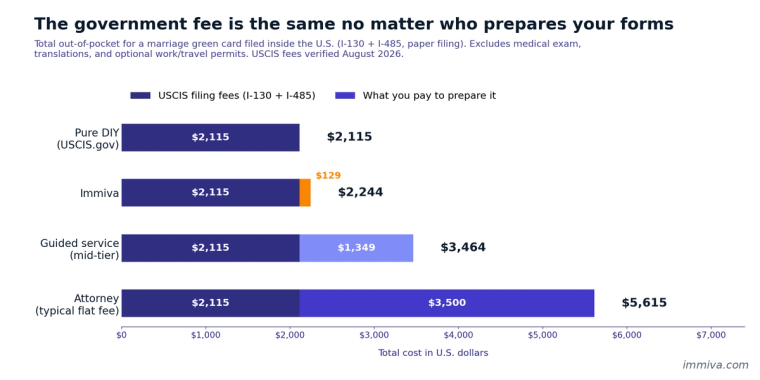
The USCIS fee is fixed at $2,115 for a marriage green card filed inside the U.S. The only part that changes is what you pay someone to prepare it.
What the flat fee does and does not cover
This is where quotes stop being comparable. A flat fee normally covers the consultation, preparing the forms, reviewing your documents, assembling the package, and filing it.
It usually does not cover the USCIS filing fee, the medical exam, translations, credential evaluations, or shipping. Worse, it often does not cover the three things most likely to happen after you file:
- Responding to a Request for Evidence. Published 2026 fee schedules show RFE responses billed separately, commonly $650 to $1,450, and more for complicated issues.
- Attending your interview. Interview attendance is frequently an add-on of roughly $600 to $1,000, with interview preparation billed on top of that.
- Appeals or motions after a denial. Usually a fresh engagement, often $2,650 and up.
Ask this before you pay anyone: if USCIS sends a Request for Evidence, is the response included in this fee, or is it billed separately? The answer separates a $2,000 quote from a real $2,000 quote.
A low quote is not automatically the better deal. Some firms price low because they only prepare forms and hand the rest back to you. That is a legitimate service, but at that point you are paying attorney rates for form preparation, which is worth knowing before you sign.
The three ways to file
Almost everyone ends up in one of three places.
Do it yourself. The forms and instructions are free on USCIS.gov. You pay only the government fee. This works if your case is routine and you are willing to read carefully. The risk is that nothing checks your work, and USCIS does not call you to clarify a blank field. It rejects the package or issues an RFE.
Guided preparation. Software walks you through the questions in plain English, runs the same checks on every answer, and produces a filing-ready packet for a flat fee. It does not give legal advice, and a good one tells you when your facts call for a lawyer.
Hire an attorney. You get legal judgment, someone who can spot a problem you did not know you had, and representation on the record. That is what the fee is for, and for a case with real complications it is money well spent.
Immiva prepares and checks forms for supported applications, with one-time preparation fees starting at $99. Each application has its own price.
Form by form: the fee, the work, and the cheaper route
N-400 citizenship
Attorneys typically charge $750 to $2,500. For a green card holder with five clean years, stable travel, and filed taxes, most of that fee is form preparation and a check on your dates.
The dates are where people slip. Miscounting days outside the U.S. is one of the most common reasons a naturalization case goes wrong, which is why a continuous residence calculator is worth running before you file anything. If you have arrests, unpaid taxes, a long trip abroad, or a criminal record question, pay for legal advice first. See our full N-400 cost breakdown and the guide to filing N-400 without a lawyer for the detail.
I-130 and I-485 marriage green card
The most expensive common filing, at $2,500 to $5,000 and up to $8,000 when there are complications. It is also the most paperwork: a petition, an adjustment application, an affidavit of support, a medical exam, and often work and travel permits too.
For a well-documented couple with no immigration history problems, this is a large fee for careful assembly. For a couple with an overstay, an old visa refusal, or thin evidence of a shared life, it is not. Our guides on the I-130 filing fee, adjustment of status, and filing the I-485 with the I-864 cover the mechanics. The sponsor income calculator tells you whether your household meets the threshold before you start.
I-751 removal of conditions
A joint filing runs $1,500 to $2,500. A waiver filing after divorce, abuse, or the death of a spouse runs $2,250 to $4,000 or more, and the gap is not arbitrary. A joint I-751 is an evidence exercise. A waiver is a legal argument about a difficult situation, and that is genuinely attorney work.
If you are filing jointly with a normal paper trail of a shared life, read the joint filing versus waiver comparison and the I-751 guide. If you are filing a waiver, talk to a lawyer.
H-4, J-2, and other work permits
The smallest fees, at $450 to $1,500, and the filings where an attorney adds the least on a clean case. Eligibility depends almost entirely on the principal's status, so the thing to check is whether that status is in order, not whether the I-765 is filled in correctly.
Timing is the risk now, not the form. See H-4 EAD without a lawyer, the H-4 EAD cost breakdown, and for students, whether OPT needs a lawyer.
USCIS filing fees are separate from all of this
No preparer, lawyer or otherwise, can reduce the government fee. These are the 2026 amounts, verified in August 2026 against the USCIS fee schedule and filing fees page:
| Form | Paper | Online |
|---|---|---|
| I-130 petition for a relative | $675 | $625 |
| I-485 adjustment of status (age 14+) | $1,440 | $1,390 |
| N-400 naturalization | $760 | $710 |
| I-751 removal of conditions | $750 | $700 |
| I-765 work permit | $520 | $470 |
| I-765 filed with a pending I-485 | $260 | $260 |
| I-131 advance parole | $630 | $580 |
The $50 online discount applies to most forms that can be filed online, so where online filing is open to your category the I-485 is $1,390 and the I-131 is $580. Online filing is not offered for every category, so check yours before assuming the lower figure. Biometrics are bundled into these amounts now, so there is no separate $85 charge. A child under 14 filing an I-485 alongside a parent pays $950 on paper or $900 online. Filing the work permit with your I-485 drops it from $520 to $260, and that reduced rate does not take a further online discount. And the N-400 has a reduced $380 fee for households at or below 400% of the Federal Poverty Guidelines, plus a full fee waiver for those who qualify on Form I-912.
Always confirm your exact amount on the USCIS fee calculator before you pay. Wrong payment is a rejection, not a correction.
What changed in 2025 and 2026 that most cost guides get wrong
This matters because a stale guide can cost you real money. As of this writing, well-ranked 2026 pages are still quoting the I-130 at $535 and the I-485 at $1,140, figures that expired in April 2024. Budget from those and you underpay by roughly $475 and get your package returned.
Four changes worth checking your sources against:
USCIS stopped accepting checks and money orders on October 28, 2025. Payment is now by credit card on Form G-1450 or bank debit on Form G-1650. Any guide telling you to make a check payable to the Department of Homeland Security is out of date. See how to pay USCIS filing fees and our note on the change.
The automatic EAD extension was eliminated for renewals filed on or after October 30, 2025 (Federal Register). Work authorisation now ends the day your card expires. Filing early is the whole strategy, as covered in H-4 EAD renewal in 2026.
New I-539 and I-765 editions take effect September 15, 2026, with no grace period. USCIS will reject the older editions from that date (USCIS forms updates). We covered the detail in the September 15 changes.
The naturalization civics test changed on October 20, 2025. Applicants filing after that date answer 12 of 20 questions from a 128-question pool, not 6 of 10 from 100.
As Immiva we think this is reason enough to check the date on any cost guide you read, including a lawyer's own fee page. If the fees are stale, assume the procedure advice is too.
When a lawyer is worth every dollar
Representation matters far more in some settings than in others, and the difference is not about how hard the form is.
In immigration court it is decisive. Analysis of Executive Office for Immigration Review data by TRAC found asylum seekers with representation succeeded at roughly 49%, against about 18% for those without. If you are in removal proceedings, this is not a budgeting question.
For affirmative filings the picture is different. A lawyer does not make USCIS decide faster, does not get your case looked at more favourably, and Form G-28 is optional. What you are buying is judgment: someone who recognises that your 2014 dismissed arrest still has to be disclosed, or that the trip you took in 2023 broke your continuous residence.
So the useful question is not whether you can fill in the form. It is whether your case contains a fact that changes the right answer.
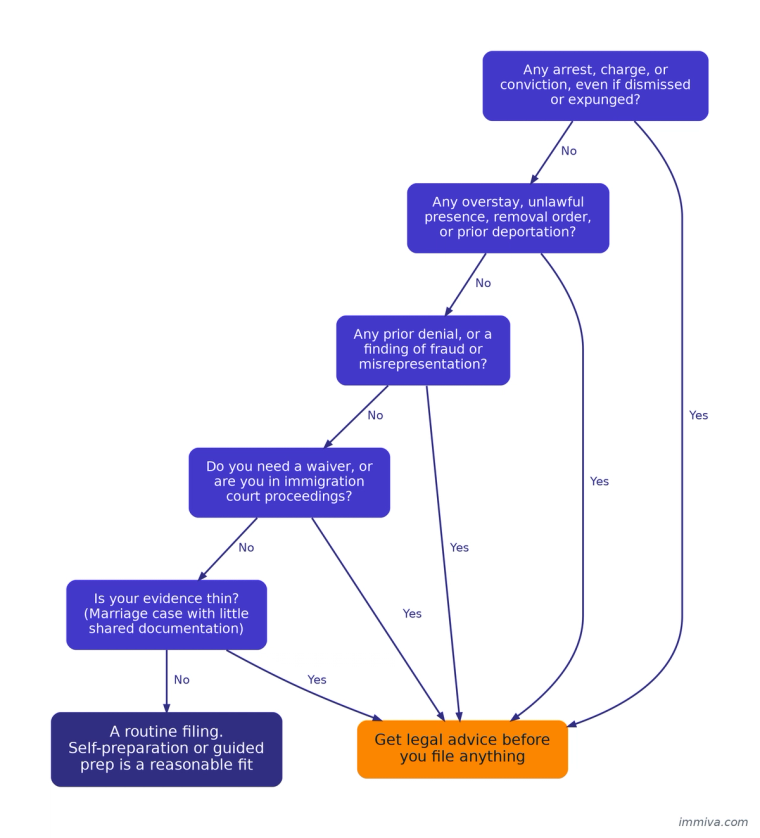
Five questions that separate a routine filing from one that needs legal advice before anything is submitted.
Get legal advice before filing if you have an arrest or conviction of any kind, a prior overstay or removal order, a previous denial or finding of misrepresentation, a need for a waiver, a marriage case with little shared documentation, or a pending court matter. An overstay before adjusting status is a particularly common one people underestimate.
If none of those apply, guided preparation does the same work an attorney would bill $2,000 for: checking the answers rather than arguing a position.
Free and low-cost help, and how to avoid getting scammed
Paying a private attorney is not the only route.
Non-profit organisations recognised by the Department of Justice employ accredited representatives who are not attorneys but may represent you before USCIS, and in some cases in immigration court. Fees at these organisations are modest, often $20 to $500, and sometimes free. Two places to search: the DOJ roster of recognised organisations and ImmigrationLawHelp.org. Law school clinics and legal aid offices are also worth calling.
A warning that matters. In the United States a notary public cannot give legal advice. In many countries a "notario" is a trained lawyer, and scammers exploit that mismatch. Only a licensed attorney or a DOJ-accredited representative may advise you or represent you. Warning signs are a guaranteed outcome, a request to sign a blank form, and a refusal to give you copies of what was filed on your behalf. USCIS explains how to avoid immigration scams, and you can report fraud to the EOIR Fraud and Abuse Prevention Program.
The short version
The immigration lawyer cost you should expect in 2026 runs from about $750 for a clean naturalization case to $5,000 or more for a marriage green card, with the USCIS fee on top either way. Whether that is money well spent depends on one thing: whether your case has a complication in it. If it does, hire someone. If it does not, you are mostly paying for careful data entry, and there are cheaper ways to get that done properly.