
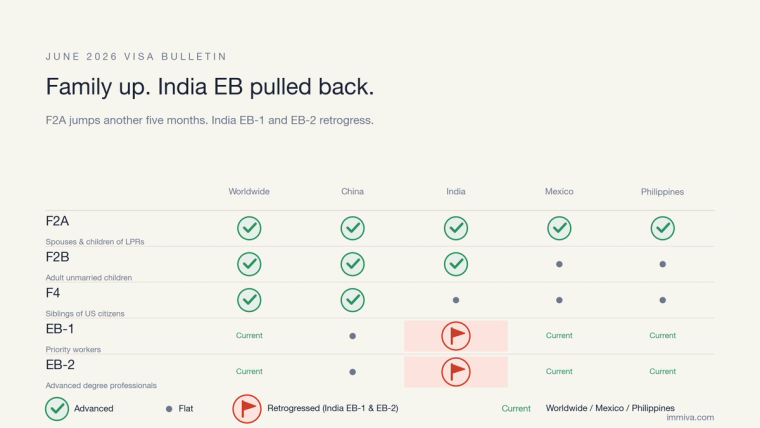
The State Department released the June 2026 Visa Bulletin in mid-May 2026, and a lot of India applicants saw this one coming. India EB-1 and EB-2 both moved backward under Final Action Dates. Family categories went the other way, with F2A picking up another five months. Family is still moving. The top employment categories for India just gave back ground.
The wider backdrop hasn't really changed. Presidential Proclamations 10949 and 10998, plus the updated immigrant visa processing guidance for certain nationalities, are still cutting consular visa issuances overseas, and unused numbers get pushed to other categories. What's different this month is demand. The May bulletin flagged India EB-5 as a risk. The June bulletin actually pulled India EB-1 and EB-2 back to keep issuances inside the FY2026 annual limit.
If you want a quick refresher on how priority dates and the bulletin work before reading on, our complete visa bulletin guide covers the mechanics.
What changed this month
Family categories advanced. India's top employment categories retrogressed. The month-over-month changes look like this.
Family-Sponsored Month-Over-Month Changes:
| Category | Country | May 2026 | June 2026 | Change |
|---|---|---|---|---|
| F2A | Worldwide | Aug 1, 2024 | Jan 1, 2025 | +5 months |
| F2A | China | Aug 1, 2024 | Jan 1, 2025 | +5 months |
| F2A | India | Aug 1, 2024 | Jan 1, 2025 | +5 months |
| F2A | Mexico | Aug 1, 2023 | Jan 1, 2024 | +5 months |
| F2A | Philippines | Aug 1, 2024 | Jan 1, 2025 | +5 months |
| F2B | Worldwide | May 22, 2017 | Sep 22, 2017 | +4 months |
| F2B | China | May 22, 2017 | Sep 22, 2017 | +4 months |
| F2B | India | May 22, 2017 | Sep 22, 2017 | +4 months |
| F1 | Mexico | Aug 15, 2007 | Nov 8, 2007 | +~3 months |
| F4 | Worldwide | Sep 15, 2008 | Nov 8, 2008 | +~2 months |
| F4 | China | Sep 15, 2008 | Nov 8, 2008 | +~2 months |
Employment-Based Month-Over-Month Changes:
| Category | Country | May 2026 | June 2026 | Change |
|---|---|---|---|---|
| EB-2 | India | Jul 15, 2014 | Sep 1, 2013 | -~10.5 months (retrogression) |
| EB-1 | India | Apr 1, 2023 | Dec 15, 2022 | -~3.5 months (retrogression) |
| Other Workers | China | Feb 1, 2019 | Apr 1, 2019 | +2 months |
| EB-3 | China | Jun 15, 2021 | Aug 1, 2021 | +~1.5 months |
| EB-3 | India | Nov 15, 2013 | Dec 15, 2013 | +1 month |
| Other Workers | India | Nov 15, 2013 | Dec 15, 2013 | +1 month |
Family-sponsored categories: all Final Action Dates
| Category | Worldwide | China | India | Mexico | Philippines |
|---|---|---|---|---|---|
| F1 | Sep 1, 2017 | Sep 1, 2017 | Sep 1, 2017 | Nov 8, 2007 | May 1, 2013 |
| F2A | Jan 1, 2025 | Jan 1, 2025 | Jan 1, 2025 | Jan 1, 2024 | Jan 1, 2025 |
| F2B | Sep 22, 2017 | Sep 22, 2017 | Sep 22, 2017 | Feb 15, 2009 | Apr 8, 2013 |
| F3 | Feb 15, 2012 | Feb 15, 2012 | Feb 15, 2012 | May 1, 2001 | Nov 22, 2005 |
| F4 | Nov 8, 2008 | Nov 8, 2008 | Nov 1, 2006 | Apr 8, 2001 | Jul 15, 2007 |
F2A: another five months forward
F2A is the family headline again. It moved from August 1, 2024 to January 1, 2025 for worldwide, China, India, and Philippines applicants. Mexico F2A went from August 1, 2023 to January 1, 2024. That's five months for everyone, on top of the six-month jump in May.
One thing worth knowing about how F2A numbers get allocated this month. For June, F2A numbers exempt from the per-country limit are available to applicants from all countries with priority dates before January 1, 2024. F2A numbers subject to the per-country limit are available for every country except Mexico with priority dates from January 1, 2024 through January 1, 2025. All F2A numbers for Mexico are exempt from the per-country limit.
Why does this matter? F2A covers the spouse and minor children of lawful permanent residents. Two big jumps in two months means a lot more families have a current priority date and can push their green card applications forward.
F2B and F4: more gains
F2B (unmarried sons and daughters of permanent residents, age 21+) moved four months for worldwide, China, and India, from May 22, 2017 to September 22, 2017. This is the category catching up after sitting still in May. Mexico and Philippines F2B didn't move.
F4 (brothers and sisters of adult U.S. citizens) advanced about two months for worldwide and China, from September 15, 2008 to November 8, 2008. India, Mexico, and Philippines F4 held flat. F1 (unmarried sons and daughters of U.S. citizens) gained about three months for Mexico but stayed put worldwide. F3 (married sons and daughters of U.S. citizens) didn't move anywhere.
If a misfiled family petition is what's holding you back, that's a common and avoidable problem. Immiva walks you through Form I-130 question by question and flags the errors that get petitions rejected. Tracking a petition that's already filed? Our I-130 petition guide explains each stage, and our I-130 processing time breakdown has realistic timelines.
Employment-based categories: all Final Action Dates
| Category | Worldwide | China | India | Mexico | Philippines |
|---|---|---|---|---|---|
| EB-1 | Current | Apr 1, 2023 | Dec 15, 2022 | Current | Current |
| EB-2 | Current | Sep 1, 2021 | Sep 1, 2013 | Current | Current |
| EB-3 | Jun 1, 2024 | Aug 1, 2021 | Dec 15, 2013 | Jun 1, 2024 | Aug 1, 2023 |
| Other Workers | Feb 1, 2022 | Apr 1, 2019 | Dec 15, 2013 | Feb 1, 2022 | Nov 1, 2021 |
| EB-4 | Jul 15, 2022 | Jul 15, 2022 | Jul 15, 2022 | Jul 15, 2022 | Jul 15, 2022 |
| Religious Workers | Jul 15, 2022 | Jul 15, 2022 | Jul 15, 2022 | Jul 15, 2022 | Jul 15, 2022 |
| EB-5 Unreserved | Current | Sep 22, 2016 | May 1, 2022 | Current | Current |
| EB-5 Rural | Current | Current | Current | Current | Current |
| EB-5 High Unemployment | Current | Current | Current | Current | Current |
| EB-5 Infrastructure | Current | Current | Current | Current | Current |
India EB-1 and EB-2: the retrogression
This is the headline of the month. India EB-2 retrogressed from July 15, 2014 to September 1, 2013, a step backward of about ten and a half months. India EB-1 moved back from April 1, 2023 to December 15, 2022, roughly three and a half months. Section E of the June bulletin spells out the reason: high demand and number use by India applicants in EB-1 and EB-2 forced the State Department to retrogress these dates to keep issuances within the FY2026 annual limit. The bulletin warns that further retrogression, or making the categories unavailable, may be necessary before the fiscal year ends on September 30.
This is how the system corrects itself. When dates advance and a wave of cases becomes eligible, demand can outrun the supply of visa numbers. The per-country limit under INA Section 202 caps each country at 7% of the annual total, and India runs into that wall harder than anyone because of the employment-based green card backlog.
There is one important nuance. The retrogression is on the Final Action Dates chart. The Dates for Filing chart for India EB-1 and EB-2 held steady at December 1, 2023 and January 15, 2015. So if USCIS allows the Dates for Filing chart in June, the retrogression on Final Action Dates may not change when you can file. It changes when a visa number can actually be assigned to your case. If you have a pending employment-based I-485 for India, that distinction matters a lot.
EB-3 and Other Workers: small gains
Not all the employment news was backward. EB-3 China nudged forward about six weeks to August 1, 2021, and EB-3 India gained a month to December 15, 2013. Other Workers China advanced two months to April 1, 2019, and Other Workers India gained a month to December 15, 2013. EB-3 and Other Workers for worldwide, Mexico, and Philippines all held steady.
EB-1 and EB-2 for worldwide, Mexico, and Philippines stayed Current. EB-2 China held at September 1, 2021. The EB-5 set-aside categories (Rural, High Unemployment, Infrastructure) stayed Current for every country, and EB-5 Unreserved was unchanged at September 22, 2016 for China and May 1, 2022 for India.
New China and Philippines warnings
The June bulletin added two fresh warnings beyond India. Section F flags that rising demand from China in EB-2 may force the State Department to retrogress that date or make it unavailable later this year. Section G says the same about EB-3 for the Philippines. And the India EB-5 Unreserved warning from May carried forward into June as Section H. These aren't retrogressions yet. They're early notice that more pullbacks could come before September 30.
Which chart should you use in June?
USCIS decides each month whether you can use the Dates for Filing chart or have to use Final Action Dates. Check USCIS.gov/visabulletininfo at the start of June to see which one applies.
If USCIS allows the Dates for Filing chart, the employment-based dates are:
| Category | Worldwide | China | India | Mexico | Philippines |
|---|---|---|---|---|---|
| EB-1 | Current | Dec 1, 2023 | Dec 1, 2023 | Current | Current |
| EB-2 | Current | Jan 1, 2022 | Jan 15, 2015 | Current | Current |
| EB-3 | Current | Jan 1, 2022 | Jan 15, 2015 | Current | Jan 1, 2024 |
| Other Workers | Aug 1, 2022 | Oct 1, 2019 | Jan 15, 2015 | Aug 1, 2022 | Aug 1, 2022 |
| EB-4 | Jan 1, 2023 | Jan 1, 2023 | Jan 1, 2023 | Jan 1, 2023 | Jan 1, 2023 |
| Religious Workers | Jan 1, 2023 | Jan 1, 2023 | Jan 1, 2023 | Jan 1, 2023 | Jan 1, 2023 |
| EB-5 Unreserved | Current | Mar 1, 2017 | May 1, 2024 | Current | Current |
| EB-5 Set-Asides | Current | Current | Current | Current | Current |
The employment Dates for Filing chart didn't change at all from May to June. That's the chart to watch if you're an India EB-1 or EB-2 applicant, because it held steady even as Final Action Dates moved back.
For family-sponsored Dates for Filing in June:
| Category | Worldwide | China | India | Mexico | Philippines |
|---|---|---|---|---|---|
| F1 | Oct 1, 2018 | Oct 1, 2018 | Oct 1, 2018 | Oct 1, 2008 | Apr 22, 2015 |
| F2A | Current | Current | Current | Current | Current |
| F2B | Mar 22, 2018 | Mar 22, 2018 | Mar 22, 2018 | May 15, 2010 | Oct 1, 2013 |
| F3 | Dec 8, 2012 | Dec 8, 2012 | Dec 8, 2012 | Jul 15, 2001 | Aug 8, 2006 |
| F4 | Dec 22, 2009 | Dec 22, 2009 | Dec 15, 2006 | Apr 30, 2001 | Mar 22, 2008 |
F2A stays fully Current on the Dates for Filing chart. F2B and F4 both advanced on this chart too. If USCIS allows the chart, any F2A applicant can file I-485 regardless of priority date and get an EAD (work permit) and Advance Parole while they wait.
Why did India retrogress?
The short answer is that demand caught up with the dates. After months of forward movement, enough India cases became eligible that demand passed the supply of numbers available under India's 7% per-country share, so the State Department pulled the line back to stay inside the FY2026 limit. The administration actions that cut consular issuances overseas (Presidential Proclamations 10949 and 10998 and the updated immigrant visa processing guidance) redirect some unused numbers, but they cannot lift a per-country cap.
Your priority date is current. Now what?
It's worth confirming first. Enter your priority date in the bulletin checker to see whether a number is available for your category and country this month.
If you're in the U.S.: File Form I-485 with USCIS. Include your medical exam (Form I-693), identity documents, and the underlying petition materials. For employment-based cases, confirm your I-140 is approved and that your job offer still stands. Our step-by-step I-485 guide covers the full process.
If you're abroad: The National Visa Center handles scheduling for consular immigrant visa interviews. Processing times vary, since the same proclamations that affect domestic dates also affect consular operations.
If you already filed I-485: Check your USCIS case status, make sure your address is current, and verify that your medical exam hasn't expired. A retrogression after you filed doesn't undo your pending application.
For permanent residents watching the family categories, the 3-year naturalization rule might let you apply for citizenship sooner if you're married to a U.S. citizen. Naturalizing moves your family members from preference categories to Immediate Relatives with no visa wait.
Diversity Visa (DV) Lottery update
For June, DV-2026 numbers are available with these regional cutoffs: Africa 55,000 (Algeria 37,000, Egypt 30,000), Asia 35,000 (Nepal 11,000), Europe 20,000, North America (Bahamas) 50, Oceania 1,500, South America and Caribbean 3,000. The one change from May is Nepal moving from 10,000 to 11,000, which the May bulletin had previewed.
The bulletin also previews July cutoffs, and they jump in several regions: Algeria 40,000, Egypt 31,000, Nepal 13,000, Europe 23,000, Oceania 1,700, and South America and Caribbean 3,300.
DV-2026 entitlement expires September 30, 2026. Numbers could run out before then. If you were selected in the DV-2026 lottery and haven't finished processing, don't wait. The DV-2026 annual limit has been cut to about 52,000 because of NACARA and NDAA provisions.
For passport requirements for the DV lottery, see our DV Lottery 2027 passport requirement guide.
What to expect for July 2026
The fiscal year ends September 30, 2026, leaving the State Department three more bulletins to hand out what's left of FY2026 visa numbers. A few things worth watching.
More India retrogression is possible. Section E says it plainly. If India demand in EB-1 and EB-2 keeps running high, dates could move back further or the categories could go unavailable before September 30.
China EB-2 and Philippines EB-3 are the new wildcards. The June bulletin added specific warnings for both. Either could retrogress in July or August if demand comes in faster than expected.
Family categories may keep advancing. F2A has now jumped eleven months across two bulletins, and the Dates for Filing chart is already Current. That suggests room left in the family allocation.
The DV lottery is running out of runway. With July cutoffs rising and the year ending September 30, DV-2026 selectees have a narrowing window to finish.
The July 2026 bulletin should come out in mid-June. To follow the trend, our May 2026 visa bulletin analysis, April 2026 analysis, and March 2026 analysis are a good place to start. For a full explanation of how the system works, our complete visa bulletin guide covers it.
Frequently Asked Questions
India EB-1 and EB-2 retrogressed under Final Action Dates. EB-2 India moved back about ten and a half months to September 1, 2013, and EB-1 India moved back about three and a half months to December 15, 2022. On the family side, F2A advanced another five months to January 1, 2025 for almost every country. Always check USCIS.gov/visabulletininfo to see which chart applies.
Demand from India applicants in those categories ran high enough that the State Department had to retrogress the Final Action Dates to keep issuances within the FY2026 annual limit. The June bulletin explains this in Section E. Per-country limits under INA Section 202 cap India at 7% of the annual total, which is why India retrogresses while worldwide stays Current.
No. A pending I-485 stays pending even if your category retrogresses afterward. You keep your work permit and travel document while you wait. USCIS just can't approve the case and assign a visa number until your priority date is current again under Final Action Dates.
It depends on which chart USCIS allows for June. The Dates for Filing chart for India EB-1 and EB-2 held steady at December 1, 2023 and January 15, 2015, so if USCIS lets you use that chart, you may still be able to file. Check USCIS.gov/visabulletininfo before you submit, and see our employment-based I-485 guide for the details.
Final Action Dates tell you when your green card application can actually be approved and a visa number assigned. Dates for Filing tell you when you can submit your I-485 to USCIS. USCIS decides each month which chart applies. Filing early under the Dates for Filing chart lets you get an EAD work permit and Advance Parole while you wait. Always check USCIS.gov/visabulletininfo.
Your priority date is on your I-797 approval notice. For employment-based cases, it's usually when your PERM labor certification was filed. For family-based cases, it's when your I-130 petition was filed. Your A-Number can also help you track your case with USCIS.
USCIS stopped accepting checks and money orders on October 28, 2025. Pay your USCIS filing fees by credit or debit card with Form G-1450, by bank transfer with Form G-1650, or through Pay.gov if you file online.