
Regular OPT gives any F-1 graduate 12 months of work authorization with almost any lawful employer. STEM OPT adds 24 more, but only if your degree is on the DHS STEM list, your employer uses E-Verify, and the two of you file a Form I-983 training plan together. Those conditions are the whole decision, and each one has a cost in practice.
Most guides on this topic were written before one change. On September 15, 2026, DHS replaced the duration of status framework that had governed F-1 admission for three decades. If you are on OPT now, or planning for it, start with that section.
At a glance
| Dimension | Regular (post-completion) OPT | STEM OPT extension |
|---|---|---|
| Duration | 12 months | 24 additional months |
| Maximum per degree level | 12 months | 36 months combined |
| USCIS category | (c)(3)(B) | (c)(3)(C) |
| Governing rule | 8 CFR 214.2(f)(10)(ii) | 8 CFR 214.2(f)(10)(ii)(C) |
| Qualifying degree | Any field, from an SEVP-certified school | On the DHS STEM Designated Degree Program List, or a prior STEM degree within 10 years |
| Earliest filing | 90 days before program end | 90 days before your current EAD expires |
| Unemployment allowed | 90 days | 60 more, 150 days across all 36 months |
| Minimum hours | No strict floor, but under 20 a week is not employment | 20 hours a week, per employer |
| E-Verify employer | Not required | Required, and enrolled before you file |
| Form I-983 | Not required | Required, plus self-evaluations |
| Self-employment, 1099, staffing agency | Allowed if related to your field | Not allowed |
| Unpaid or volunteer work | Counts if 20+ hours and related | Not allowed, must be paid |
| If filed on time and still pending | No automatic extension | Up to 180 days, 8 CFR 274a.12(b)(6)(iv) |
| H-1B lottery attempts, typical | One | Up to three across 36 months |
Who actually qualifies for the extension
Five conditions, and you need all five. You completed a qualifying degree at an SEVP-certified U.S. school. You are currently on valid post-completion OPT, not in a grace period. Your degree appears on the DHS STEM Designated Degree Program List. Your employer is enrolled in and actively using E-Verify. And you have a paid role of at least 20 hours a week that connects directly to that degree and is documented on a Form I-983.
The degree condition is where people are caught out. Eligibility runs on the CIP code your school assigned your program, not on what your diploma says. A degree that sounds technical may not be listed, and one that does not may be. Our guide to STEM OPT eligible degrees and CIP codes explains how to check yours.
You can also rely on an earlier STEM degree from a U.S. school, earned within the previous 10 years, even when your current OPT comes from a non-STEM program, provided the job connects to that earlier degree.
If none of that applies, you have 12 months and should plan around them rather than hope for more. That usually means treating the H-1B cap season during your OPT year as your one attempt, looking at whether a further degree resets your eligibility, or considering employers who sponsor other categories. Twelve months is workable, but the planning has to start early rather than in month ten.
The employer requirement is the real dividing line
Regular OPT barely cares who employs you. Freelance, contract on a 1099, work for your own company, join a two-person startup. As long as the work relates to your field and you clear the hours, it counts.
STEM OPT is far narrower. You need a bona fide employer-employee relationship with a company enrolled in E-Verify, pay comparable to similarly situated U.S. workers, and supervision that matches what the I-983 describes. Self-employment does not qualify. Neither does unpaid work. Staffing agencies, consulting firms placing you at a client site, and sole proprietorships often fail because they cannot demonstrate that relationship.
The most common trap is an employer who is not enrolled in E-Verify but intends to enroll before you start. That does not work. Enrollment must be complete when you file, and your Form I-765 needs the employer's E-Verify company identification number. Our STEM OPT employer requirements guide covers what to ask a prospective employer before you accept.
Form I-983 and the reporting you take on
Regular OPT reporting is light. Tell your DSO within 10 days of any change to your name, address, employer, or employment status. That is essentially all of it.
STEM OPT adds three layers. You and your employer jointly complete a Form I-983 training plan before filing, covering objectives, supervision, how the work relates to your degree, and how you will be assessed. Every six months you confirm with your DSO that your SEVIS record still reflects your name, address, employer, and employment status. And you submit an initial self-evaluation 12 months after the STEM start date and a final one covering the whole 24-month period, each signed by you and your employer.
Missing a validation report puts your status at risk, so treat those dates as hard deadlines. Our section-by-section I-983 guide walks through the form itself.
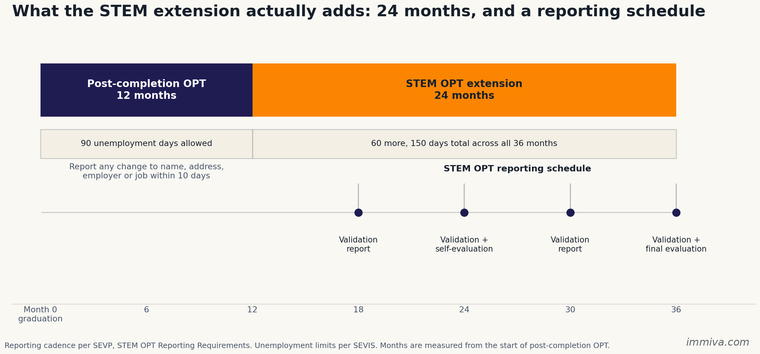
The 36 months side by side, with the reporting schedule the extension brings and the unemployment days you are allowed across each period.
Unemployment days, fees, and processing
Unemployment accrues on any day you are on OPT without qualifying employment. Regular OPT allows 90 days across the 12 months. The extension adds 60, for 150 across the full 36. Exceed the cap and your F-1 status ends. The OPT unemployment rules cover how SEVIS counts them.
Two details catch people. The clock runs from the start date on your EAD, not from the day you begin looking, so a card that arrives late has already spent some of your budget. And days accrued during regular OPT carry forward, so arriving at the extension having used 80 of your 90 leaves you 70 rather than a fresh 150.
Both tracks use the same form. Filing Form I-765 costs $520 on paper or $470 online, and premium processing through Form I-907 is $1,780 for OPT and STEM OPT cases, with USCIS required to act within 30 business days (Form G-1055, edition 05/29/26). Our premium processing breakdown works through whether that is worth paying. For the full cost picture see the I-765 OPT filing fee guide.
If you file a STEM extension on time and your current EAD expires while it is pending, you keep working for up to 180 days under 8 CFR 274a.12(b)(6)(iv). This is a separate provision from the general automatic extension for EAD renewals, which DHS ended on October 30, 2025 (90 FR 48799). The STEM OPT 180-day extension remains in the current regulation.
What changed on September 15, 2026
This is the part most OPT guidance has not caught up with.
DHS published a final rule on July 17, 2026, 91 FR 44976, replacing duration of status for F, J, and I nonimmigrants with a fixed period of admission. It took effect September 15, 2026.
If you are admitted or re-enter on or after that date, your I-94 carries a specific end date rather than D/S: your program length, capped at four years, plus 30 days to arrive and 30 days to depart. Needing longer means filing a Form I-539 extension of stay with USCIS.
If you were already in the United States on duration of status on September 15, 2026, transition provisions apply. You may remain to your I-20 program end date, or the end of your post-completion OPT or STEM OPT that was valid on the effective date, without filing an extension of stay, subject to an outer limit of November 14, 2030 (SEVP).
If you are on OPT or about to file for it, the date that matters most is March 18, 2027. Students in that transition group who timely file Form I-765 for post-completion OPT or STEM OPT on or before that date do not need a separate Form I-539. After it, an OPT or STEM OPT application has to be paired with an extension of stay.
Litigation over the rule was pending as this was written, so confirm the current position with your DSO before you rely on any date here.
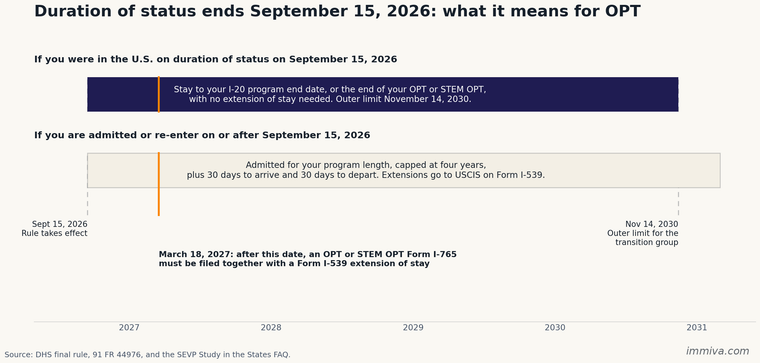
The two groups the September 2026 rule creates, and the two dates that decide whether an OPT filing needs an extension of stay alongside it.
The H-1B arithmetic
The strongest argument for the extension is the lottery. On regular OPT alone you generally get one attempt at the H-1B cap before your authorization runs out. The extension usually buys three across the 36 months. Our H-1B cap recap covers how the selection process works.
Cap-gap still exists. Where your employer files a timely cap-subject petition requesting a change of status and you are otherwise eligible, your F-1 status and work authorization can be bridged to the start of the H-1B validity period. The cap-gap extension guide covers the mechanics and what happens if the petition is denied.
It is worth planning one step further out. If you do reach H-1B and your spouse joins you on H-4, their work authorization is a separate I-765 filing, and Immiva prepares H-4 EAD applications even though it does not handle OPT.