
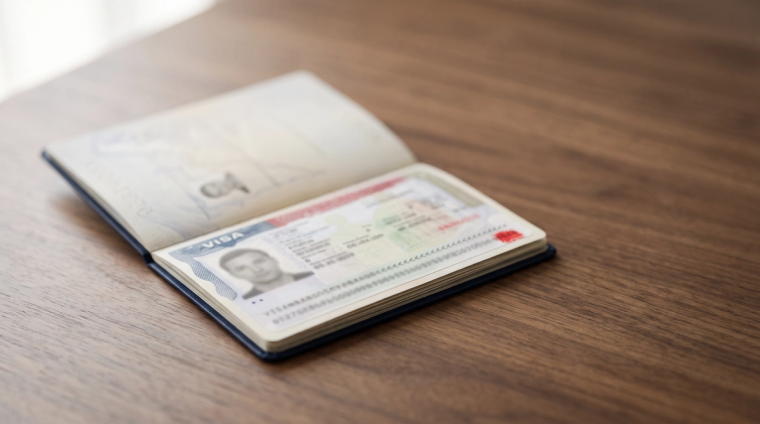
You are halfway through an immigration form, and it wants a "visa number." You flip to the visa page in your passport and find five or six different strings of digits staring back at you. One is your passport number. One runs along the bottom in a long unbroken line. One is printed in a color nothing else on the page uses.
Picking the wrong one is an easy, self-inflicted delay, the same kind of mistake as entering your A-Number where a receipt number belongs or confusing your green card number with a card expiration line.
What a US visa number is and where it sits on the foil
A visa is not a stamp in the informal sense. It is a foil, a printed sticker that a consular officer puts on a page of your passport after approving your application. That foil carries your photo, your visa classification, the issuing post, the issue and expiration dates, an "Entries" field, and several numbers.
The visa number is the one printed in red, toward the lower right of the foil. It is typically eight characters. Most are all digits; some begin with a single letter followed by seven digits. Both are normal.
The red ink is the shortcut. Every other field on the foil prints in black, so if you are looking at something black, it is not your visa number. In particular, that long black string running along the bottom edge of the foil is the machine-readable zone, which border systems scan. It is not the number a form is asking for.
Two things worth knowing about how the number behaves:
Each visa gets its own number. When you renew, the new foil carries a new number. The old number stays attached to the old visa as a historical record, so update it anywhere you have stored it.
A visa in an expired passport stays valid until the foil's printed expiration date, which is why some travelers carry two passports. That date governs how long you may travel to a port of entry, not how long you may stay once admitted (U.S. Department of State). Your authorized stay comes from the admission stamp or Form I-94. While you are checking documents, confirm your passport still meets the six-month validity rule.
The lookalike numbers, and how to tell them apart
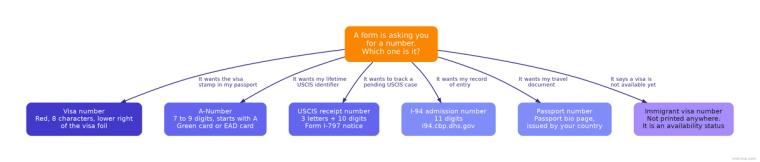
Most of the trouble is that federal immigration paperwork hands you half a dozen identifiers and expects you to keep them straight. They come from different agencies and do different jobs.
| Number | Format | Where it lives | What it identifies |
|---|---|---|---|
| Visa number | 8 characters, red | Lower right of the visa foil | One specific visa issuance |
| Passport number | Varies by country | Passport bio page | Your travel document |
| A-Number | 7 to 9 digits after "A" | Green card, EAD, USCIS notices | You, permanently, in DHS systems |
| USCIS receipt number | 3 letters + 10 digits | Form I-797 notices | One pending USCIS case |
| I-94 admission number | 11 digits | i94.cbp.dhs.gov, or a paper I-94 | One arrival record |
| Control number | Black, on the foil | Elsewhere on the visa | Internal State Department tracking |
The A-Number is a unique seven-, eight-, or nine-digit number that DHS assigns to a noncitizen, and it follows you across every case you ever file (USCIS Glossary). The receipt number is different: it is a 13-character identifier, three letters followed by ten numbers, that USCIS issues per application so it can track that one case (USCIS). And the I-94 admission number is 11 digits tied to a single entry, not to you as a person (USCIS Glossary).
Practical rule: if a form is tracking a document, it wants the visa number or passport number. If it is tracking you, it wants your A-Number. If it is tracking a filing, it wants the receipt number, which is also what you use to check a case status online.
When a form actually asks for it
Fewer forms want the visa number than people assume. The most common place it comes up is Form DS-160, the online nonimmigrant visa application, which asks for the number of your most recent prior US visa under previous travel history (U.S. Department of State). The form's own on-screen help describes it as the red number toward the lower right of the visa stamp, and it offers a "do not know" option if your visa was lost or the foil is illegible.
Beyond that, it comes up when reporting a lost or stolen visa, when an employer or school records your immigration documents, and occasionally on carrier forms. Most USCIS filings do not ask for it at all. They want your A-Number, your receipt number, or your I-94. So before you go hunting for red digits, reread the field label.
The other "visa number," and why it matters more
Here is the part that catches green card applicants off guard. In immigrant visa conversations, "visa number" does not mean anything printed on a foil. It means a slot in an annual quota.
Congress caps how many family-sponsored and employment-based immigrant visas can be issued each year. INA section 201 sets an annual minimum family-sponsored preference limit of 226,000 and a worldwide employment-based level of at least 140,000. Section 202 sets the per-country limit at 7% of those combined totals, which works out to 25,620, with dependent areas capped at 2%, or 7,320 (U.S. Department of State).
When demand in your category and country of chargeability exceeds those limits, a queue forms. The State Department publishes a monthly Visa Bulletin with cut-off dates, and only applicants whose priority date falls earlier than the cut-off can get a number. If an annual limit runs out, the category goes "unavailable" and no more numbers are issued until the next fiscal year.
That is what people mean when they say a visa number is not available. Nothing is missing from your paperwork. The queue has not reached you yet. Our guide to how the Visa Bulletin works walks through the charts, and the Visa Bulletin checker lets you see where your category stands right now. If you are unsure, start by learning how to check whether your priority date is current, and for family cases, how I-130 priority dates feed into the same system.
Once a number is available, the filing itself is the part most people overpay for. Attorneys routinely charge $1,500 to $4,000 to prepare an adjustment of status package. Immiva walks you through Form I-485 question by question for $249, and flags the inconsistencies that trigger a request for evidence before you mail anything.
If the red number is worn or unreadable
Foils fade. Edges rub off in well-traveled passports. If you cannot read yours cleanly:
- Check old paperwork. A saved DS-160 confirmation may still record the number.
- Look for scans. Employers and universities often keep a copy on file.
- Use the form's escape hatch. If it offers "do not know," take it.
- Do not guess a digit. A wrong number causes more delay than an honest blank.
If the foil is physically damaged rather than faded, that is a separate problem: a torn or peeling foil may not scan at the border, so apply for a replacement visa before your next trip.
The short version
Your US visa number is the red, roughly eight-character code near the lower right of your visa foil, unique to that one visa and reissued every time you get a new one. It is not your passport number, your A-Number, your receipt number, or the black machine-readable line. And when someone says a visa number is not available for your category, they mean the annual quota, not anything printed in your passport.