
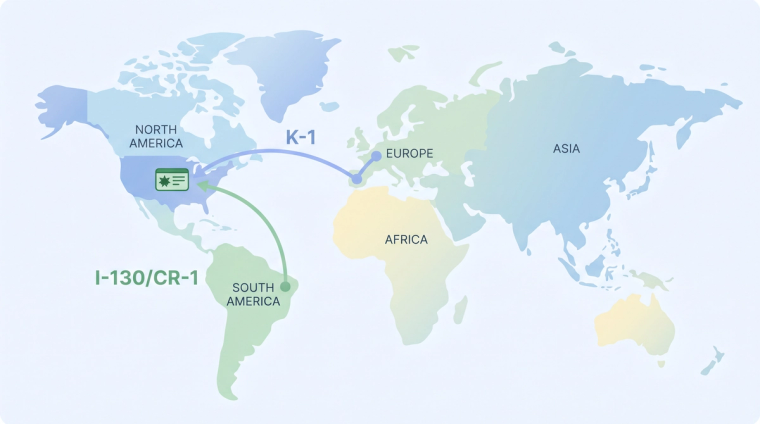
A 2026 cost, timeline, and work-authorization breakdown for engaged and newly married couples choosing between the fiancé visa and the marriage-based green card.
The choice between an I-130 spouse petition and a K-1 fiancé visa usually comes down to a few practical questions: how long each path takes, what each one actually costs in 2026, and how soon the foreign partner can start working in the U.S. The numbers aren't what most couples expect.
Most couples assume the K-1 fiancé visa is faster and cheaper than filing Form I-130 for a marriage-based green card. It isn't either, and the gap got wider after the April 2024 USCIS fee rule unbundled work-permit and travel-document fees from the I-485 adjustment filing.
The I-130 vs K-1 question is really about total time to a green card and when the foreign spouse can start earning. K-1 gets the partner into the U.S. a few months earlier, but the green card itself shows up six to twelve months later than it would on the I-130 consular route, and the partner usually can't work for the first five to nine months after arriving. If you only remember one number, remember this: the K-1 path costs roughly $1,300 to $1,900 more in government fees than filing Form I-130 for your spouse and processing the immigrant visa abroad.
This guide walks through the full comparison so you can pick the path that fits your situation, not the one that has the better reputation.
K-1 and I-130 at a glance: the essential difference
The K-1 and the I-130 are not two flavors of the same thing. They sit in different visa categories, rest on different parts of the statute, get filed at different points in your relationship, and they end with the foreign partner arriving in the U.S. in two very different ways.
The K-1 is a nonimmigrant fiancé(e) visa under INA §101(a)(15)(K). It lets an engaged foreign partner enter the U.S. for 90 days to marry a U.S. citizen, then apply to adjust status to permanent resident from inside the country using Form I-485. Green card holders can't file a K-1. Only U.S. citizens can.
The I-130 is a petition for an immigrant relative, filed by either a U.S. citizen or a lawful permanent resident. For a spouse of a U.S. citizen, the case usually moves through the National Visa Center and a consulate abroad. The foreign spouse arrives in the U.S. as a permanent resident on day one. That single difference, walking off the plane as an LPR versus walking off the plane as a nonimmigrant who still has to file adjustment of status, drives almost every other decision you'll weigh below. Our I-130 petition for alien relative complete guide covers the petition itself in depth.
Here is the short version in a table:
| Feature | K-1 fiancé visa | I-130 / CR-1 or IR-1 |
|---|---|---|
| Relationship required | Engaged, not yet married | Already legally married |
| Petitioner status | U.S. citizen only | U.S. citizen or LPR |
| Where partner marries | In the U.S., within 90 days of entry | Abroad or in the U.S., before I-130 filing |
| Status on U.S. entry | K-1 nonimmigrant, not a green card | Permanent resident (CR-1 or IR-1) |
| Work on arrival | Not authorized until EAD approved | Authorized immediately |
| Extra steps after arrival | Marriage plus I-485, I-765, I-131 | None for IR-1; I-751 later if CR-1 |
If the foreign partner is already your spouse, the K-1 isn't an option. You file I-130. If they're your fiancé(e) and you are a U.S. citizen, both paths are open, and the rest of this post is about choosing between them.
Which path is actually faster? The timeline myth, debunked
The "K-1 is faster" line is a half-truth. K-1 is faster to reunite. The I-130 route is often faster to a green card. Those are not the same thing.
Here is the K-1 timeline as of early 2026, using the USCIS processing times tool and NVC timeframes:
- I-129F filing to USCIS approval: about 10 months
- NVC and embassy processing: 2 to 4 months
- Total to U.S. entry: roughly 9 to 14 months
- Marry within 90 days, then file I-485, I-765, and optionally I-131
- I-485 adjustment and green card issuance: roughly 8 to 14 more months, sometimes longer
- Total time to a green card: roughly 18 to 28 months
And here is the I-130 / CR-1 consular timeline:
- I-130 filing to USCIS approval: 10 to 14 months
- NVC processing: 2 to 4 months
- Consular interview and visa issuance: 1 to 3 months
- Total time to a green card on arrival: 12 to 20 months
At current processing speeds, the K-1 path still wins the reunification race by a few months. The I-130 path usually wins the green card race by six months or more, since there's no separate adjustment of status filing once the foreign partner arrives. If you want a deeper look at the petition stage on its own, see our I-130 processing time guide.
So the question is: do you need to be physically together sooner, or do you need the green card (and work rights) sooner? That one question usually makes the call for you.
The real cost comparison in 2026
This is where the K-1 path loses its reputation. For adjustment applications filed on or after April 1, 2024, Form I-765 (employment authorization) and Form I-131 (advance parole) are no longer bundled into the I-485 fee. Form I-765 carries a separate fee if the applicant wants work authorization, and Form I-131 is optional and priced separately if they want advance parole.
Here is the K-1 path fee stack:
| Fee item | Amount | Paid to | Stage |
|---|---|---|---|
| Form I-129F petition | $675 | USCIS | Petition |
| DS-160 K-1 visa application | $265 | State Dept. | Consular |
| Medical exam abroad | $200 to $500 | Panel physician | Consular |
| Form I-485 adjustment of status | $1,440 | USCIS | After marriage |
| Form I-765 EAD | $260 | USCIS | With I-485 |
| Form I-131 advance parole (optional) | $630 | USCIS | With I-485 |
| K-1 subtotal without advance parole | ~$2,840 to $3,140 | ||
| K-1 subtotal with advance parole | ~$3,470 to $3,770 |
And the I-130 consular path fee stack:
| Fee item | Amount | Paid to | Stage |
|---|---|---|---|
| Form I-130 petition (online) | $625 | USCIS | Petition |
| DS-260 immigrant visa fee | $325 | NVC | NVC |
| Affidavit of Support review | $120 | NVC | NVC |
| Medical exam abroad | $200 to $500 | Panel physician | Consular |
| USCIS immigrant fee | $235 | USCIS | Before travel |
| I-130 / CR-1 subtotal | ~$1,505 to $1,805 |
The gap is real money. For a typical filing, K-1 runs about $1,300 more in government fees without advance parole, and about $1,900 more with it. Add attorney fees, which run higher on the K-1 side because the case is filed in two distinct stages, and the total gap can easily reach $3,000.
A fuller breakdown of the petition-stage fee on its own, including the online vs paper discount, lives in our I-130 fee post. And since USCIS no longer accepts paper checks, our how to pay USCIS filing fees guide is worth a quick read before you file.
Work authorization: the K-1's biggest hidden cost
Most K-1 regret stories on forums and subreddits aren't about paperwork or fees. They're about the work gap.
A K-1 holder isn't work-authorized just by being admitted. They can apply for employment authorization after admission by filing Form I-765, but a K-1-based EAD is only valid for the 90-day K-1 admission period, so most applicants skip that step and file Form I-765 with or after Form I-485 once they're married. They cannot start a job until the EAD is approved, or until they otherwise become employment-authorized. Our I-485 for K-1 visa holders guide walks through the post-marriage filing step by step.
A CR-1 or IR-1 holder lands in the U.S. as a lawful permanent resident. The admission stamp in the passport is evidence of LPR status for I-9 purposes on day one. Work is authorized immediately.
Here is the month-by-month reality, assuming the foreign partner is an educated professional who plans to contribute financially:
K-1 path after arrival:
- Months 1 to 3: Wedding, paperwork, no work allowed. One income.
- Month 4: File the I-485 bundle. Pay roughly $2,000 in USCIS fees in one go.
- Months 4 to 8: Wait for the EAD. Most arrive within about 2 to 5 months of the I-485 filing. Still no income from the foreign partner, and no international travel without advance parole.
- Months 6 to 9: The EAD arrives for most applicants and the job search begins.
I-130 / CR-1 path after arrival:
- Month 1: Green card in hand or in the mail. Social Security number on the way. Job search begins.
- Month 2 onward: Two incomes.
If the foreign partner was earning, say, $60,000 abroad and loses five to nine months of that on the K-1 side, the real "cost" of the K-1 path stops being $1,300 and turns into $25,000 or more in lost wages. This is the single biggest factor most couples ignore when they weigh I-130 vs K-1.
When the K-1 fiancé visa makes more sense
The K-1 isn't the wrong answer for everyone. There are real situations where it's the better fit.
- You want a U.S. wedding with U.S. family. The K-1 is the only path that lets the foreign partner enter specifically to marry you here. Tourist visas are not a legal substitute; entering on a B-2 with intent to marry and stay raises misrepresentation concerns under INA §212(a)(6)(C)(i).
- Marriage abroad is complicated. Same-sex couples whose partner lives in a country that doesn't recognize the marriage often prefer K-1, since the marriage itself happens in the U.S. The same can apply when one partner's home country has heavy documentation or religious-marriage requirements.
- You need to reunite a few months sooner and can absorb the work gap. If the foreign partner has savings, isn't planning to work right away, or will continue remote work for a non-U.S. employer (with appropriate caution around K-1 employment restrictions), the reunification gain can outweigh everything else.
- The K-1 includes K-2 children on one petition. If your fiancé has children under 21, a single I-129F covers them as K-2 derivatives. The I-130 path requires a separate I-130 for each child, which adds filing fees and paperwork. CSPA age-out rules apply on both paths.
If none of these apply to you, the I-130 path is almost always the better economic choice.
When the I-130 is the better choice
For most couples, the I-130 path wins on time to green card, cost, and work authorization. You should strongly favor filing I-130 if any of the following apply:
- You are already married, or willing to marry abroad. If you are married, the K-1 isn't available. Full stop.
- The foreign spouse has a career and needs to work. The CR-1 / IR-1 lets them start on day one.
- Budget matters. You save roughly $1,300 to $1,900 in government fees, plus the opportunity cost of delayed work.
- The petitioner is a green card holder, not a citizen. LPRs cannot file K-1 petitions. I-130 is the only option, though F2A priority date waits may apply.
- You prefer one clean arrival. The I-130 route ends with the foreign partner walking into the U.S. as a permanent resident. No adjustment filing, no EAD wait, no dueling USCIS receipts.
The branches are simple. If you're already married, it's I-130. If the petitioner holds a green card rather than citizenship, it's I-130, since LPRs can't file K-1 petitions. If the foreign partner needs to work soon after arriving, I-130 again. The K-1 wins only when you want the wedding in the U.S. or marrying abroad is impractical, and you can absorb the work gap. Couples who walk through those branches honestly almost always land on the I-130 side.
For the document side of the I-130 filing, see our I-130 documents checklist, and for what happens after approval, the I-130 approved: next steps guide.
What if your K-1 is denied? The I-130 backup plan
K-1 cases carry real risk at both the petition and the visa stage. USCIS FY2024 data show 56,382 Form I-129F approvals and about 12,000 denials, a denial rate of roughly 17.5% among completed USCIS decisions. Consular refusal statistics measure something different: many refusals, especially 221(g) document refusals, are later overcome once the applicant supplies what was missing. Don't stack the two rates together, because the combined number would overstate how many couples actually fail somewhere in the process.
If yours is denied, you aren't stuck. A denied K-1 doesn't bar you from filing I-130 afterward. There's no formal waiting period. Couples routinely respond to a denied fiancé petition by marrying abroad and filing Form I-130 for the new spouse, which is often approved on the strength of a well-documented marriage.
The exceptions are narrow. If the K-1 denial was based on an INA §212(a)(6)(C)(i) misrepresentation finding, that's a lifetime bar on admissibility and you'll need an I-601 waiver before any future immigrant visa can issue. Criminal inadmissibility findings and certain fraud findings also carry over into a later I-130 case. If none of those apply, you can move forward.
If USCIS sends a request for evidence (RFE) during either petition, our I-130 RFE response guide walks through how to handle the most common ones. The strength of the marriage evidence is usually what turns a borderline case into an approval.
How 2025 and 2026 policy changes affect your choice
Two recent shifts matter for any couple weighing I-130 vs K-1 timing.
First, travel restrictions changed twice in under a year. The June 4, 2025 proclamation (PP 10949) suspended visa issuance, fully or partially, for nationals of 19 countries, and the expanded proclamation that took effect January 1, 2026 (PP 10998) grew the list to roughly 39. On top of that, the State Department paused immigrant visa issuance for nationals of 75 countries effective January 21, 2026. Because the rules have shifted more than once already, couples affected by a country-based suspension should check the current State Department guidance before deciding between K-1 and CR-1/IR-1.
Second, vetting and interview practices keep shifting. USCIS can still waive interviews in some adjustment cases, so a marriage-based filing does not automatically mean an interview. On the consular side, the State Department announced expanded online-presence review effective March 30, 2026 for certain nonimmigrant visa classes, including K-1, K-2, and K-3. That review does not apply the same way to immigrant-spouse processing, so expect screening practices to keep evolving on both paths.
Form editions matter too. Form I-129F has been on the 01/20/25 edition since May 1, 2025. Form I-485 uses the 01/20/25 edition before September 18, 2026 and the 09/18/26 edition from that date. Filings submitted on older editions get rejected outright.
CR-1 vs IR-1: conditional or permanent on arrival
Once you've chosen the I-130 path, there's one more wrinkle. The kind of green card the foreign spouse receives depends on how long you've been married on the date of U.S. entry.
| Feature | CR-1 (conditional resident) | IR-1 (immediate relative) |
|---|---|---|
| Marriage length at entry | Under 2 years | 2 years or more |
| Green card validity | 2 years, conditional | 10 years, unconditional |
| Additional filing required | Form I-751 in the 90 days before expiry | Just a normal renewal at 10 years |
The marriage length is measured at the date of admission to the U.S., not at the date of filing. Couples who are close to the two-year mark sometimes time their consular interview and travel to push the entry date past the anniversary so the foreign spouse arrives as an IR-1. If you're in that window, it's worth thinking through.
If you do end up with a CR-1, removing the conditions on the green card two years later is a separate case. Our I-751 guide walks through that filing in detail.
And if citizenship is the eventual goal, spouses of U.S. citizens can apply to naturalize after three years as LPRs instead of the usual five. Our citizenship through marriage 3-year rule guide covers the requirements.