
Your fiancé visa got you into the country. The marriage gets you the green card. Here's how K-1 adjustment of status actually works in 2026, including the one form a lot of guides get wrong.
If you came in on a K-1 fiancé visa, married your petitioner within 90 days, and want a green card next, you file Form I-485 to adjust status. The K-1 path has six legal differences from a standard spouse-based filing that other guides routinely miss, and one of them may save you the Form I-130 filing fee, which is $675 for paper filing and $625 for online filing under the current USCIS fee schedule. Here are the steps, the costs, the realistic timeline, and what changed in 2025 and 2026 that you need to know before you file.
What makes K-1 adjustment of status different
Six things about the K-1 path don't apply to other I-485 filers. If you know them going in, you'll save money and avoid the rejections that catch most people off guard.
1. No Form I-130 required. Start here. The approved I-129F your spouse already filed is the underlying petition. USCIS's K-1 adjustment guidance asks for the I-797 approval notice for the I-129F, not an I-130. You'll still see guides telling K-1 filers to send an I-130 anyway. They're wrong when the K-1 entrant married the original U.S. citizen petitioner within 90 days, and that mistake costs the current Form I-130 filing fee: $675 for paper filing or $625 for online filing. If you married after the 90-day window, your spouse files I-130 with your I-485 instead. We get into that scenario in our I-130 vs K-1 fiancé visa post.
2. You can only adjust based on marriage to your petitioner. INA § 245(d) bars K-1 holders from adjusting on any other basis. Marry someone else and you have to leave and start over.
3. The 90-day deadline is for the wedding, not the I-485. Your K-1 status expires 90 days after entry under 8 CFR § 214.1(c)(3)(iv), and it cannot be extended. You must be married by day 90. You do not have to file I-485 by day 90, but filing soon after helps avoid accruing unlawful presence after K-1 status expires and gives you a pending adjustment application while USCIS processes the case.
4. K-1 holders cannot switch nonimmigrant status. INA § 248(a) blocks K visa holders from changing to F-1, H-1B, or any other category. Marrying your petitioner is the only legal way out.
5. You'll usually get a 2-year conditional green card. If USCIS approves the I-485 before your second wedding anniversary, INA § 216 makes you a conditional permanent resident. File Form I-751 during the 90-day period immediately before the conditional green card expires.
6. K-2 children file their own I-485s. Children admitted on K-2 visas adjust based on the parent's marriage to the petitioner, but each child needs a separate I-485 with their own documents. They can use a photocopy of the K-1 parent's I-864.
How to file I-485 after your K-1 marriage
Follow these steps in order.
- Marry within 90 days of K-1 entry. Keep a certified marriage certificate.
- Schedule a medical exam with a USCIS-designated civil surgeon if you are required to submit Form I-693. USCIS requires applicants who must submit Form I-693, or a partial Form I-693, to include it with Form I-485; if it is required and missing, USCIS may reject the Form I-485.
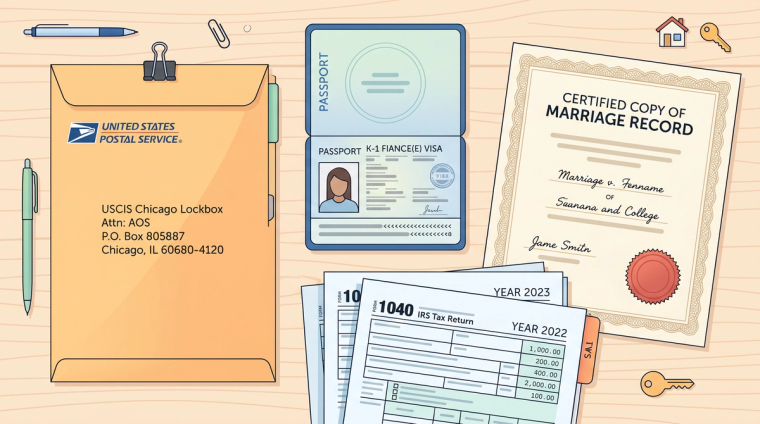
- Build the I-485 package. Include Form I-485, the I-797 for your I-129F, passport biographic page and admission stamp, I-94, marriage certificate, Form I-864 Affidavit of Support with your spouse's tax returns, sealed I-693, two passport-style photos, and bona fide marriage evidence. Add Form I-765 (EAD) and Form I-131 (advance parole) if you want to work or travel while waiting.
Your U.S. citizen spouse is the sponsor here, and their income has to meet the I-864 minimum for your household size. Our Green Card Sponsor Income Calculator shows the threshold and whether assets can cover any gap.
- Pay correctly. As of October 28, 2025, USCIS no longer accepts paper-based forms of payment for benefit requests unless an exception applies. Pay by card using Form G-1450 or by ACH using Form G-1650.
- Mail to the correct USCIS lockbox address listed on the Form I-485 page. K-1 adjustment applicants should follow the current USCIS filing-address instructions for Form I-485. USCIS will send a receipt notice after it accepts the filing.
- Attend biometrics if USCIS schedules an appointment. Timing varies by case and field office, and USCIS will send an appointment notice with the date, time, and location.
- Attend the AOS interview if USCIS schedules one. USCIS may waive some interviews, but K-1 adjustment applicants should plan to attend in person with their spouse if they receive an interview notice. Bring updated bona fide marriage evidence, including evidence dated after the I-485 was filed.
Bona fide marriage evidence is where K-1 cases most often go sideways. It's the number-one reason for RFEs and denials. Immiva's I-485 flow builds you a personalized evidence checklist and flags thin documentation before you mail anything.
What K-1 adjustment of status costs in 2026
USCIS fees for a single K-1 filer with EAD and advance parole, per the G-1055 fee schedule:
| Form or item | Fee | Notes |
|---|---|---|
| I-485 (age 14+) | $1,440 | Biometrics included since April 1, 2024 |
| I-765 EAD | $260 | Reduced rate when filed with pending I-485 |
| I-131 advance parole | $630 | Required for any international travel |
| I-693 medical exam | $200 to $500 | Paid to civil surgeon, varies by clinic |
| I-864 affidavit of support | $0 | No filing fee |
| Total | $2,530 to $2,830 | Plus attorney fees if you use one |
Add another $1,440 I-485 fee for each K-2 child age 14 or older. Children under 14 pay a reduced rate, so check the G-1055 before paying. If you'd rather skip the $2,500 in attorney fees, Immiva's I-485 flow handles the forms and evidence prep for $249.
How long K-1 adjustment of status takes
K-1 cases run on the same I-485 timeline as other family-based filings. There's no separate K-1 queue. Current I-485 processing times:
| Milestone | Typical timing |
|---|---|
| Receipt notice (I-797C) | 1 to 3 days e-file, 2 to 3 weeks paper |
| Biometrics appointment | 2 to 5 weeks after filing |
| EAD approval | 2 to 5 months for most filers |
| AOS interview | 8 to 14 months, varies sharply by field office |
| Conditional green card | 10 to 18 months total, up to 26 months in high-volume offices |
USCIS does not publish a K-1-specific I-485 approval rate on the Form I-485 page. Denials can result from failure to prove eligibility, insufficient relationship evidence, affidavit-of-support problems, inadmissibility issues, missing required initial evidence, or other case-specific defects.
2025 and 2026 policy changes K-1 filers should know
Four recent changes hit K-1 adjustment filings directly.
I-693 required at filing when required for the applicant. USCIS announced that applicants who need to submit Form I-693, or a partial Form I-693, must submit it with Form I-485; if it is required and missing, USCIS may reject the I-485. Old advice saying every applicant can wait until the interview is no longer reliable.
540-day EAD auto-extensions ended. Renewal applications filed on or after October 30, 2025 no longer receive the automatic 540-day extension; renewals filed before that date kept whatever extension applied at filing. K-1 AOS applicants should check the current I-765 rules for category (c)(9) before relying on any automatic extension.
Bona fide marriage scrutiny. USCIS examines whether the marriage is bona fide and may request additional evidence or schedule an interview if needed. Some marriage-based cases may involve separate questioning, but applicants should rely on the interview notice and current USCIS instructions.
Travel bans and possible processing holds. Presidential Proclamation 10998, the expanded version of the June 2025 travel ban, took effect on January 1, 2026 and suspended or limited entry and visa issuance for nationals of roughly 39 countries, with exceptions and national-interest waiver authority. Under USCIS memo PM-602-0194, pending benefit applications, including the I-485, were also put on hold for nationals of the listed countries; a federal court struck those holds down on June 5, 2026, and USCIS is expected to resume decisions while a likely appeal plays out. Applicants from affected countries should check the latest State Department and USCIS guidance before filing or traveling.