
The complete strategy guide for filing your green card petition and adjustment of status together, covering both family-based and employment-based cases.
With concurrent filing, you send your green card petition (I-130 or I-140) and your I-485 adjustment of status to USCIS in a single packet, rather than filing the petition and waiting months for it to approve first. This guide walks through both the family-based and employment-based paths, the 2026 fees, and the late-2025 policy shifts that change the timing math.
This guide is about execution: who qualifies, what goes in the packet, and what it costs. If you are still working out what the I-130 and I-485 each do, start with our I-130 vs I-485 comparison and come back.
Last updated: June 2026
What I-485 concurrent filing actually means (and who qualifies)
You can file Form I-485 at the same time as the underlying immigrant petition, or after the petition is already pending, as long as concurrent filing is allowed for your category and an immigrant visa number is immediately available. Filing concurrently by itself doesn't give you the right to work or to travel; for those, you need to file Form I-765 and, if you need travel permission, Form I-131, and wait for those to be approved.
The eligibility rule traces back to INA § 245(a): you need to have been inspected and admitted or paroled, you have to be admissible, and a visa number has to be available the moment you file. That last piece is what trips most people up.
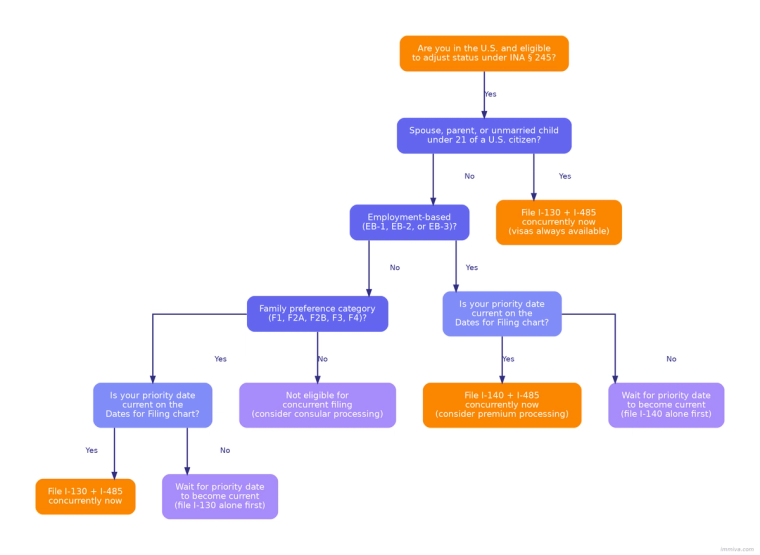
A simplified path through I-485 concurrent filing eligibility, covering both family-based and employment-based applicants.
Family-based eligibility (I-130 + I-485)
Immediate relatives of U.S. citizens (spouses, parents, and unmarried children under 21) always have a visa number waiting for them, because INA § 201(b)(2)(A)(i) keeps them out of the annual cap. They can file concurrently in any month of the year.
Family preference categories (F1, F2A, F2B, F3, F4) are capped under INA § 203(a), so concurrent filing only works when your priority date is current. Per the June 2026 Visa Bulletin analysis, F2A (spouses and children of green card holders) is "Current" across every chargeability area on Dates for Filing. The other categories need a priority date check first. VAWA self-petitioners and widow(er)s of U.S. citizens are also eligible, but they file Form I-360.
Employment-based eligibility (I-140 + I-485)
EB-1, EB-2, and EB-3 applicants can file concurrently only when an immigrant visa number is available under whichever chart USCIS picks for that month. Check the USCIS adjustment-of-status filing-chart page for the month you plan to file; don't just assume Dates for Filing is in play. Skim our Visa Bulletin guide before you commit, because which chart applies depends on your country of birth and your category.
If you're going through consular processing, concurrent filing isn't an option, since adjustment of status is a U.S.-based process. Some EB-4 applicants can file concurrently when USCIS allows it and a visa number is available; Special Immigrant Juveniles in EB-4 are one example USCIS expressly permits.
Chart A vs. Chart B: a 30-second primer
USCIS publishes two columns each month: Final Action Dates (Chart A), the date when a green card can actually be approved, and Dates for Filing (Chart B), the earlier date when an applicant is allowed to submit the I-485. USCIS picks one of the two each month on the Adjustment of Status Filing Charts page. When USCIS picks Chart B, applicants get to file weeks or months sooner.
How to file I-485 concurrently in 2026: step-by-step
A concurrent filing has more moving parts than a standalone I-485. You're sending at least five forms in one packet, and the rules around payment, form editions, and supporting evidence shifted several times in late 2025 and early 2026.
Forms in the packet
| Form | Purpose | Required for |
|---|---|---|
| I-485 | Adjustment of status application | All applicants |
| I-130 | Family-based petition | Family-based applicants |
| I-140 | Employment-based petition | Employment-based applicants |
| I-765 | Work authorization (EAD) | Optional, but almost always filed together |
| I-131 | Travel permission (Advance Parole) | Optional, but almost always filed together |
| I-693 | Medical exam | All applicants |
| I-864 | Affidavit of support | Family-based and some employment-based |
| Supplement J | Job offer confirmation | Employment-based applicants |
| I-907 | Premium processing for I-140 | Optional employment-based add-on |
Two things to flag here. Form I-693 has to go in with the initial I-485 (since December 2, 2024) and is only valid for the specific I-485 it's attached to (since June 11, 2025). The I-485 page on USCIS.gov carries the edition dates. Use 01/20/25 if your packet is postmarked before September 18, 2026, and 09/18/26 from that date.
Family-based filing process
You can file Form I-130 online for $625 or by paper for $675, but Form I-485 has to be filed by mail. When concurrent filing is allowed, USCIS lets you mail paper Forms I-130 and I-485 together to the proper filing address. If you filed Form I-130 online first, you can mail Form I-485 separately with a copy of the I-130 receipt notice attached.
The I-485 packet usually includes civil documents like birth and marriage certificates where they apply, the Form I-94 record if you have one, two passport-style photos for Form I-485, and Form I-693 if it's required. If you need more passport-style photos, that depends on which other forms you're filing and how you're filing them. For spouses, our I-130 spouse guide covers the bona fide marriage evidence USCIS now expects under PA-2025-12, which raised the bar on family-petition documentation in August 2025.
Employment-based filing process
The employer is the petitioner on Form I-140, except in self-petitioning categories like EB-1A and EB-2 NIW. Premium processing on eligible I-140 filings costs $2,965, and USCIS takes adjudicative action within 15 business days for most eligible I-140 classifications, or 45 business days for EB-1C and EB-2 NIW. I-485 processing times swing widely by case type and office, so look at the current USCIS Processing Times page before you file.
Payment rules (effective October 28, 2025)
USCIS stopped accepting paper checks and money orders. Everything is now electronic: card payment with Form G-1450, or ACH with Form G-1650, one payment form per filing. An I-485 + I-140 + I-765 + I-907 packet means four separate G-1450s in the envelope. Our paying USCIS filing fees guide covers the mechanics.
Current fees and total cost breakdown
These figures match the current USCIS Form G-1055 fee schedule. Check the latest edition before you file, because several fees changed during 2025 and early 2026.
| Form | Fee | Notes |
|---|---|---|
| I-485 | $1,440 (ages 14 to 78); $950 (under 14) | Biometrics included |
| I-130 (paper) | $675 | Standard family petition |
| I-130 (online) | $625 | $50 online discount |
| I-140 | $715 | Employment petition |
| I-765 with pending I-485 | $260 | Reduced from $520 standalone |
| I-131 (Advance Parole) | $630 | Separate fee since April 1, 2024 |
| I-907 (premium processing) | $2,965 | Effective March 1, 2026 |
| I-693 medical exam | No USCIS fee | Civil surgeon charges $200 to $500 |
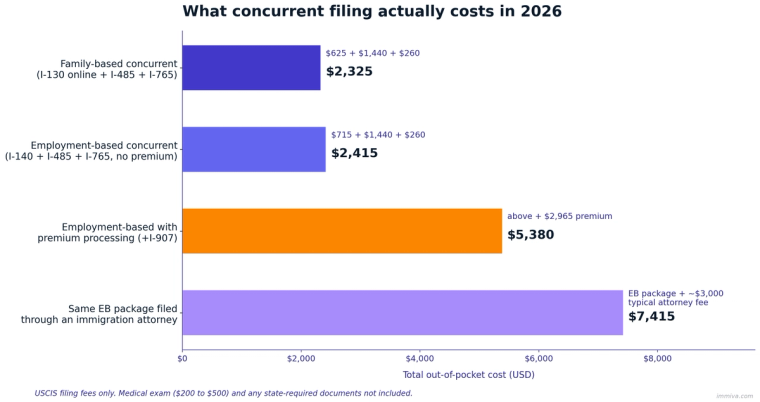
Total out-of-pocket cost for the four most common concurrent filing scenarios in 2026, including the typical immigration attorney markup.
Fees are non-refundable. If your petition is denied, USCIS keeps every dollar you paid. The attorney scenario is on the conservative side; many lawyers charge $3,000 to $5,000 for a concurrent filing package. Immiva walks you through the I-485 packet field by field for $249.
Benefits and risks of concurrent filing vs. waiting
This decision is worth thinking through because filing fees are non-refundable, and getting it wrong easily runs $2,000+ on top of months of lost time.
The benefits
Timeline compression. If you file the petition first and wait for it to approve, you tack on 9 to 18 months. Concurrent filing puts both forms in motion at the same time, so I-130 processing and I-485 review happen in parallel.
Interim work and travel authorization. Once your I-485 receipt notice shows up, you can file I-765 for an Employment Authorization Document and I-131 for Advance Parole. The EAD usually shows up within about 2 to 5 months and Advance Parole in roughly 3 to 5, well before the I-485 itself is adjudicated. You also stop accruing unlawful presence even if your underlying nonimmigrant status (H-1B, F-1, B-2) lapses while everything is pending.
AC21 portability (employment-based). Under INA § 204(j), once your I-485 has been pending for 180 days and your I-140 is approved, you can change employers as long as the new job is in the "same or similar" occupational classification. That is the real reason premium processing your I-140 is worth thinking about: a quick approval plus a 180-day I-485 pendency gives you job mobility that H-1B portability rules don't.
The risks
Petition denial. If your I-130 or I-140 is denied, your I-485 falls apart with it because there's nothing underneath to support it. You lose every fee you paid. EB applicants with a riskier I-140 (thin NIW evidence, an unusual EB-1 profile) often file the I-140 alone first and hold the I-485 until they have an approval in hand. Our I-130 RFE response guide covers what happens when family petitions get questioned, and the same logic applies on the EB side.
Travel restrictions. Leaving the U.S. without an Advance Parole document is treated as I-485 abandonment. There are two exceptions: people in valid H-1B or L-1 status. Everyone else is grounded for 3 to 5 months until the AP arrives.
Priority date retrogression. Visa Bulletin dates can move backwards. A pending I-485 is not cancelled when that happens; it just sits there, unable to be approved, until your date is current again. You keep your work permit and travel document in the meantime. Given the State Department's warning about retrogression if the 75-country freeze is lifted, this is a real 2026 concern, not a theoretical one.
Service center routing. Concurrent filings usually route to the Texas or Nebraska Service Center. Standalone I-485s filed after the petition is approved often route to the National Benefits Center instead. NBC has been moving some employment-based cases faster, so for certain categories, waiting can actually produce a faster final decision.
Processing times and what to expect after filing
The usual sequence: receipt notice in 4 to 8 weeks, biometrics in 6 to 12 weeks, EAD card in about 2 to 5 months and AP document in 3 to 5 months, then either an interview notice or an interview waiver, then a decision.
| Stage | Family-based | Employment-based |
|---|---|---|
| Receipt notice | 4 to 8 weeks | 4 to 8 weeks |
| Biometrics | 6 to 12 weeks | 6 to 12 weeks |
| EAD (I-765) | 2 to 5 months | 2 to 5 months |
| Advance Parole (I-131) | 3 to 5 months | 3 to 5 months |
| I-130 / I-140 decision | Varies (months to a year) | Varies (15 days with premium) |
| I-485 final decision | 8 to 14 months typical | 10 to 17 months |
The biometrics appointment usually covers fingerprints, photo, and signature. USCIS may waive interviews on some employment-based cases, while family-based cases, especially marriage-based ones, more often end up needing an interview.
USCIS often issues the EAD and Advance Parole as separate documents now, so plan for two documents arriving on separate timelines, and do not travel on the EAD alone; you need the Advance Parole document in hand to reenter.
Six 2026 policy changes every concurrent filer must know
End of automatic EAD extensions (October 30, 2025). Renewal applications filed on or after that date no longer receive the up-to-540-day automatic extension. A concurrent filer who later renews a C09 EAD needs to file early, because there is no grace period while the renewal is pending.
EAD validity capped at 18 months (December 5, 2025). Policy alert PA-2025-27 cut new adjustment-based EAD validity from up to five years to a maximum of 18 months, so expect at least one renewal during a typical I-485 timeline. Employment-based filers can find the full EAD and job-portability picture in our I-485 guide for EB-2 and EB-3 workers.
CSPA age calculation reversal (August 15, 2025). USCIS now uses Final Action Dates (not Dates for Filing) to decide when a visa "becomes available" for Child Status Protection Act purposes. That pushes the CSPA age calculation later, which raises the aging-out risk for India and China EB-2 and EB-3 families. Premium processing the I-140 to shorten pending time (which gets deducted from CSPA age) matters more than it used to.
PA-2025-12: heightened I-130 scrutiny (August 1, 2025). Policy Alert PA-2025-12 raised the documentation bar on family-based petitions, expanded fraud detection, and increased NTA risk for petitions with red flags. Bona fide relationship evidence matters more in 2026 than it did in 2024.
The 75-country immigrant visa freeze (January 21, 2026). DOS paused immigrant visa issuance for nationals of 75 countries on public-charge grounds, and recent Visa Bulletins warn that retrogression may be needed later in the fiscal year. Consular processing is off the table for many affected applicants, which makes adjusting from inside the U.S. the only practical route. Our breakdown of the 75-country freeze covers the country list and the options.
USCIS holds struck down in court (June 5, 2026). USCIS had paused decisions on pending applications, including I-485s, from nationals of the 39 countries covered by the expanded travel ban. A federal judge struck those holds down on June 5, 2026, and USCIS is expected to resume working through the parked cases while a likely appeal plays out. Our USCIS travel ban ruling guide explains what that means for a pending case.