

If your green card goes missing abroad, you need a way to board your flight home. Paying the I-90 fee won't give you a document you can use to board. For permanent residents in your situation, the USCIS I-131A page explains how to apply for carrier documentation through the I-131A process. You file for a replacement card after you return.
Use I-131A for carrier documentation. For travel documents such as reentry permits, use I-131. The Form I-131 guide explains which travel documents that form covers.
Do you need a boarding foil?
The I-131A instructions explain that a boarding foil lets an airline carry you without your usual proof of permanent residence. It usually goes in your passport. You still need to replace your missing card, and the foil doesn't guarantee admission. CBP inspects you when you arrive.
Ask your airline what it will accept before you pay the nonrefundable fee. The USCIS special instructions list cases where you may be able to board without carrier documentation. For the expired-card exceptions below, you need the documents themselves.
| Your situation | What to check |
|---|---|
| Card lost, stolen, or destroyed; temporary trip under one year | I-131A may be the appropriate boarding route. |
| You possess an expired ten-year card; trip under one year | Ask the airline about boarding with that card. |
| You possess an expired two-year card and an unexpired I-797 extension from I-751 or I-829; trip under one year | Ask whether that document combination is accepted. |
| A reentry permit was lost during a trip under two years | The permit must meet the applicable validity requirements; ask the consulate. |
| You are already at or beyond the applicable absence limit | Get an assessment of your return options before paying. |
The two-year rule for a lost permit appears in the USCIS I-131A guidance and the State Department rules in 9 FAM 202.2-5. It doesn't give everyone permission to spend two years abroad.
How to return after a lost green card abroad
If you need carrier documentation, here's how to apply and what to check before booking your flight.
- Contact the U.S. embassy or consulate that serves the place you're staying. Ask how to get an I-131A appointment. If you also lost your passport, contact your country's passport authorities and tell the U.S. consular office both documents are missing. Check whether you can use an emergency travel document. The USCIS filing instructions explain that the consular office can issue carrier documentation. You'll need to replace your green card separately.
- Gather proof of your status and when you left the U.S. Collect a copy of your green card if you have it, your A-Number, proof of permanent residence, and records showing when you left. The I-131A instructions call for proof of your departure date. Tickets and passport stamps can help establish it.
- Pay the fee that applies to you online and keep the receipt. The USCIS fee schedule lists the standard fee as $575. Someone else may pay for you, including a relative in the U.S. Double-check your name, date of birth, and A-Number when you pay. You still need to file the application in person.
- Get the current form and gather what you need for the appointment. Complete, sign, and date the form as your consular section directs. Bring it with your valid passport, payment receipt, proof of permanent residence and departure, two identical passport-style photos, and copies of every page of your passport. The I-131A instructions require those copies even though the webpage has a shorter checklist.
- Attend your appointment. When you receive your carrier document, check it before booking your flight. Make sure your details are correct and check the expiration date. Under the State Department rules in 9 FAM 202.2-5, a document for a missing green card is generally valid for 30 days and one entry. Follow the dates printed on your document. The I-131A instructions explain that different rules can apply if you lost a reentry permit.
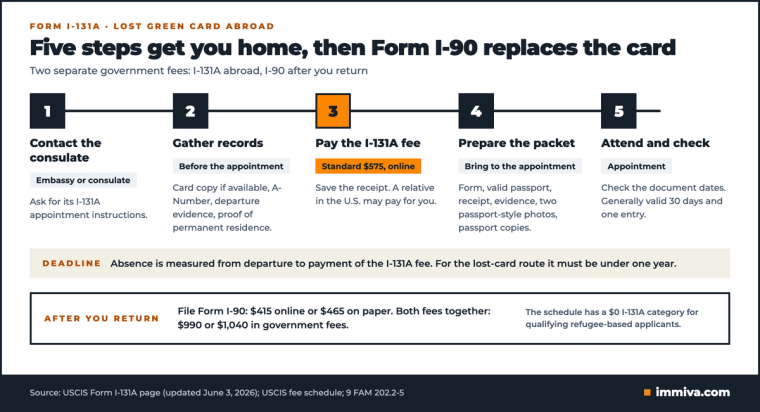
If you paid on time, State Department guidance in 9 FAM 202.2-5 allows the consulate to issue the document after the anniversary. A significant delay can require further review. Paying doesn't guarantee approval. Under USCIS travel guidance, you can still face a separate finding that you abandoned your permanent resident status.
What the fees and waiting time mean for your trip
When you plan your return, allow for two separate government fees. The USCIS fee schedule lists the standard I-131A fee as $575. To replace a lost card, the standard I-90 fee is $415 online or $465 on paper. Together, that's $990 or $1,040 in government fees if both standard fees apply. Travel and preparation cost extra. Check your category before you pay because qualifying refugee-based applicants have a $0 I-131A fee.
Confirm which document you need before paying. According to the USCIS I-131A page, the I-131A fee is generally nonrefundable, even if your application is unsuccessful. The USCIS fee-payment guide can help you plan for the cost. When you're ready to pay, follow the instructions for I-131A.
You don't have a guaranteed date for your flight home. Under State Department guidance in 9 FAM 202.2-5, each consular office handles its own appointments. Before you buy a nonrefundable replacement ticket, ask the office when you can get an appointment, how long processing takes, and how to collect your document.
When you're back in the U.S., you can prepare the application to replace your card. Immiva's I-90 preparation asks you questions in plain language to identify your filing reason and show you which documents you need and how to file. Immiva charges a preparation fee separate from the government fees.
For step-by-step help after you return, the lost green card replacement guide walks you through filing I-90. The Form I-90 guide covers other reasons you might file.
What happens when you land
CBP decides whether to admit you when you arrive. Keep proof of your trip and permanent resident status handy for inspection. The I-131A instructions explain that the foil lets the airline carry you. Under USCIS travel guidance, questions about abandonment or admission remain open even with the foil. If you have a specific concern, such as a long absence or a criminal history, get individual legal advice.
Once you're home, follow the USCIS replacement guidance and file I-90 to replace your missing card unless the conditional-card restriction below applies to you. If you need proof of permanent residence sooner, ask the USCIS Contact Center about temporary evidence, often called an ADIT stamp. For travel or work, check whether the replacement receipt alone gives you the proof you need.
If USCIS schedules a biometrics appointment, follow the instructions in your appointment notice. Immiva's I-90 preparation shows you the completed application and document list before you pay for preparation. You can review the packet before you file.
Frequently Asked Questions
A photo alone isn't one of the documents listed on the USCIS I-131A page for boarding under an exception. Keep the photo as evidence for your application and use it to look up your A-Number. Check with your airline about which documents you need to board.
You should generally bring a police report if you have one and it's applicable to your case. Follow your consulate's instructions. A police report alone doesn't prove you qualify to board, according to section 202.2-5 of the State Department's Foreign Affairs Manual.
The USCIS I-131A page says you may be able to board with your expired conditional card and a valid extension. The I-90 instructions say not to use I-90 to replace your card if it has expired or expires within 90 days. Follow the instructions for removing conditions with I-751 or I-829. Consult the I-751 travel guide and check your deadline for removing conditions.
If you've reached the lost-card deadline, contact the consulate before paying. Ask whether a valid reentry permit or an SB-1 returning-resident visa could allow you to return. For SB-1, you need evidence that circumstances beyond your control kept you abroad longer than planned, as the State Department’s SB-1 guidance explains.
No. Use I-131A for carrier documentation, as the USCIS I-131A page explains. The USCIS I-131 page lists reentry permits and advance parole among the travel documents I-131 covers. The Form I-131 guide explains how to apply for those travel documents.
Your next step
Before you pay, contact your airline and the consulate. Ask about two things: which documents you need and when payment is due. If you need carrier documentation, follow the USCIS I-131A instructions to get it. Replace your card once you're home.