

This guide walks through who qualifies, what the I-983 actually asks for, how E-Verify fits in, what filing costs in 2026, and the specific mistakes that turn into RFEs. It is written for students filing without an attorney, or for anyone double-checking one who is, and it assumes you already know roughly what OPT is. If you want the basics first, read our OPT application overview and circle back here.
The short version: if you hold a bachelor's or higher STEM degree from an accredited U.S. institution, you are currently on post-completion OPT for that degree, and your employer is actively enrolled in E-Verify, you are probably eligible. File Form I-765 with category (c)(3)(C), attach the STEM OPT evidence USCIS asks for (your STEM-recommended Form I-20 and proof of your STEM degree), pay the current fee of either $470 online or $520 on paper, and file before your current EAD expires. You also complete Form I-983 and give it to your DSO before the STEM recommendation goes into SEVIS; the I-983 stays with the DSO and is not attached to the I-765. As long as USCIS receives your application on time, you keep working for up to 180 days while the case is pending (8 CFR 274a.12(b)(6)(iv)). You can apply for your STEM OPT extension with Immiva.
That is the whole program in four sentences. Everything else in this guide is where it can go wrong.
What the STEM OPT extension actually is
STEM OPT is a 24-month extension of post-completion Optional Practical Training, available only to F-1 students whose most recent, or most recently qualifying, degree appears on the current DHS STEM Designated Degree Program List. The regulatory basis sits at 8 CFR 214.2(f)(10)(ii)(C) and 8 CFR 214.2(f)(11).
In practice, the extension buys you time. One 24-month addition takes your total work authorization under F-1 to roughly three years. That window means more shots at the H-1B lottery, more time to pursue employer-sponsored green card petitions, and more room to build the kind of U.S. work history that supports a later O-1, an EB-2 NIW, or an employment-based green card through a family member's adjustment. None of that is guaranteed, but the extension is what makes any of it realistic while you're still in F-1 status.
A few things this extension is not.
It is not automatic. You have to file, pay, and get an approval, same as any other EAD. It is not portable the way an H-1B is: you can change employers during the extension, but each new employer still has to be E-Verify enrolled, and you still have to file a new I-983. And it is not a separate visa. You stay in F-1 status the whole time, so the same maintenance-of-status rules apply.
It is also not a one-time-only benefit. If you later finish a higher-level qualifying STEM degree, you can file for a second 24-month extension based on that new degree. More on that in the FAQ.
What changed in 2025 and 2026
Most of the confusion in 2026 traces back here. Four separate developments hit the F-1 community over the last year, and students keep asking the same worried questions about all of them.
The October 2025 EAD rule did not touch STEM OPT
On October 30, 2025, DHS published an interim final rule that ended the automatic extension of EADs for renewal applicants in most categories. That was the extension under 8 CFR 274a.13(d), which a December 13, 2024 final rule had raised from 180 days to 540 days a year earlier. STEM OPT was never in that group. The 180-day extension for timely filed STEM OPT applicants sits in a different regulation, 8 CFR 274a.12(b)(6)(iv), and it still applies.
STEM OPT applicants are not eligible for the 540-day automatic extension under 8 CFR 274a.13(d); instead, timely filed STEM OPT extension applicants receive the separate 180-day automatic extension under 8 CFR 274a.12(b)(6)(iv). USCIS states this directly on its STEM OPT page and Automatic EAD Extension page.
If a friend or coworker tells you that your auto-extension went away, they may be confusing STEM OPT with other EAD renewal categories. They are almost certainly thinking of the renewal categories that lost their automatic extension on October 30, 2025. Timely filed STEM OPT applicants were never covered by that rule and still get their separate 180-day automatic extension while the case is pending.
the fixed-admission rule is postponed
DHS published a final rule on July 17, 2026 that would replace duration of status with fixed admission periods for F, J, and I nonimmigrants. A September 14 federal court order postponed its September 15 effective date. USCIS says it is applying the previous regulations, so the proposed four-year cap and 30-day departure period are not current rules.
The postponed rule's March 18, 2027 transition cutoff does not currently require you to file Form I-539 alongside an ordinary OPT or STEM OPT application. Eligible F-1 students continue under the previous duration-of-status framework while the order remains in force. You may still need Form I-539 for a separate change of status or reinstatement. Check the USCIS I-539 notice and discuss any travel or status problem with your DSO or attorney.
The H-1B $100,000 supplemental fee makes STEM OPT more valuable
A $100,000 supplemental fee on new H-1B petitions, set by presidential proclamation (90 FR 46027) in September 2025, changed the sponsorship math for entry-level roles. DHS went further on August 25, 2026, proposing a $103,265 fee on every H-1B cap-subject petition, including advanced-degree cases (91 FR 54817). That one is still a proposed rule.
For students, the practical effect is that STEM OPT stopped being a nice-to-have. If you don't land H-1B sponsorship in your first cap cycle, the extension is your primary runway. Our FY 2026 H-1B cap recap covers the broader sponsorship picture.
Fees are higher and payment methods are stricter
Two fee changes matter in 2026. The I-765 filing fee has been $470 online and $520 on paper since April 2024, replacing the old $410 figure that still shows up on plenty of blogs. Biometrics are bundled in, so there's no separate $85 charge. Premium processing on Form I-907 went from $1,685 to $1,780 on March 1, 2026, under the Federal Register final rule published January 12, 2026.
There's also a payment-method change. Paper filers now pay by Form G-1450 (card) or Form G-1650 (ACH). Personal checks, cashier's checks, and money orders only work if you qualify for an exemption under USCIS's paper-fee-payment policy. Online filers pay electronically through the USCIS online filing system. Our guide to paying USCIS fees the right way walks through each method, and the USCIS check-acceptance announcement covers the transition itself.
Who qualifies
Five gates decide whether you can file. Miss any one of them and the application either gets denied outright or turns into an RFE that costs you weeks.
Gate 1: Qualifying STEM degree
Your degree has to be on the current DHS STEM Designated Degree Program List, matched by CIP code. "Computer science" isn't one single entry on that list. There are dozens of CIP codes within computing alone, and only some of them qualify. Your DSO can confirm your CIP code against the official list, and your transcripts will show which code your program is actually classified under.
A common edge case worth knowing: you may qualify based on a prior STEM degree, even when the degree behind your current OPT isn't STEM. Say you earned a STEM bachelor's, then completed a non-STEM master's, and you're on OPT based on the master's. You can still apply for STEM OPT based on the earlier bachelor's, as long as the work is directly tied to that bachelor's field. USCIS lays this out on the STEM OPT page.
Both degrees, the prior one and the current one, need to come from SEVP-certified accredited U.S. institutions.
Gate 2: Currently on post-completion OPT
You need to be in valid F-1 status and currently working under post-completion OPT. You can't apply from CPT, from unemployment that's already blown past the 90-day cap on initial OPT, or from outside the United States.
The timing window is narrow. You can file as early as 90 days before your current OPT EAD expires, and USCIS has to receive your I-765 before that EAD expires for the 180-day automatic extension to kick in.
Gate 3: E-Verify employer
Your employer has to be enrolled in E-Verify and actually using it. Enrollment alone isn't enough; the employer needs a valid E-Verify company identification number (or a client company ID if filing through an agent). That number goes on the I-983 and gets cross-checked by the DSO and by USCIS.
This is one of the most common reasons a STEM OPT application stalls. Small and mid-sized employers sometimes start E-Verify enrollment and never finish it, and some assume they're enrolled when they aren't. Verify the number before you file, not after.
Gate 4: Paid, directly related, at least 20 hours per week
USCIS doesn't allow volunteer or unpaid positions under STEM OPT, even when the "training value" looks real on paper. The work has to be paid at a level that lines up with the role and what comparable workers earn.
The role also has to be directly related to the STEM degree behind the application. "Directly related" means tied to the specific field, not just adjacent to it. A mechanical engineering graduate working as a mechanical engineer qualifies; that same graduate working as a product manager on consumer software probably doesn't, depending on how the I-983 training plan is written.
Minimum 20 hours of work per week with each qualifying STEM OPT employer. Part-time under that bar doesn't qualify. Self-employment and sole proprietorships generally don't qualify either: STEM OPT needs a bona fide employer-employee relationship and an employer who can sign the I-983.
Gate 5: Completed Form I-983
You can't file without a complete, signed Form I-983. Your DSO needs it before they can enter the STEM extension recommendation into SEVIS. USCIS doesn't require you to upload the I-983 with the I-765, but the DSO keeps the original and can produce it during a DHS site visit.
The I-983 is the substance of your entire application. If it's weak or inconsistent, everything downstream gets harder.
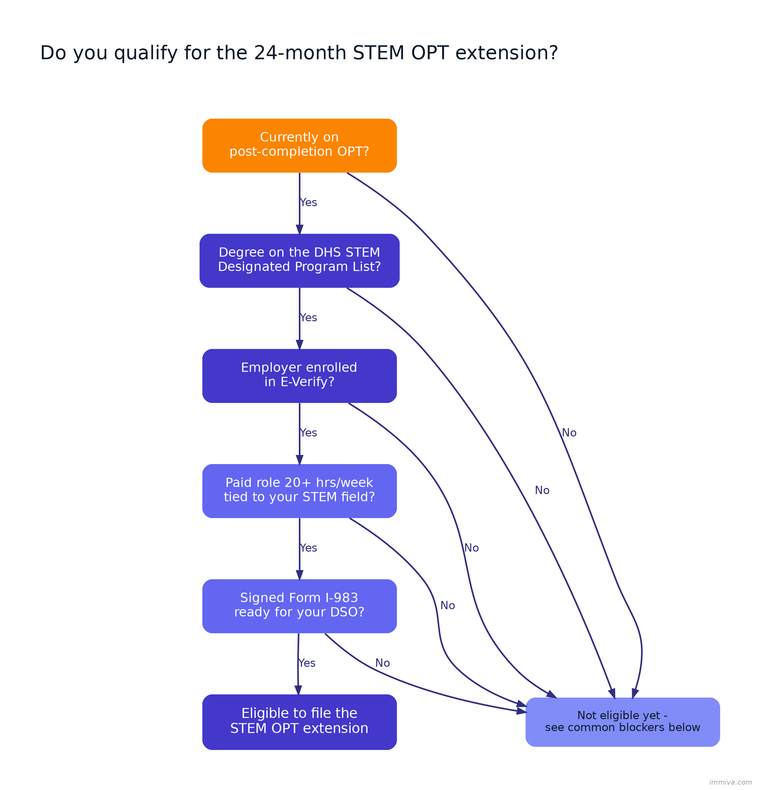
A five-gate check on STEM OPT eligibility, covering current OPT status, qualifying degree, employer E-Verify enrollment, paid STEM-related work, and a signed I-983 training plan.
Form I-983 in plain English
The I-983 does the most work of anything in the application. It's the document that tells DHS what training you'll get, how your employer will oversee it, how your progress gets measured, and how all of that ties back to your STEM degree. You and an authorized employer representative sign it, and your DSO keeps the original.
You don't send the I-983 to USCIS with the I-765. You hand it to your DSO, who uses it to justify entering the STEM extension recommendation into SEVIS. That recommendation triggers a new I-20 with the requested extension dates, and it's this I-20 you attach to the I-765.
What goes into the I-983
The form has six substantive sections. You provide your basic identifying information (name, SEVIS ID, school details) and your employer's identifying information (name, address, EIN, North American Industry Classification System code, number of full-time employees, and E-Verify company identification number). Then you describe the site of activity in detail. The worksite has to be the location where the training actually happens; a student who signs an I-983 listing a San Francisco worksite while working remotely from Michigan full-time has a compliance problem from day one.
The training plan itself sits in Section 5, and it has four parts, each doing different work: the goals and objectives of the training, the oversight the employer will provide, the measurements and assessments the employer will use to evaluate your progress, and the hours per week. Don't paste in a job description. A training plan is a different document entirely, and USCIS reads this section closely.
Section 6 is the employer official certification and signature. Whoever signs has to be authorized to commit the employer to the training plan, which in practice means a manager, an HR partner, or legal counsel. A coworker can't sign for you.
Section 2 is your certification and signature, and Section 4 is where the employer certifies its own information.
For a field-by-field walkthrough, including the kind of Section 3 wording that survives review and what to avoid, we keep a separate deep-dive on the I-983 training plan. Ask your DSO for the official form from the Study in the States STEM OPT Hub.
Evaluations and amendments
Once you file, you owe the I-983 two self-evaluations: one at 12 months, and a final one at 24 months. Both go to your DSO. You also have to file a new I-983 whenever the training plan materially changes, which covers changing employers, changing worksites (beyond minor office moves), changing the EIN of your employing entity, or substantially changing the duties described in Section 5.
Report material changes to your DSO within 10 days. If the change affects the training plan, the updated or new Form I-983 is due to your DSO inside that same 10-day window.
The bona fide relationship requirement
The employer who signs your I-983 has to be the entity that actually employs you and provides your training. This is where staffing firms and labor-for-hire arrangements routinely fall apart: if a consulting firm signs your I-983 but you're working on a client project at the client's office under the client's direction, with no real oversight from the consulting firm, that arrangement doesn't meet the bona fide employer-employee standard in 8 CFR 214.2(f)(10)(ii)(C)(9).
USCIS has gotten stricter on this point since the 2016 guidance. If your arrangement looks like staffing, the I-983 signer needs to be the real employer providing the training, not a vendor.
Filing Form I-765
Once the I-983 is signed and the DSO has entered the recommendation into SEVIS, you can move to the actual filing. This part is mostly mechanical, but the mechanics still matter.
Timing: 90 days out, not later
The earliest you can file is 90 days before your current OPT EAD expiration. USCIS has to receive the application before your current EAD expires, so treat the expiration date itself as already too late. If USCIS receives your I-765 on or after that date, you lose the 180-day automatic extension, and your work authorization lapses the day after your EAD runs out.
On top of that, 8 CFR 214.2(f)(11) requires you to file your I-765 within 60 days of the DSO's STEM extension recommendation. Work backward from your EAD expiration date: aim to have your I-983 signed and delivered to your DSO around 100 days out, your new I-20 about 90 days out, and the I-765 filed within two weeks of getting that new I-20.
Online or paper
Category (c)(3)(C) is one of the I-765 categories eligible for online filing at myUSCIS, and it's the better option in almost every case: the fee is $50 lower ($470 vs $520), uploads are faster and verifiable, case tracking is cleaner, and you get a receipt notice in your account within minutes.
Paper filing is still around if you can't file online for some reason. Paper I-765s go to a service center based on the address USCIS lists for your category on the I-765 filing locations page. Paper fees pay through Form G-1450 (card) or G-1650 (ACH); checks and money orders are no longer accepted for most paper filings.
Documents to include
For the I-765 itself, you'll need to attach the following.
The current Form I-20 showing the STEM extension recommendation, endorsed by your DSO within the last 60 days. Your most recent I-94 from the CBP I-94 site. The biographic page of your passport. Your current EAD (both sides). STEM degree evidence, such as a diploma or transcript, to confirm the STEM classification. A passport-style photo that meets current USCIS specifications. The photo has to be unmounted and unretouched, but it does not need to come from a professional photo service, and the I-20 does not need a blue wet-ink signature.
If you have prior EADs, include copies. If you already have a Social Security Number and the online form asks for it, provide it; if you don't have one, you can no longer request it on this form. USCIS suspended SSN requests through Form I-765 in March 2025, and the current form edition dropped those fields, so apply at a Social Security office once your EAD arrives.
For a full document checklist that covers the edge cases, we publish a separate checklist article worth bookmarking next to this one.
Premium processing is worth considering
Premium processing is available for category (c)(3)(C) through Form I-907. For the $1,780 fee (effective March 1, 2026), USCIS guarantees an adjudicative action within 30 business days. That means an answer inside that window (approval, denial, RFE, or NOID), not a guaranteed approval.
Premium is worth paying when you're close to your EAD expiration and the 180-day auto-extension won't give your job enough runway, or when an RFE under standard processing would leave you no time to respond before the auto-extension runs out. It's not worth paying if you filed early, your application is clean, and you're comfortable waiting.
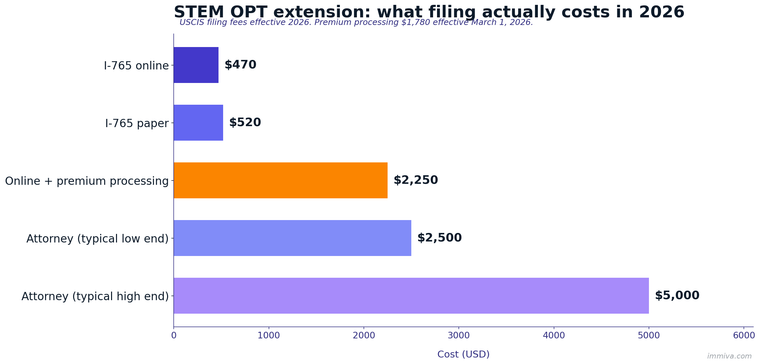
A visual comparison of the four common 2026 filing paths and the range of attorney fees students sometimes pay on top of the USCIS fees.
Biometrics (BSA) notices
There's no separate biometrics fee for a STEM OPT filing, and it doesn't normally require an appointment, but USCIS can still schedule one while it processes your case. If a biometric services appointment notice arrives, go.
If your appointment conflicts with something serious, you can reschedule the biometrics appointment through your USCIS account.
The 180-day automatic extension, explained
If USCIS receives your timely I-765 before your current OPT EAD expires, your work authorization continues for up to 180 days past the EAD expiration while the application is pending. That rule lives at 8 CFR 274a.12(b)(6)(iv). Three conditions all have to be met: you're an F-1 student with a timely and properly filed I-765, you requested a STEM extension, and USCIS hasn't yet adjudicated the application.
Your employer uses the combination of your expired EAD and your I-797C Notice of Action receipt as proof of continued work authorization for Form I-9 purposes during the 180 days. USCIS keeps detailed I-9 guidance at I-9 Central, and your employer can reference Chapter 5 of the Handbook for Employers for the exact document combination.
The 180-day extension ends on the earliest of three dates: the day USCIS adjudicates your application (approval or denial), 180 days from your original EAD expiration, or the day your F-1 status otherwise ends. If processing times stretch past 180 days, which does happen, your work authorization lapses until USCIS makes a decision. That's why processing time matters, and why premium processing is sometimes worth paying. You can keep an eye on your case with our case status tracking guide.
Staying compliant during the 24 months
Getting the extension is step one. Keeping it in good standing for 24 months is step two, and that's the step that trips people up in year two, once the filing starts to feel like ancient history.
Reporting requirements
Every 6 months, you report to your DSO, even if nothing has changed, to confirm your legal name, address, employer name and address, and that you're still working. Miss a 6-month check-in and your SEVIS record can fall out of compliance, which can invalidate your status.
On top of that, you report material changes within 10 days: address changes, employer changes, any loss of employment, an employer EIN change, or a substantial change in duties. Most of those changes also require a new I-983 with your DSO. Minor address changes within the same locality usually don't require a new I-983, but they still need a timely update.
Unemployment cap
STEM OPT extends the cumulative unemployment allowance to 150 days across your entire F-1 OPT period, including whatever you already used during the initial 90 days. The clock counts every day you're not employed in a qualifying STEM OPT role, not just days you're totally idle.
Hit 150 days and you're out of status. The clock runs faster than people expect if you're between employers for a few weeks at a time, so track it carefully. Taking any job during that window, even a part-time one, starts a fresh I-983 obligation.
Employer changes
You can change employers during the extension. The new employer has to meet the same requirements: E-Verify enrollment, a bona fide relationship, paid work tied to your STEM field, and at least 20 hours per week. Submit a new Form I-983 to your DSO within 10 days of the change. You do not file a new I-765 unless USCIS instructs you to. For STEM OPT, your DSO generally has to add the new employer in SEVIS, because STEM OPT students can't add an employer or change a start date themselves in the SEVP Portal.
Multiple employers
You can hold more than one qualifying STEM OPT position at the same time, with a separate Form I-983 for each employer, but each qualifying STEM OPT employer must provide at least 20 hours of work per week. Hours do not combine across employers to satisfy the minimum.
Travel
You can travel during the extension. To reenter the U.S., you'll need your passport with a valid F-1 visa (or a Canadian passport that doesn't require one), your I-20 signed for travel by your DSO within the past 6 months, your EAD (or I-797C receipt if your application is still pending), and a letter from your current employer showing continuing employment. If your extension is still pending when you travel, reentry is legally permitted but can feel riskier at the port of entry, so if waiting for the approval before you travel is an option, wait.
Common RFEs and how to avoid them
Requests for Evidence on STEM OPT cases tend to cluster around the same handful of mistakes. Run through this list before you file.
The degree isn't on the current STEM Designated Degree Program List. Double-check your CIP code against the list on the day you file, not the day you collected your documents; the list has been updated several times in recent years.
The employer isn't actually enrolled in E-Verify. Before you file, ask HR for the E-Verify company identification number and verify it independently at E-Verify's company look-up where possible, or ask your DSO to confirm.
The I-983 is missing a signature, a field, or a date. Every field needs something in it, even if that something is "N/A." Walk through it page by page with your DSO.
The job duties in Section 5 are disconnected from the degree field. "Software engineer" on a mechanical engineering I-983 will draw attention unless the training plan specifically ties the duties to mechanical engineering concepts.
Transcripts are missing or don't show the major. If your diploma doesn't specify the major, include an official transcript that does; USCIS uses it to confirm STEM classification.
The photo isn't compliant. Submit a passport-style photo that meets current USCIS specifications, unmounted and unretouched. Follow the spec sheet exactly; a professional photo service isn't required, but meeting the spec is.
A staffing-firm arrangement where the I-983 signer isn't the actual employer providing training. If your work is at Client A but the I-983 is signed by Vendor B, expect an RFE asking you to document the bona fide relationship.
The role is under 20 hours per week, or unpaid. Both are disqualifying, not fixable.
Address changes or employer changes between filing and adjudication that weren't reported. USCIS will sometimes flag inconsistencies between the I-765 and the SEVIS record.
If you do receive an RFE, read it carefully. Most RFEs are fixable with the right evidence, and you generally have 87 days to respond. Our broader article on responding to USCIS RFEs covers the format and approach; STEM OPT specifics mostly mirror those general principles.
After STEM OPT ends
Your 24 months go fast. Plan the transition at least a year out.
The most common paths after STEM OPT are: selection in an H-1B cap registration (which usually requires employer sponsorship by March of the cap year), employment-based adjustment of status if your employer has started I-140 sponsorship, an O-1 for individuals with extraordinary ability, an L-1 if you can be transferred abroad and then back, or a return to F-1 for a higher degree, which could itself trigger a second 24-month extension later on.
Cap-gap extensions are one of the few status protections that still help STEM OPT students selected for H-1B. If your H-1B petition with a change of status request is pending or approved with an October 1 start date, USCIS automatically extends your F-1 status and work authorization to April 1 of the fiscal year the H-1B is requested for, or to the petition's validity start date if that comes first. USCIS documents cap-gap on its F-1 page.
The USCIS backlog means some of these paths take longer than the headline number suggests. Plan for slower, not faster.
Frequently Asked Questions
Yes, with conditions. If you previously earned a bachelor's or higher STEM degree from an accredited U.S. institution, you can apply for the STEM extension based on that earlier degree, as long as your current OPT employment is directly related to that prior STEM field. USCIS lays this scenario out on its STEM OPT page. Your DSO will need copies of both the prior and current I-20s. For more on OPT variations, see our OPT application guide.
Yes. There's no minimum length of E-Verify enrollment required; the employer just has to be enrolled and actively using E-Verify at the time you file. Don't confuse enrollment with application: a company that filed paperwork but hasn't yet received an E-Verify company identification number doesn't meet the requirement yet.
No. The automatic extension at 8 CFR 274a.12(b)(6)(iv) requires USCIS to receive your timely I-765 before your current OPT EAD expires. If USCIS receives the application on or after the expiration date, work authorization lapses the day after the EAD expires. Filing by mail carries transit risk, which is one more reason to file online.
Yes. Find a new employer that meets all the requirements (E-Verify, bona fide relationship, paid STEM-related role, and at least 20 hours per week). File a new Form I-983 with your DSO within 10 days of the change. For STEM OPT, your DSO generally must add the new employer information in SEVIS because STEM OPT students cannot add a new employer or change the start date through the SEVP Portal. You do not need to file a new I-765 unless USCIS instructs you to.
Yes, once. If you later earn a higher-level qualifying STEM degree from an SEVP-certified U.S. institution, you can apply for a second 24-month extension based on that new degree. You can't stack two extensions on the same degree level, though: a bachelor's plus a master's can get you two extensions, but two master's degrees can't.
Legally, yes. Practically, it depends. To reenter, you'll need a valid passport and F-1 visa, an I-20 with a travel signature dated within the last 6 months, proof of extended employment authorization (your EAD plus the I-797C receipt if pending), and a current employer letter. If you can, wait for the approval notice before your first international trip on the extension; it avoids complications with CBP at reentry. Our travel rules overview covers the general framework for pending USCIS applications.
Attend it. Biometrics notices have been reaching applicants in categories that did not usually draw them, including (c)(3)(C). DHS proposed expanding biometrics collection to essentially everyone filing a benefit request in a rule published on November 3, 2025 (90 FR 49062), which is still a proposed rule, but the direction of travel is clear. The notice itself doesn't signal a problem. Bring the notice, a valid government ID, and any USCIS correspondence. Our biometrics appointment walkthrough covers what to expect, and if the date doesn't work for you, you can reschedule through your USCIS account.
Yes. USCIS publishes its guidance, and the process is well documented. Filing on your own saves thousands of dollars. An attorney earns the fee when there is a real legal question in your history: a prior visa denial, a criminal record, a long unemployment gap, contested academic credentials, or a staffing arrangement that needs untangling. Immiva also offers guided OPT and STEM OPT Form I-765 preparation with the applicable checks and document list. Your employer and DSO still complete their I-983 and SEVIS steps, and our pricing for OPT preparation is published up front.
A denial means your F-1 OPT has ended, your work authorization has ended, and you have a 60-day grace period to depart the U.S., change status, or enroll in a new program. You can file a motion to reopen or reconsider within 33 days if the denial was based on an error, but most denials don't get reopened, so the better investment is making sure the filing is clean from the start.