

There is no single trick to becoming a U.S. citizen for as little money as possible. There is a short stack of choices, and each one is worth between $50 and $2,500.
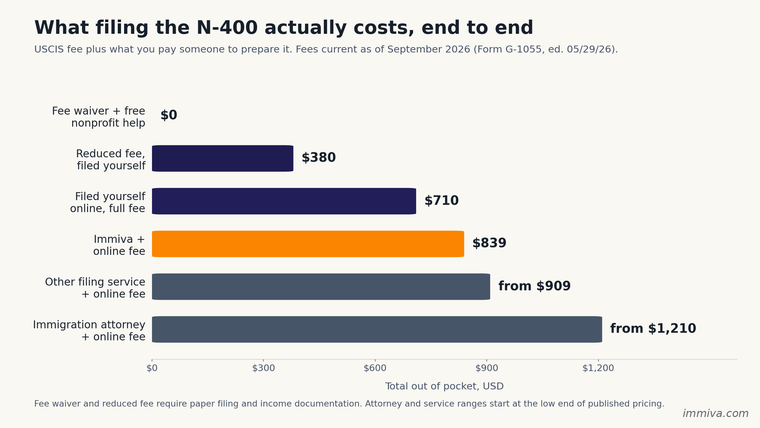
Right now the government charges $710 to file Form N-400 online and $760 on paper. Some applicants pay $380. Some pay nothing at all. On top of that sits whatever you pay a person or a service to prepare the form, which ranges from $0 to several thousand dollars.
Here is every lever, in the order that saves you the most money, plus the reason 2026 is a bad year to wait.
The short answer
The cheapest legitimate way to file the N-400 depends entirely on your household income:
- $0 if you qualify for a fee waiver and prepare the form yourself or through a free nonprofit clinic.
- $380 if your income is too high for a waiver but low enough for the reduced fee.
- $710 if you pay the full fee and file online yourself.
- $839 if you pay the full online fee and want a guided service checking your answers.
Everything above that is either a more expensive filing service or an attorney. Nobody is required to use either one.
Why "before the fee increase" is in the title
On June 23, 2026, DHS published a proposed rule called Naturalization Application Fee Adjustments (91 FR 37500). If it is finalized as written, the N-400 fee would go to $1,280 online and $1,330 on paper. The $380 reduced fee would disappear. Fee waivers for the N-400 would disappear too.
Two things matter about that sentence. First, it is a proposed rule. As of today there is no final rule and no effective date, and the current fees are fully in force. Anyone telling you the fee is already $1,330 is wrong. Second, the comment period closed on August 24, 2026, which means the rule is now in the stage where a final version can appear without much warning.
That is the whole urgency argument, and it is enough. If you are eligible today and you file today, you pay today's fee and you keep access to today's waiver. If you wait a year and the rule is finalized, the same application could cost $570 more, and the $0 and $380 paths may not exist at all. Our full breakdown of the proposed N-400 fee increase covers the timeline, the legal challenges, and what happens to applications already in the queue.
Lever 1: File online and keep $50
USCIS charges $710 to file the N-400 online and $760 to file it on paper. Same form, same review, same officer. The $50 difference is a discount for not making anyone open an envelope.
Filing online also removes a small category of expensive mistakes. The system will not let you submit without a signature, your payment is processed immediately instead of arriving as a card authorization that can fail, and you get a receipt number the same day.
There is one catch, and it decides the rest of this article: you cannot file online if you are requesting a fee waiver or a reduced fee. Both require a paper N-400. So the $50 online discount is only the cheapest option for people who are paying full price. If you qualify for income-based relief, take it and mail the packet. Our comparison of online versus paper N-400 filing walks through the trade-off in more detail.
Lever 2: Pay $380 with the reduced fee
USCIS approves a reduced fee of $380 when your documented annual household income is less than 400% of the Federal Poverty Guidelines. That is a much higher ceiling than most people assume.
Using the 2026 guidelines for the 48 contiguous states and D.C., 400% works out to roughly:
| Household size | 2026 poverty guideline | 400% ceiling |
|---|---|---|
| 1 | $15,960 | $63,840 |
| 2 | $21,640 | $86,560 |
| 3 | $27,320 | $109,280 |
| 4 | $33,000 | $132,000 |
Alaska and Hawaii use higher figures. Add $5,680 per person for households larger than eight.
A single applicant earning $60,000 is under the ceiling. So is a family of four on $130,000. If that describes you, the reduced fee saves $330 against the online fee and $380 against paper.
You do not file a separate form. On the paper N-400 you answer Yes to Part 10, Item Number 1, complete the rest of Part 10, and mail $380 with documentation of your household income. (You may still see references to Form I-942 online. That page is archived and quotes fees that stopped being correct in 2024.)
Lever 3: Pay nothing with a fee waiver
A fee waiver takes the N-400 to $0. You request it with Form I-912 filed alongside a paper N-400, and you qualify on any one of three bases:
- You, your spouse, or your parent (if you are under 21 or disabled) currently receive a means-tested benefit such as Medicaid or SNAP.
- Your household income is at or below 150% of the Federal Poverty Guidelines when you file. For 2026 that is $23,940 for one person and $49,500 for a household of four.
- You are experiencing extreme financial hardship, including unexpected medical bills or an emergency.
One basis is enough. The means-tested benefit route is usually the easiest to document because a current benefit letter does most of the work.
Do not file both a fee waiver request and a reduced fee request. USCIS asks you to pick one. If you are at or below 150%, the waiver is the one to pick, because it costs $0 rather than $380. Our guide to who qualifies for the N-400 fee waiver covers the evidence USCIS expects for each basis.
Military applicants naturalizing under INA sections 328 or 329 pay $0 regardless of income, and the proposed rule would leave that exemption alone.
Lever 4: Decide honestly whether you are paying for a lawyer or for a checker
This is where the biggest dollar figures sit. An immigration attorney for an N-400 generally runs $500 to $2,500, and more where there is a criminal record, a long absence from the country, tax problems, or a prior denial in the file. Hourly billing typically lands between $200 and $450.
That money buys legal judgment. It is worth paying for when there is a real legal question in your history, and our overview of what immigration lawyers charge sets out where the numbers come from.
But much of what people pay an attorney for on an N-400 has nothing to do with judgment. They are paying somebody to make sure the form is filled in correctly, the dates add up, and nothing is missing. That is checking work, and checking costs far less than counsel.
What preparation costs, from cheapest to most expensive:
| Option | Preparation cost |
|---|---|
| Do it yourself with the USCIS instructions | $0 |
| Free nonprofit clinic or Citizenshipworks | $0 |
| Immiva | Price temporarily unavailable |
| CitizenPath | $199 |
| SimpleCitizen | $249 to $615 |
| FileRight | $345 |
| Boundless / RapidVisa | from $349 |
| Immigration attorney | $500 to $2,500+ |
If a free nonprofit clinic near you has capacity, that is the best value on the entire list. They are also frequently booked out for months, which is the reason paid options exist. Our guide to filing the N-400 without a lawyer covers what you take on when you handle it yourself.
Lever 5: The cheapest filing is the one you only pay for once
Every saving above disappears the moment your packet comes back in the mail.
USCIS rejects filings at intake for reasons that have nothing to do with whether you deserve citizenship: the wrong fee amount, an outdated form edition, a missing signature, a payment method that failed. The current N-400 edition is 01/20/25, and since October 28, 2025 USCIS no longer accepts paper checks or money orders, so payment goes on Form G-1450 for a card or Form G-1650 for a bank debit. A rejected packet comes back to you and you start again.
Two costs follow from that. The obvious one is time: you lose weeks, and every week is a week closer to a final fee rule. The less obvious one is that intake rejection and denial are different things. If USCIS rejects your filing at intake, you get the package and the fee back. If USCIS accepts your filing and later denies it, the fee is gone. There is no refund on a denial.
That is why accuracy belongs on a list about saving money. The most common N-400 problems are ordinary: continuous-residence math done wrong, a trip abroad left off, a decade-old arrest omitted because the case was dismissed, a good-moral-character question answered without thinking. We collect them in our guide to the mistakes that get N-400 applications denied, and the N-400 document checklist covers what has to travel with the form.
Putting the levers together
Run them in this order:
- Check the waiver first. If you receive a means-tested benefit or your income is at or below 150% of the poverty guidelines, file on paper with Form I-912 and pay $0.
- If not, check the reduced fee. Under 400% of the guidelines means $380 on paper via Part 10 of the N-400.
- If neither applies, file online and keep the $50.
- Then decide what preparation you actually need. Free clinic if you can get in, a guided service if you want the form checked, an attorney if there is a genuine legal question in your history.
- File before a final rule appears. Today's fee is locked in by the date USCIS receives your application, not the date they decide it.
For a wider view of what naturalization costs beyond the filing fee, including photos, translations, and travel to the interview, see our full N-400 cost breakdown.