
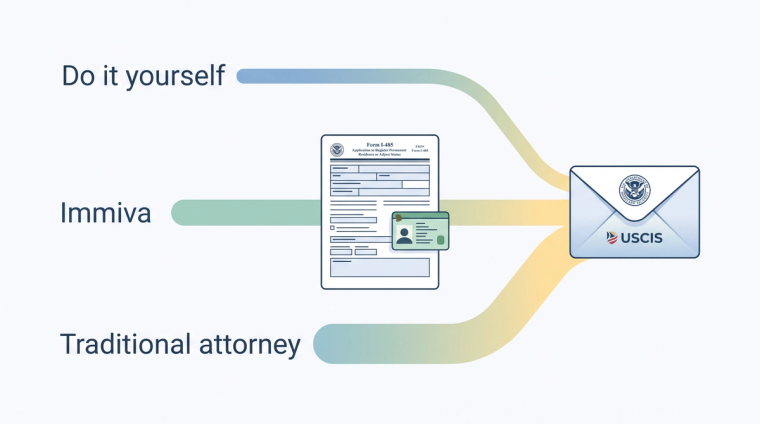
Do you need a lawyer for I-485? Not as a matter of law. USCIS lets you file adjustment of status yourself, and thousands of people do it every month. Whether you should is a different question, and the answer changed on September 18, 2026.
What USCIS actually requires
You can file Form I-485 yourself. The agency says applicants may complete and submit its forms without an attorney, and the Department of Justice uses the same pro se language for people who appear on their own behalf. The official I-485 page treats an authorized legal representative as an option, not a condition of filing. The governing regulation, 8 CFR Part 245, sets out eligibility and procedure. It says nothing about needing counsel.
What USCIS does warn about is the wrong kind of help. Its legal services page exists largely to steer people away from notarios and unaccredited consultants who charge attorney prices for clerical work. An unqualified middleman is worse than filing alone.
So the question is risk, not permission. The I-485 asks dozens of questions about your entry, your status, your background and your finances, and the cost of answering one of them wrong has gone up.
What changed on September 18, 2026
Two things landed on the same date, and together they reset the calculation.
A new form edition with no grace period. USCIS published a revised Form I-485 with edition date 09/18/26. There is no transition window. USCIS will reject the older 01/20/25 and 09/04/26 editions if they are postmarked or submitted electronically on or after September 18, 2026, and will only accept the new edition from that date forward (USCIS). If you downloaded a blank form this summer and have been filling it in slowly, it is now the wrong form.
The public charge rules underneath it changed too. The form was revised to match the Public Charge Ground of Inadmissibility final rule, published July 20, 2026 at 91 FR 45324 and effective the same September 18 date. The rule rescinds the 2022 public charge regulations. DHS describes the 2022 framework as unduly restrictive and says the rescission restores broader discretion for officers to weigh all pertinent facts. Broader officer discretion cuts both ways: fewer bright-line rules to fail, and fewer bright-line rules to rely on. Our explainer on the 2026 public charge rule changes covers what the shift means in practice.
Layered on top is an enforcement change from the year before. USCIS policy memorandum PM-602-0187, issued February 28, 2025, directs the agency to issue a Notice to Appear when it denies a benefit request and the applicant is not lawfully present (USCIS). For someone whose status has already lapsed, a denied I-485 is no longer just a lost filing fee. It can be the start of removal proceedings.
None of this makes self-filing wrong. It does mean a rejected or denied packet costs more than it did when this question was easier to answer.
When you can file I-485 without a lawyer
Plenty of adjustment cases are administrative rather than legal. A case you can reasonably handle yourself usually has all of these features:
- A lawful entry you can document. You were inspected and admitted or paroled, and you have the I-94 to show it.
- Status you have kept. No unauthorized work, no gap that triggers a bar under INA 245(c) (USCIS Policy Manual, Volume 7, Part B, Chapter 2).
- A clean background. No arrests of any kind, including dismissals and expungements. No prior removal, no prior denial, no misrepresentation.
- A sponsor who clearly qualifies. For family cases, income comfortably above 125% of the federal poverty guidelines on Form I-864.
- An approved or concurrently filed petition and a visa number available to you now.
Immediate relatives of U.S. citizens filing on a clean record are the clearest example. Employment-based applicants whose employer's counsel already handled the I-140 are another, since the legal analysis happened upstream. Our complete adjustment of status guide walks the full sequence, and how to file I-485 covers assembly and mailing.
If you are not sure you clear all five, the free I-485 eligibility check runs your category, entry and status against the requirements in about two minutes. You do not need an account.
If your priority date is the open question rather than your eligibility, check it before anything else. The Visa Bulletin checker reads the current bulletin against your category, country and priority date and tells you whether you can file now.
When you do need a lawyer for I-485
In these situations the question stops being about forms:
- Any criminal history at all. Arrests without charges, dismissed charges, deferred adjudications, sealed records. Inadmissibility analysis is legal work.
- Unlawful presence, overstay, or unauthorized employment. These can bar adjustment outright. If you are in this position, read filing I-485 after an overstay first, then talk to someone licensed.
- Any removal proceeding, past or present. An open case, a prior order, or an NTA you already received.
- Waivers. Forms I-601, I-601A and I-212 are argued, not filled in.
- A prior denial or a finding of fraud or misrepresentation.
- A child close to aging out where the Child Status Protection Act math is tight.
- An RFE or NOID you do not fully understand. The clock on a request for evidence is the wrong time to start learning.
Every item on that list has the same catch: you have to know it applies to you before you can act on it. Plenty of people do not. They remember the arrest but not that it was dismissed, or they have never counted the weeks between one status ending and the next beginning.
That is why the screening comes before the decision. Immiva checks criminal history grounds, removal and immigration court history, fraud and misrepresentation, the bars under 245(c) and the age-out math against the rest of your answers, and the pre-filing report shows every flag it raises with the reason for it. The report is free to read; you pay only if you decide to download the finished packet. So if something on the list above applies to you, you find out before you file, and you can take the specific issue to an attorney rather than paying one to go looking for it.
What an attorney actually does for the money
Be specific about what you are buying, because a flat fee covers less than you might assume.
What a licensed attorney provides that no software can: an opinion about your specific facts. Whether a 2014 arrest that was dismissed still counts as a conviction under immigration law. Whether your six weeks out of status fall within an exception to the bars in INA 245(c). Whether to file at all, given what a denial would expose you to. That is legal judgment, and it is the actual product.
A flat fee usually covers preparing the forms, assembling exhibits, corresponding with USCIS and answering an RFE. It usually excludes the government filing fees, the medical exam, translations and often the interview appearance. What it does not buy is a guarantee of care. Firms delegate adjustment packets to paralegals, and the 76 errors mentioned earlier came out of a real firm's real work product. Ask any prospective attorney who prepares the packet, who reviews it, and what happens if an error is theirs.
So the two things are not substitutes, and the order matters. Judgment about a contested fact is what a lawyer sells. Finding out whether you have a contested fact, and getting every other answer on the form right, is a different job. Doing the second one first costs you almost nothing and makes the first one cheaper if you end up needing it.
What each path costs
Everyone pays the same government fees. Only the preparation layer differs.
Filing on paper as one adult applicant, verified against USCIS Form G-1055, edition 05/29/26:
- Form I-485: $1,440 on paper, $1,390 online. The one reduced rate is $950 on paper, $900 online, for a child under 14 filing together with a parent
- Form I-765 for a work permit: $260 when your I-485 was filed with a fee on or after April 1, 2024 and is still pending
- Form I-131 for advance parole: $630 on paper, $580 online
- Form I-693 medical exam: no USCIS fee, but the civil surgeon bills you directly
That is $2,330 to USCIS for the common three-form package, before anyone prepares anything.
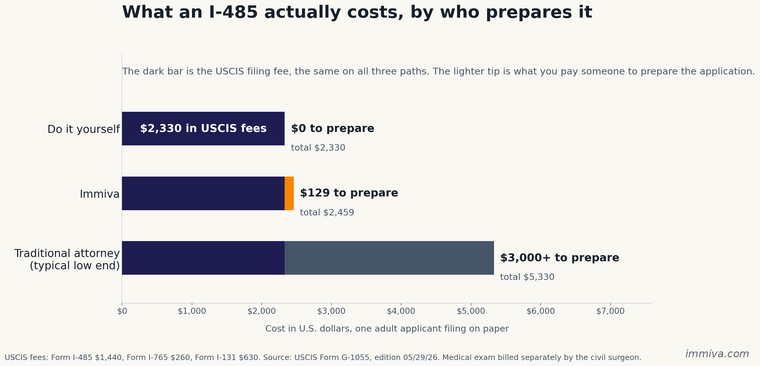
The USCIS filing fees are identical on all three paths. Only the preparation layer on the end of each bar changes.
Attorney fees for adjustment of status commonly start around $3,000 for a full family package and climb from there, with waivers and removal defense well above that. Our immigration lawyer cost breakdown has the form by form detail. Most flat fees exclude government fees, the medical exam and translations.
To price your own case rather than the generic one, the green card cost calculator totals every USCIS and State Department fee for your path and dependents using the current fee schedule.
The mistakes that sink self-filed applications
Filing the wrong form edition. As of September 18, 2026 this is the easiest way to lose a filing, because there is no grace period to absorb the error.
A missing or expired medical exam. Form I-693 must go in with your I-485, sealed by the civil surgeon, and paper filers must leave the envelope unopened.
An Affidavit of Support that does not hold up. Household size counted wrong, the wrong tax year attached, or income that misses the 125% threshold. The sponsor income calculator settles this in a minute and handles the military threshold, a household member on Form I-864A and the assets rule. Our I-864 guide covers joint sponsors.
Miscalculating the fees. Paper and online prices differ per form, and the I-765 fee depends on when your I-485 was filed.
Answering an inadmissibility question wrong. These sit near the end of the form and they are where cases are lost. Marking "no" on the inspection question when you were in fact inspected reads to USCIS as an admission of entry without inspection, which is a different case entirely.
Every one of these is a checkable error, which is what Immiva's I-485 preparation is for. It fills the form from your answers in plain English, prepares the I-864 for family cases, and runs up to 37 checks: your category and entry, status under 245(c), the full block of inadmissibility questions, public charge, age-out risk, five-year address and employment history, and eleven separate checks on the sponsor's income and documents. Each one comes back pass, review or fix, with the reason. You read the whole report before you pay, and the Price temporarily unavailable is charged only when you choose to download the packet.
Those checks do not stop at easy cases. Immiva also checks the grounds that decide hard ones: criminal history, prior removal, misrepresentation. Those are the answers most likely to go wrong for someone who does not know they matter. Immiva is software and not a law firm, so it does not give legal advice or represent you. It makes sure each question got answered correctly and tells you plainly when what it found belongs with an attorney.
The bottom line
Whether you need a lawyer for I-485 depends on your facts, not on the form. A case with an open court matter, a removal order, a waiver or a real inadmissibility question needs legal judgment, and nothing else substitutes for it. Most cases do not have one of those, and the ones that do are usually better served by an attorney who is handed the specific issue rather than the whole packet.
Either way the first move is the same, and it is free: run your answers through the checks and read the report. If it comes back clean, you have your finished application. If it raises something, you now know what to ask a lawyer about instead of paying one to find it. What changed on September 18, 2026 is the margin for a clerical mistake, and it is thinner than it was. That is an argument for having the thing checked, whoever ends up filing it.