
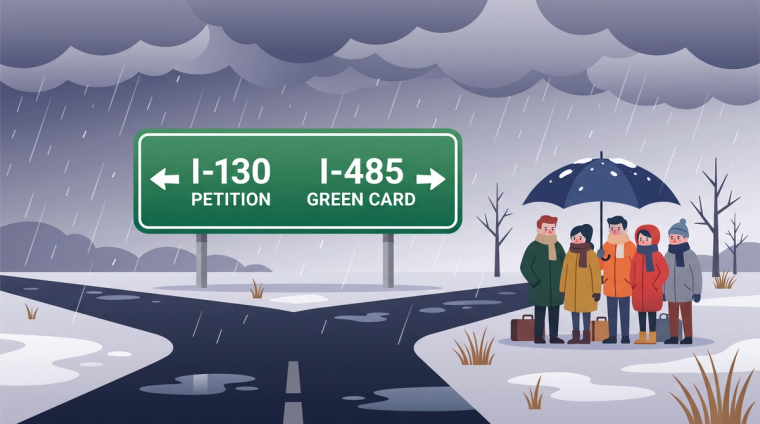
If you are sponsoring a relative or waiting on your own marriage green card, "the backlog" can sound like one undifferentiated pile of cases. It is actually two piles. A family case moves through two separate government steps, and the wait at each one is its own number. As of December 31, 2025, the family green card backlog held roughly 894,500 cases across those two stages combined (USCIS net backlog data, FY2026 Q1). Which stage holds your case tells you a lot more than that headline figure does. This guide puts the petition stage and the adjustment stage next to each other, using the latest USCIS numbers. For how the two forms fit together from start to finish, our I-130 vs I-485 explainer walks through the whole sequence.
The family green card path has two stages
Almost every family-based green card runs through two forms. First is Form I-130, the petition that proves the family relationship is real, filed by the U.S. citizen or permanent resident sponsor. After that comes the green card itself: if the relative is already in the United States and a visa is available, they file Form I-485 to adjust status; if they are abroad, the case goes to a consulate instead. Our complete I-130 guide and I-485 adjustment of status guide cover each form in detail.
For immediate relatives of U.S. citizens, the two forms can often be filed together at the same time, which is called concurrent filing. For most other family categories, the I-130 has to be approved and a visa has to become available before the I-485 can be filed at all. That split in the rules is why the backlog sits unevenly across the two stages, as you will see below. If your relative is overseas, the second stage works differently again: see our I-130 consular processing timeline.
Immediate relatives and preference relatives wait in different places
Family-based cases fall into two buckets, and which bucket you are in determines where your wait happens.
Immediate relatives are spouses, parents, and unmarried children under 21 of U.S. citizens. There is no annual cap on green cards for this group, so a visa is available the moment the I-130 is approved (U.S. Department of State, Visa Bulletin). Their wait is mostly USCIS adjudication time, not a wait for a visa to open up.
Preference relatives are everyone else: spouses and children of green card holders (F2A), adult children of citizens (F1 and F3), and siblings of citizens (F4). Congress caps how many of these green cards are issued each year, so even after the I-130 is approved, the case has to wait for a priority date to become current on the monthly Visa Bulletin. That visa wait can run years, and it is tracked separately from the processing backlog. Our I-130 priority dates and Visa Bulletin guide and our breakdown of how the Visa Bulletin works explain how to read your place in line, and the July 2026 Visa Bulletin analysis shows where the dates stand right now.
This distinction matters for reading the numbers in the next section, because USCIS counts a "visa unavailable" preference case very differently from an immediate relative case that is simply waiting in the queue.
How big the family green card backlog is at each stage
The official USCIS net backlog report showed the following as of December 31, 2025, the close of the first quarter of fiscal year 2026 (USCIS net backlog data).
At the petition stage, Form I-130 carried 489,800 cases in net backlog for immediate relatives, plus another 49,500 for the family preference categories. At the green card stage, family-based Form I-485 adjustment applications carried 355,200 cases. Add those together and the family green card backlog comes to about 894,500 cases sitting across the two stages.
Two numbers are worth pausing on. The immediate relative petition stage is the single largest pile, at nearly half a million cases, and the family-based adjustment stage is large too, at 355,200. The preference petition number, by contrast, looks oddly small at 49,500, which is the opposite of what most people expect given how long preference categories wait. The next section explains why that small number is misleading. For context, these family figures are a slice of a much larger picture: total USCIS net backlog across all forms stood at 6.33 million at the same date, and our post on the broader USCIS backlog and how to keep your case moving covers the system-wide trend.
What the backlog does and doesn't tell you about your wait
The word "backlog" suggests a running clock, but it is really a snapshot. USCIS defines net backlog as cases pending beyond an acceptable timeframe that are within the government's control, after removing two groups: cases delayed by the applicant (for example, while answering a Request for Evidence) and cases where no visa is currently available (USCIS net backlog data, FY2026 Q1).
That last exclusion explains the preference puzzle. Most preference petitions are missing from the net backlog because they are parked, waiting for a visa number, not because USCIS has finished with them. Their real wait shows up in the Visa Bulletin, not in this report. So the modest 49,500 preference figure undercounts the actual wait for those families by a wide margin, while the 489,800 immediate relative figure is closer to a true measure of adjudication delay, since visas for that group are always available.
There is a second limit to keep in mind: a backlog count is not your personal processing time. Your case has a receipt date, a category, and a specific office, and those drive your estimate far more than the national pile does. The USCIS processing times tool gives the category-specific ranges, and our guides to I-130 processing time and I-485 processing time explain how to read them against your own receipt notice. One avoidable factor is entirely up to you: a rejected or incomplete filing restarts the clock, so a form that is filed cleanly the first time tends to clear faster. Immiva checks each answer as you go and flags the gaps that trigger a Request for Evidence, the kind of delay that adds to your own wait rather than the agency's. Immiva's I-130 preparation is built around that: it checks each answer as you go and flags the gaps that trigger an evidence request.
What you control, and what you can only wait on
It helps to sort the timeline into two columns. You control filing accuracy, how fast you respond to USCIS notices, and whether you file the right forms for your category. You do not control the size of the backlog, your priority date, or how quickly a given office works through its queue.
Cost is one of the parts you can plan for. The I-130 petition fee is $675 by mail or $625 online, and the family-based I-485 fee is $1,440 for applicants 14 and older, with a reduced $950 fee for children under 14 filing with a parent (USCIS Fee Schedule, Form G-1055). Many families also pay an attorney $1,500 to $3,000 on top of those government fees. If you would rather skip that, Immiva builds the I-130 and I-485 from one set of answers, checks every answer before you file, and charges a flat fee, a fraction of attorney pricing. While the I-485 is pending, immediate relatives can also apply for work and travel permission; our guide to the I-485 EAD and advance parole covers that. And once an I-130 is approved, the case does not stop there: see what happens after I-130 approval.