

The USCIS instructions call for different evidence depending on whether you have a pending green card application or you’re a permanent resident requesting a reentry permit. Use this I-131 checklist to gather the travel documents for your packet. If your I-485 is pending, compare an EAD and advance parole to decide whether you need authorization to work or travel.
Immiva’s I-131 preparation uses your answers to prepare your document list, completed form, and mailing instructions. Use the lists below to check which attachments belong in your packet.
Choose your i-131 checklist
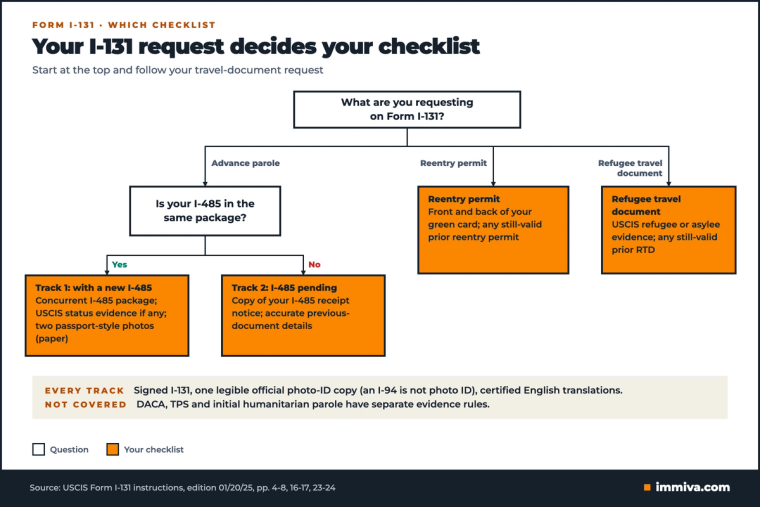
What you need for I-131 depends on your request. Choose one track. The USCIS instructions let you file for advance parole with your I-485 or after you file your I-485. The other tracks cover reentry permits and refugee travel documents (RTDs). DACA, TPS, and initial humanitarian parole have separate evidence rules. The I-131 eligibility check can help you identify your request.
Check these common items first
- [ ] Completed and signed I-131. Sign by hand if you file on paper. You can send a copy of your handwritten signature. A typed name does not count.
- [ ] One legible official photo-ID copy, showing your photograph, name, and date of birth. You can use a passport identity page, green card, qualifying EAD, or government driver’s license. Your I-94 does not count as photo ID.
- [ ] Evidence for your request, as listed below. Include the applicable payment authorization or evidence of exemption.
- [ ] Full English translations for documents in a foreign language. Include the translator’s signed certification of accuracy and competence, printed name, date, and contact information.
Photos and fee payments depend on your category, so check what applies before attaching them.
Advance parole: two filing checklists
Under the USCIS instructions, the documents you need for advance parole depend on whether you file I-485 in the same packet or already have an application pending. Keep your I-131 evidence together as you gather the documents for your I-485. Both lists apply to adjustment-based advance parole.
Track 1: filing with a new i-485
- [ ] Common items above, including photo ID and your signed I-131.
- [ ] USCIS-issued evidence of current status, if any, for example, the relevant I-797 notice.
- [ ] Two recent passport-style photos if you are filing for advance parole on paper from inside the United States.
- [ ] The concurrent I-485 package, arranged so USCIS can identify the adjustment application associated with your request.
- [ ] Check the fee for your I-131. If you pay a fee for a new I-485, check whether it covers this request.
When you file both forms together, you won’t have a receipt for your new I-485 yet. You need a copy of the receipt when you file I-131 separately. When you file I-131 with I-485, USCIS expressly waives the separate explanation of why your circumstances warrant advance parole.
Track 2: filing after i-485, including a new ap request
- [ ] Your signed I-131, photo ID, any status evidence, and applicable photos.
- [ ] A copy of your I-485 receipt notice, which shows you already filed for adjustment.
- [ ] Correct details of previous documents in the fields that request them.
- [ ] Payment authorization or evidence that supports an applicable fee exemption.
The instructions list several ways to document your request. If you file separately and use your adjustment receipt notice, USCIS does not require a medical or employer letter in every case. If you apply under DACA, you must include your deferred-action notice and document an educational, employment, or humanitarian reason for travel. Include your travel dates and how long you plan to be away.
Replacement requests have separate requirements. Enter the relevant I-131 receipt number where the form requests it. You must return damaged or incorrect documents as directed. A copy of an earlier approval can help you organize a new request, though USCIS does not require it for every request.
Reentry permit: evidence of permanent residence
For a reentry permit, include these I-131 supporting documents along with the common items. The USCIS instructions require you to show permanent residence and be physically in the United States when you file.
- [ ] Copies of both sides of your green card, with all details clear.
- [ ] If you have not received the card, choose one of these alternatives. You can send passport biographic pages with evidence of your initial LPR admission, or submit other LPR evidence. USCIS also accepts an I-797 approval notice for your card-replacement application or temporary LPR evidence.
- [ ] Return any previous reentry permit that is still valid, following the return instructions, or provide evidence that it was lost.
- [ ] Payment authorization, if applicable.
An I-90 filing receipt differs from the approval notice that USCIS specifies. Mail clear copies and keep your original green card.
Make time for your biometrics appointment, and finish the required biometrics before you leave. The section on reentry permits does not require every applicant to submit bank statements or travel-purpose letters as initial evidence.
Refugee travel document: evidence of qualifying status
Under the USCIS instructions, the refugee travel document checklist covers refugees and asylees. It also covers permanent residents who obtained residence directly through refugee or asylee status.
- [ ] Common items, including your official photo ID and signed I-131.
- [ ] Evidence of refugee/asylee status issued by USCIS, or an order from the immigration judge granting you asylum.
- [ ] If you apply as a permanent resident, show that you obtained residence directly through refugee or asylee status. Include other information that supports your eligibility.
- [ ] Return any previous RTD that is still valid, following the return instructions, or provide evidence that it was lost or destroyed.
- [ ] The applicable fee or evidence of exemption, adding photos only if your location requires them.
Make sure your A-Number matches across your form and supporting notices.
If you’re already abroad, USCIS can choose to accept your overseas filing within one year of departure. Include evidence of your departure and a detailed statement explaining why you left without applying. Describe your intent, travel, and activities abroad. Ordinarily, you should file before you leave and complete the required biometrics. If you plan to visit the country where you claimed persecution, get an individual legal assessment.
Photos, payment, and the final packet check
Attach photos only when your track requires them
| Filing situation | Photo treatment |
|---|---|
| Paper advance parole, inside the U.S. | Two recent identical passport-style photos |
| RTD applicant outside the U.S. | Two recent identical passport-style photos |
| Domestic RTD or reentry permit | No blanket two-photo attachment rule in the photograph subsection; follow biometrics notices and USCIS requests |
| Eligible online advance parole | Follow the online upload instructions |
If you need paper photos, the USCIS instructions say your passport-style photos must measure 2 × 2 inches and show your full face from the front against a white to off-white background. Follow the directions to lightly mark your name and A-Number, if any, on the back.
Confirm the fee and payment method
Checked October 16, 2026: the USCIS fee schedule lists $630 for a reentry permit. Adjustment-based advance parole generally costs $630 on paper or $580 if you qualify to file online. RTDs cost $0 for refugees and permanent residents who obtained residence through refugee status. For asylees and permanent residents who obtained residence through asylum, the fee is $135 under age 16 and $165 at age 16 or older. Applicable exemptions or waivers can change what you owe.
When you pay your USCIS filing fee by mail, you generally use G-1650 ACH or G-1450 card authorization. The USCIS payment guidance says to include a signed G-1651 and the correct payment when you claim a qualifying paper-payment exemption. A separate parole fee has its own collection rules and exceptions. Do not add it automatically to your filing packet.
Review before sending
- Use edition 01/20/25 as listed on the USCIS I-131 page. Check that every page is present and every footer is visible.
- Verify the current address for your category. Filing locations changed on October 7, 2026, according to the USCIS I-131 addresses page.
- Save a complete copy and follow the packet assembly steps in USCIS mailing guidance.
Immiva’s I-131 preparation lets you check your form, fee, address, and document list before you pay the preparation fee.
For help completing the form, follow our I-131 instructions guide. The I-131 mailing address guide gives you the address for your category and state. Check the I-131 fee guide for fee amounts and exemptions.
Before you choose a travel date, review your unlawful-presence history for risks that could affect travel on advance parole.
Frequently Asked Questions
No. Your I-94 may help document your status. For identification, you need an official document that shows your photo, name, and date of birth. (USCIS instructions, p. 23)
No. When you include your new I-485 in the same packet, you don’t have a receipt yet. You need the receipt copy when you file I-131 separately. Use the I-485 document checklist to prepare the adjustment section. (USCIS instructions, p. 24)
The base-fee exemption applies if you filed your I-485 on or after July 30, 2007 and before April 1, 2024, paid the required fee, and the case is still pending. Check the fee-payment guidance separately. (USCIS fee schedule, p. 50)
Usually, you can send clear copies. Follow the return instructions for previous permits or RTDs that are still valid and for damaged or incorrect documents you’re replacing. Keep your originals in case USCIS asks for them later or at your biometrics appointment. (USCIS instructions, pp. 4–5, 17, 21)
You can file online for standalone adjustment-based advance parole only if your I-485 receipt starts with IOE. For reentry permits and RTDs, you must file on paper. Immiva’s I-131 preparation gives you a paper packet. (USCIS filing table)
Keep a complete copy of your I-131 packet for your records before you mail it.