

Before you pay the I-131 fee, find the row for your travel document. The fee for filing I-131 is separate from the charge for a grant of parole. The 2027 parole-fee notice says that as of October 16, 2026, the charge is $1,050 unless an exception applies. Under USCIS collection policy, leave that charge out of your filing payment.
If you still need to choose a document, Immiva’s I-131 preparation overview shows which requests Immiva supports. If you plan to travel while your green card application is pending, the I-485 work and travel permit guide explains how work and travel authorization fit into your application.
Contents
- Find your filing amount.
- Check the pending-I-485 exemption.
- Review the separate parole charge.
- Choose the correct payment method.
- Compare sample budgets and find answers to common fee questions.
I-131 fee table: find your document and status
The table shows government filing fees from the USCIS fee schedule, checked on October 16, 2026. It covers ordinary fee-paying requests and the exemptions listed here. Other categories have their own rules. Budget separately for private preparation and any charge for a later grant of parole.
| Document or situation | Paper filing | Eligible online filing |
|---|---|---|
| Advance parole with a pending I-485, without an exemption | $630 | $580 |
| Reentry permit, without an exemption | $630 | Not available |
| Refugee travel document for a refugee, or a permanent resident whose residence resulted directly from refugee status | $0 | Not available |
| Refugee travel document for an asylee or qualifying former-asylee permanent resident, under 16 | $135 | Not available |
| Same asylee category, age 16 or older | $165 | Not available |
| TPS beneficiary travel authorization, without an exemption | $630 | $580 |
| Qualifying older, paid, still-pending I-485 described below | $0 | Confirm the submission route |
The amounts and status distinctions come from USCIS G-1055, Appendix B. The USCIS I-131 filing table shows which categories can file online. Check yours before you choose a filing route.
Advance parole and the online discount
For ordinary advance parole, federal rules set the fee at $630 by mail or $580 if your category is eligible for online filing. The $50 discount depends on whether you can file online. Having a pending green card application alone does not qualify you.
For pending-I-485 advance parole, the USCIS I-131 filing table lists an IOE receipt-number requirement, but the same table lists the category as paper-only. Before you budget $580 for filing, check whether your USCIS account offers online filing for your category. An IOE prefix alone does not resolve those conflicting instructions.
Reentry permits and refugee travel documents
For an ordinary reentry permit, you pay $630. You must file I-131 on paper. USCIS may still require a biometrics appointment, but its current schedule leaves out the old $85 charge.
Your refugee travel document fee depends on your status first, then your age. If you are a refugee or became a permanent resident directly through refugee status, your fee is $0. Asylees and qualifying permanent residents who were asylees generally pay $135 if under 16 or $165 if 16 or older. Both groups request the same document, called a “refugee travel document.”
The application steps depend on whether you need a reentry permit or a refugee travel document.
The form number alone does not tell you what to pay. If USCIS returned your filing because you paid the wrong amount, start with the rejection notice when you correct the payment error.
Is advance parole free with a pending i-485?
Filing the forms together today does not automatically qualify you for free advance parole. Check when you filed your I-485. Under federal fee rules, the exemption covers applications filed on or after July 30, 2007, and before April 1, 2024. You must also have paid the required I-485 fee, and that application must still be pending.
Check your records for these three conditions.
- Filing date: you filed your I-485 within that date window.
- Payment: you paid the required I-485 filing fee.
- Current status: the same application remains pending.
If you meet all three conditions, you qualify for a $0 advance-parole filing fee, even if you request the document after filing the I-485. Your income does not determine eligibility for this exemption.
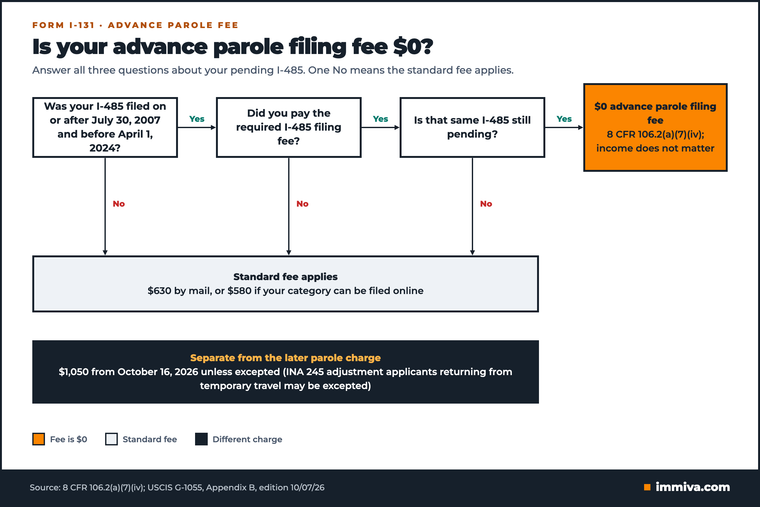
If you filed your I-485 in March 2024, paid the required fee and still have that application pending, you may qualify. If you file a fee-paying I-485 in October 2026, the USCIS fee schedule generally calls for a separate advance parole fee unless another exemption applies. Your filing history determines eligibility, even if you mail the forms together.
Have your receipt notice ready when you check the fee. The USCIS I-131 page lists the pending-I-485 receipt as evidence for a separately filed request. Keep the receipt with the other documents for your I-485.
You can find the current cost of the underlying adjustment application in the I-485 filing-fee guide.
The separate parole charge: $1,050 from october 16
Under the 2027 adjustment notice, the immigration parole charge applies to a covered grant of parole. Submitting Form I-131 or receiving an advance travel document alone does not trigger that fee. DHS may assess it whenever parole is granted, unless a statutory exception applies.
| When parole is granted | Amount unless excepted |
|---|---|
| October 16 through December 31, 2025 | $1,000 |
| January 1 through October 15, 2026 | $1,020 |
| October 16, 2026 onward under the FY 2027 schedule | $1,050 |
Sources: 2026 adjustment notice and 2027 adjustment notice.
Use the date parole is granted. Filing before October 16, 2026 does not lock in $1,020 for a covered grant on or after that date. The 2027 notice leaves the ordinary filing amounts in the first table unchanged. The USCIS fee schedule still lists $630 or $580.
The adjustment-applicant exception
Under section 100004(b)(7) of the statutory parole-fee rules, the exception covers a lawful applicant for adjustment under INA 245 returning from temporary travel abroad. You must show to DHS’s satisfaction that you qualify for this exception. An advance parole document alone does not prove eligibility.
The USCIS Policy Manual says in section C.1 and footnote 22 that this exception does not cover adjustment under INA 209 or INA 245A. DACA or a pending asylum application alone does not establish eligibility for the INA 245 exception either. Check the conditions for any other statutory exception you plan to use.
If you are a qualifying current INA 245 adjustment applicant, you can owe the $630 filing fee under the fee regulation and qualify for the exception to the later $1,050 charge. If your qualifying I-485 was filed under the older rules, you may meet both sets of conditions. Your filing payment alone does not settle either question.
When and where payment happens
Keep the additional parole payment out of your initial USCIS request. Under section C.2 of its collection policy, USCIS sends written payment instructions for covered parole-in-place or re-parole cases. At a port of entry, CBP makes the final decision on whether the exception applies and collects any required payment there. Follow the instructions from the agency handling your case.
Under section 100004(f), you cannot get this charge waived or reduced because you cannot afford it. If a statutory exception applies, you do not owe the charge. The USCIS litigation alert says the agency has paused specific fees for confirmed Ms. L. settlement class members and qualifying additional family members under the February 5, 2026 court decision. That narrow court-related rule provides no general humanitarian exemption.
If your I-485 is pending and you plan to travel, check how advance parole works before you leave.
How to pay without creating a filing problem
Use the payment authorization that matches your filing route and fee. The USCIS filing-fee guidance generally requires electronic payment authorization for paper applications. Use G-1450 for a credit, debit, or prepaid card, or G-1650 for ACH debit from a U.S. financial institution. If you meet the eligibility conditions on the USCIS G-1651 page, you may use G-1651 to request a paper-payment exemption. If you file online, pay through your USCIS account.
If your package includes several benefit requests, provide separate payment authorizations for each request and use one type of payment method throughout the package. Never combine the travel-document and adjustment payments on one authorization. The USCIS payment guide walks you through the payment paperwork.
Check these five items before you mail the package:
- Request: match the fee row to the document you selected.
- Exception: confirm that you meet the status, age, or older-I-485 conditions you rely on.
- Authorization: complete the current payment form with the correct amount.
- Form edition: check that every page uses the accepted edition.
- Destination: confirm the current address for your request category.
The USCIS I-131 page currently lists the 01/20/25 I-131 edition. An October 7, 2026 alert announced changes to some filing locations. Check the USCIS page immediately before you mail your application.
Find the current address for your category, state, and carrier in our I-131 mailing address guide. Gather your documents with the I-131 checklist.
Under the USCIS I-912 instructions, you can request a fee waiver only if both you and your request qualify. Ordinary pending-I-485 advance parole has no general hardship waiver. Ordinary reentry-permit filing does not qualify for an income-based waiver. The USCIS fee schedule gives the waiver rules for refugee travel documents and other listed categories. Before you leave out payment, check your eligibility in the current I-912 instructions and fee schedule.
If USCIS returned your package, read the notice before you pay again: a rejection for a filing problem is not a decision on an accepted case. Once USCIS accepts a request, it generally keeps the fee even if it denies the request or you withdraw it.
Budget examples: government fees and preparation costs
Your budget has three parts. Allow for the filing payment, any later parole charge and the cost of any preparation service you choose.
| Example | Government filing amount | What the example assumes |
|---|---|---|
| Ordinary reentry permit | $630 | Paper filing, no applicable exemption |
| Qualifying older pending-I-485 advance parole | $0 | Filing-date, payment, and pending-status conditions all met |
| Paper I-485 for an adult, qualifying reduced-fee I-765, paper advance parole | $2,330 | $1,440 + $260 + $630 |
| Same paper-I-485 example with eligible online advance parole | $2,280 | $1,440 + $260 + $580 |
These examples use the USCIS fee schedule and the fee regulation. Under federal fee rules, the $260 work-permit amount applies only if you have a qualifying, fee-paid I-485 filed on or after April 1, 2024.
These adjustment examples exclude a family petition, medical examination, photos, delivery, representation, private preparation, and any separately applicable later fee. Include any of those expenses that apply to you when you estimate your total green card application cost.
To assemble your paper packet, Immiva’s I-131 preparation uses your answers to organize the request, fee, address and evidence for $99. You can review the forms, fee, address and document list before paying for preparation. You pay the government separately. Immiva does not file an online USCIS application for you.
Include the other adjustment costs covered in the I-485 filing-fee guide.
Frequently Asked Questions
Ordinary advance parole costs $630 on paper or $580 if you qualify to file online. An ordinary reentry permit costs $630. For a refugee travel document, check the fee for your status and age in the current USCIS schedule. Use the travel-document eligibility checker for help choosing your request.
No. The current fee schedule lists no extra biometrics charge for these requests. USCIS can still require an appointment. The biometrics appointment guide explains what to expect.
No. The fee is $0 if you fall within a qualifying refugee category. In a qualifying asylee category, you generally pay $135 if you are under 16 or $165 if you are 16 or older. Find your status in Appendix B. The document name alone cannot tell you what you owe.
You may qualify for a free renewal if you still meet the older paid-I-485 exemption. Check the fee for each new request, even if you paid for the previous request. (8 CFR 106.2(a)(7)) Organize your underlying records using the I-485 document checklist.
Confirm with USCIS whether your earlier payment covers the emergency request under your exemption category. Use the I-131 page to find the urgent-travel procedure and the USCIS payment guide to understand the payment forms.
No. Paying the fee does not give you permission to travel or guarantee your return. The USCIS I-131 alert explains changes to unlawful-presence treatment for advance-parole departures. Read it before departure and get advice about your specific travel risk.
Confirm your amount before submitting
Before filing, recheck the I-131 row in the USCIS fee schedule for your document, status and filing route. Check the older-I-485 exemption separately from the INA 245 exception. If you owe the parole charge, follow the agency’s payment instructions. The 2027 parole-fee notice sets the charge at $1,050 for parole granted on or after October 16, 2026.