
The current I-485 filing fee is $1,440, but by the time you add medical exams, work permits, and travel documents, most applicants end up spending $3,000 to $9,000+. Here's the full 2026 breakdown.
If you've searched for the I-485 filing fee in the past few months, you've probably run into conflicting numbers. Some sites still list $1,225. Others say $1,140. A few get the fee right but skip the work permit and travel document costs, which went from free to $890 since the rules changed. This guide walks through the 2026 I-485 cost line by line, with breakdowns for single applicants and families up to four people. All the numbers here come straight from the USCIS G-1055 Fee Schedule and the official Form I-485 page. For a wider look at the adjustment-of-status process and how it compares to filing the I-130 petition first, keep reading.
The Current I-485 Filing Fee in 2026
The I-485 filing fee depends on the applicant's age and whether they file with a parent. As of April 2026, the fees are:
| Applicant | Filing fee | Biometrics | Total USCIS fee |
|---|---|---|---|
| I-485, age 14 and older | $1,440 | Included | $1,440 |
| I-485, under 14, filing with a parent | $950 | Included | $950 |
| I-485, under 14, filing alone | $1,440 | Included | $1,440 |
A few things worth pulling out from that table.
Biometrics are bundled. The old $85 biometrics fee was rolled into the main filing fee under the April 2024 fee rule. There is no separate biometrics payment for I-485 anymore. If you receive a biometrics appointment notice, you don't owe anything at that step.
Form I-485 is currently paper-only. USCIS does not list Form I-485 as a form available to file online, so there is no online filing discount for Form I-485 at this time.
For most standard USCIS-filed I-485 applications, the base fee has stayed at $1,440 since April 1, 2024. USCIS did update Form G-1055 in 2025 after the H.R. 1 fee changes took effect, though, and the current fee schedule now also lists a $1,500 I-485 fee if the form is filed with, or adjudicated by, the Immigration Court.
What Changed in April 2024 (And Why So Many Sites Are Wrong)
The April 2024 fee rule did two things that changed the math on what an I-485 actually costs.
The first change was modest: it raised the base I-485 fee from $1,140 to $1,440 and folded in the $85 biometrics charge. Annoying, but not dramatic on its own.
The second change was the bigger deal: it unbundled the work permit (Form I-765) and travel document (Form I-131) from the I-485 package. Before April 1, 2024, anyone filing I-485 could file I-765 and I-131 alongside it for $0 extra. After that date, each form carries its own fee: $260 for the I-765 and $630 for the I-131.
So a single applicant who files all three forms concurrently now pays $2,330 instead of $1,225. That is roughly a 90% jump in what most applicants will spend on USCIS forms alone.
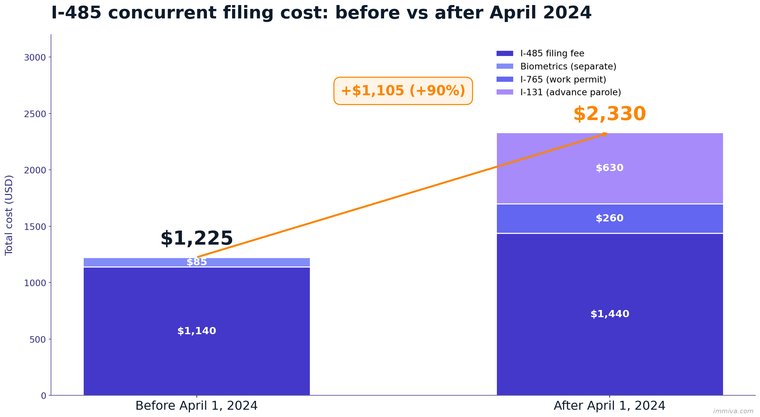
A side-by-side look at what concurrent I-485 filing cost before the April 2024 fee rule versus after. Most of that 90% increase comes from unbundling the work permit and travel document.
There is a grandfathering provision worth knowing about. If you filed your I-485 between July 30, 2007 and April 1, 2024 and paid the applicable fee at the time, you can still file I-765 and I-131 at no additional charge while your I-485 is pending. Anyone filing today does not get that benefit.
Concurrent Filing Costs: I-485 Plus I-765 and I-131
For most applicants, "I-485 cost" means the cost of all three forms together, since the work permit and travel document make life much easier while the green card application sits in queue.
| Form | What it gets you | Fee |
|---|---|---|
| I-485 | Adjustment of Status (the green card application itself) | $1,440 |
| I-765 | Employment Authorization Document (EAD), valid 5 years | $260 |
| I-131 | Advance Parole. Lets you re-enter the U.S. while I-485 is pending | $630 |
| Total per person | $2,330 |
The $260 I-765 fee is a 50% discount off the standalone $520. USCIS only charges the lower amount when I-765 is filed alongside a pending I-485. The $630 I-131 fee, by contrast, is the same whether filed concurrently or standalone.
Whether you need both supplementary forms depends on your situation. A few questions to think through:
- Do you already have valid work authorization through an H-1B, H-4 EAD, J-2 EAD, or similar status? If yes, you may not need to file I-765 right away. The same logic applies to children in school who don't plan to work.
- Do you have any plans to leave the United States during the 12+ months your I-485 may be pending? If no, you can skip the I-131. Leave without an approved Advance Parole, though, and USCIS will treat your I-485 as abandoned in nearly all cases.
- Are you on a status with strong dual-intent protections like H-1B or L-1? You may be able to keep that nonimmigrant status as a backup and rely on it for travel and work, which lets you put off the I-765 and I-131 for now.
Total I-485 Cost by Family Size
This is where the math gets uncomfortable. USCIS doesn't offer family discounts on adjustment of status. Each person needs their own I-485, their own medical exam, and usually their own I-765 and I-131. Whether you need one Form I-130 or several depends on the visa category: many cases require a separate I-130 for each beneficiary, while derivative beneficiaries are only available in some categories.
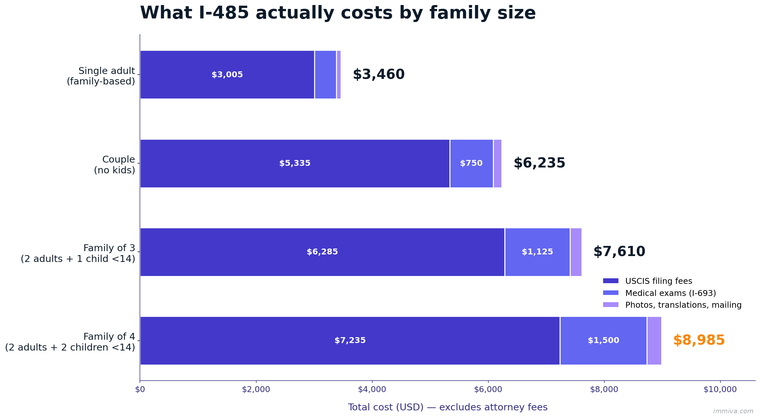
USCIS-only costs scale almost linearly with family size. The I-130 petition is the one cost that doesn't multiply.
Here is the line-by-line breakdown for each scenario, assuming family-based filing (so Form I-130 is included at $675):
Single adult (family-based):
| Item | Amount |
|---|---|
| I-130 | $675 |
| I-485 | $1,440 |
| I-765 | $260 |
| I-131 | $630 |
| Medical exam | $250–$500 |
| Photos, translations, mailing | $55–$170 |
| Subtotal (no attorney) | $3,310–$3,675 |
| Attorney (optional) | $3,500–$5,000 |
Couple:
| Item | Amount |
|---|---|
| I-130 (one petition covers spouse) | $675 |
| I-485 × 2 | $2,880 |
| I-765 × 2 | $520 |
| I-131 × 2 | $1,260 |
| Medical exam × 2 | $500–$1,000 |
| Other | ~$150 |
| Subtotal (no attorney) | $5,985–$6,485 |
Family of 4 (couple + 2 children under 14):
| Item | Amount |
|---|---|
| I-130 | $675 |
| I-485 × 2 adults | $2,880 |
| I-485 × 2 children under 14 | $1,900 |
| I-765 × 2 adults | $520 |
| I-131 × 2 adults | $1,260 |
| Medical exam × 4 | $1,000–$2,000 |
| Other | ~$250 |
| Subtotal (no attorney) | $8,485–$9,485 |
A few cost-saving notes that other guides routinely miss. Children in school who don't need to work can skip the I-765 and save $260 each. Family members who don't plan to travel can skip the I-131 and save $630 each. And the under-14 reduced fee of $950 only applies when the child files concurrently with at least one parent; kids filing alone pay the full $1,440.
For employment-based cases, swap the I-130 for the I-140 ($715), and budget for the separate Asylum Program Fee that generally applies to Form I-140 filings ($600, with reduced $300 or $0 rates for certain filers). Request premium processing on an eligible I-140 classification and the fee is $2,965 for requests postmarked on or after March 1, 2026. There's no premium processing for the I-485 itself.
The Medical Exam (Form I-693): $200 to $500+
The I-693 immigration medical exam has no USCIS fee, but the civil surgeon who completes it does. Costs vary widely by city and provider, with bundled packages typically running $349 to $400. Individual line items look like this:
- Physical exam plus I-693 paperwork: $200–$250
- TB blood test (QuantiFERON): around $95
- Syphilis screening: around $15
- Gonorrhea urine test: around $55
- Hepatitis B test: around $45
- Missing vaccinations: $50–$300+ depending on what you need
- Chest X-ray (only if TB test is positive): $50–$150
Two policy points matter for budgeting. Effective December 2, 2024, USCIS requires applicants who must submit Form I-693 to include it with Form I-485. And as of June 11, 2025, a Form I-693 signed on or after November 1, 2023 stays valid only while the specific application it was submitted with remains pending, so if that I-485 is denied or withdrawn and you refile, you'll generally need a new medical exam.
Health insurance almost never covers immigration medical exams because they're classified as elective or administrative. Plan to pay out of pocket.
Attorney Fees vs. DIY vs. Guided Filing
This is the line item with the widest range, and the one where most applicants overspend. Standard attorney fees in 2026 look like:
| Case type | Attorney fee range |
|---|---|
| Standard AOS (I-485 only) | $2,000–$3,500 |
| Marriage-based (I-130 + I-485) | $3,500–$5,000 |
| Employment-based (I-140 + I-485) | $4,700–$5,200 |
| Each additional dependent | $1,000–$2,500 |
| RFE response | $3,000–$5,000 |
Many applicants can file without an attorney. The same logic the N-400 cost guide lays out for naturalization applies here: guided software builds every form from one set of answers, so the forms can't contradict each other, and checks each answer against the current form edition. You pay a flat fee instead of an hourly bill. Where attorneys earn their fee is in cases involving prior immigration violations, criminal history, prior denials, or messier employment-based wrinkles like job changes under AC21.
If you're in removal proceedings, have an arrest or conviction on your record, a prior denial or misrepresentation finding, or need a waiver, hire an attorney. Otherwise, don't assume the only options are $0 (full DIY) and $5,000 (full representation). Guided filing gets you the checks without the hourly bill.
Hidden Costs Most Applicants Don't See Coming
The $1,440 sticker price is just the start. Here are the costs that catch first-time filers off guard:
EAD and Advance Parole renewals. USCIS can issue up to 5-year EADs to pending adjustment applicants in category (c)(9), but if your case outlasts the card's validity, renewing the EAD and advance parole still adds $260 + $630 = $890 per person. Eligible EAD renewal applicants, including category C09 adjustment applicants, can also get an automatic extension of up to 540 days by filing a renewal on time; that extension was permanently increased in late 2024, not eliminated in 2025.
Document translations. Every non-English document you submit to USCIS needs a certified English translation, including birth certificates, marriage certificates, divorce decrees, and foreign police clearances. Translation services run $20 to $50 per page.
Travel to USCIS appointments. USCIS schedules biometrics and interviews at specific Application Support Centers and field offices. If you don't live near one, budget $200 to $1,000+ in travel over the life of the case.
RFE response costs. If USCIS issues a Request for Evidence and you bring in an attorney to respond, expect $3,000 to $5,000 added to your bill.
Non-refundable everything. USCIS fees are non-refundable. If your I-485 is denied, the $1,440 is gone. With the USCIS backlog still north of 11 million cases, denials and long waits are both real risks worth pricing in.
Fee Waivers: Who Actually Qualifies
Most applicants searching for I-485 fee waivers don't qualify. Standard family-based and employment-based applicants are not eligible regardless of income. The Form I-912 fee waiver is limited to specific protected categories:
- VAWA self-petitioners (abused spouses, children, or parents of U.S. citizens or LPRs)
- T visa holders (trafficking victims) and derivatives
- U visa holders (crime victims) and derivatives
- Special Immigrant Juveniles
- Battered spouses of A, G, E-3, or H nonimmigrants
Refugees adjusting under INA § 209(a), current and former U.S. Armed Forces members, and certain NACARA applicants are fully fee-exempt. They pay $0.
Eligible applicants must also demonstrate inability to pay through one of three paths: receiving a means-tested benefit (Medicaid, SNAP, TANF, SSI), household income at or below 150% of the Federal Poverty Guidelines, or extreme financial hardship.
How to Pay USCIS Filing Fees
As a general rule, USCIS stopped accepting personal and business checks, money orders, and cashier's checks for paper filings on October 28, 2025, unless you qualify for an exemption. For paper I-485 filings, the standard payment options are Form G-1450 for card payment or Form G-1650 for ACH debit. Filers who qualify for an exemption from the electronic-payment requirement need to use Form G-1651 with an approved paper-based payment method instead.
- Form G-1450 for credit, debit, or prepaid card payments
- Form G-1650 for ACH bank transfers (a newer option that's easier for large payments)
- Money orders and cashier's checks generally aren't accepted for paper USCIS filings unless the filer qualifies for an exemption from the electronic-payment requirement and submits Form G-1651.
Form I-485 is not currently available to file online. For paper filings, each form requires a separate payment, and USCIS may reject a package if you submit a single combined payment for multiple forms. For forms that are actually filed online, USCIS processes payment through the online system. The full guide to paying USCIS filing fees covers each method step by step.
Frequently Asked Questions
The I-485 filing fee is $1,440 for applicants age 14 and older, and $950 for children under 14 filing with a parent. Biometrics are included. With the work permit (I-765, $260) and travel document (I-131, $630) added, the per-person USCIS total comes to $2,330.
No. They were free if your I-485 was filed before April 1, 2024. For any I-485 filed on or after that date, the I-765 costs $260 and the I-131 costs $630, separately.
No. Since April 1, 2024, the $85 biometrics fee has been bundled into the main I-485 filing fee. You don't pay anything additional at your biometrics appointment.
Only if you fall into one of the protected categories: VAWA, T visa, U visa, SIJS, or certain battered spouses. Standard family-based and employment-based applicants do not qualify, and applying anyway can create public charge issues.
Most civil surgeons charge $200 to $500, with $349 to $400 typical for a bundled package. Costs go up if you need missing vaccinations or a chest X-ray for TB follow-up. Health insurance does not cover this exam.
No. I-485 fees are generally the employee's responsibility, though some employers cover them as a benefit. What the employer must pay is different: PERM labor certification costs, including their own attorney fees (20 CFR 656.12(b)), and the $600 Asylum Program Fee on a Form I-140 ($300 for small employers, $0 for nonprofits). The I-140 filing fee itself carries no employer-pays rule, though most employers cover it. Check your offer letter or HR policy. The work permit and travel document are also typically the employee's cost unless the employer agrees otherwise.
No. Premium processing is only available for I-129, I-140, certain I-539, and certain I-765 categories. There is no fast-track payment option for the I-485 itself, although you can request a discretionary expedite for severe financial loss or urgent humanitarian reasons.
No. All USCIS fees are non-refundable, regardless of outcome. If your case is denied, the $1,440 (and everything else) is gone.
Processing times in 2026 typically run 9 to 16 months for employment-based cases and 11 to 26 months for family-based cases, depending on the service center or field office. The I-130 processing time guide covers timing for the underlying family petition, and USCIS processing times shows the current estimates by category.
USCIS will reject your entire I-485 package and return it. You'll lose nothing in fees (a rejected G-1450 or G-1650 payment isn't charged), but you may lose your filing date, which can hurt if your priority date later retrogresses or if you're racing a pending immigrant visa freeze or other policy change.