
Most couples budget for one form and get surprised by four. The petition is only the entry ticket, and the fee schedule changed enough in the last two years that half the cost guides still circulating on the internet are quoting numbers that no longer exist.
This post covers one narrow thing: what a marriage-based adjustment of status costs in 2026 when you file the petition and the green card application together. If you want the fee for the petition on its own, our I-130 filing fee breakdown covers that form alone. If you want the mechanics of filing both at once rather than the price, read the concurrent filing strategy guide. Here we are talking about money.
Every figure below comes from the USCIS fee schedule on Form G-1055, edition 05/29/26, and we checked every one twice before publishing.
What a marriage green card costs in 2026
Here is the whole picture in one table. The "who pays" column matters more than people expect, because the sponsor and the applicant are often keeping separate accounts.
| Item | Paper | Online | Who pays | Required? |
|---|---|---|---|---|
| I-130 Petition for Alien Relative | $675 | $625 | Sponsoring spouse | Yes |
| I-485 Application to Adjust Status (age 14+) | $1,440 | $1,390 | Applicant | Yes |
| I-485 (child under 14, filing with a parent) | $950 | $900 | Applicant | If applicable |
| I-765 Work Permit | $260 | $260 | Applicant | Optional |
| I-131 Advance Parole | $630 | $580 | Applicant | Optional |
| I-130A Spouse Beneficiary Information | $0 | $0 | Applicant | Yes |
| I-864 Affidavit of Support | $0 | $0 | Sponsor | Yes |
| I-693 Medical Exam form | $0 | $0 | Applicant | Yes |
That produces three numbers worth remembering. The government fee floor for a concurrent marriage filing is $2,115 on paper, or $2,065 if the sponsor files the I-130 online. The full package with both the work permit and advance parole runs about $3,005. And the realistic all-in total, once you add the medical exam and paperwork, sits between roughly $2,400 and $3,800 depending on which optional forms you file and how many documents need translating.
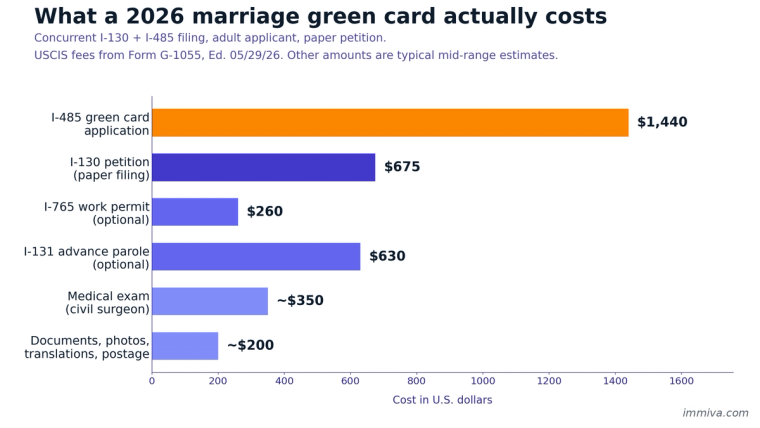
Every line item in a 2026 concurrent marriage green card filing, from the $1,440 I-485 down to postage and photos.
Why most cost guides you read are already wrong
Three changes since 2024 made a lot of published advice wrong, and you will still find all three errors on pages updated this year.
The work permit and travel document are no longer free. This is the big one. For adjustment applications filed between July 30, 2007 and March 31, 2024, the I-765 and I-131 carried no separate fee when filed alongside a pending I-485. The April 2024 fee rule ended that. File today and you pay $260 and $630 respectively (CLINIC). We found law firm pages updated in 2026 still telling readers these forms are included at no extra charge. They are not, and believing it puts you $890 short.
USCIS stopped taking checks. As of October 28, 2025, personal checks, cashier's checks and money orders are gone. Paper filings must include either Form G-1450 for a credit or debit card or Form G-1650 for an ACH debit from a U.S. bank account. We covered the switch when it happened in our post on USCIS ending check payments. Any guide still telling you to write a check will get your packet returned.
A new I-485 edition becomes mandatory on September 18, 2026. USCIS will only accept the 09/18/26 edition for anything postmarked on or after that date, and there is no grace period. The 01/20/25 edition gets rejected outright (USCIS alert). The revision updates the form for the new public charge rule, which takes effect the same day. Filing the wrong edition is not a small correction. It is a full rejection, and you start over.
That last point is exactly the kind of thing that costs people a whole filing cycle over a detail nobody told them to check. If you are filing anywhere near mid-September, confirm the edition date printed at the bottom of the form before you seal the envelope.
The USCIS fees, line by line
Form I-130, $675 by mail or $625 online. The sponsoring spouse files this one. Filing it through a USCIS online account saves $50, and it is the easiest $50 in the whole process. Our guide to the spousal petition covers what goes in it.
Form I-485, $1,440 by mail or $1,390 online. The largest single charge, and the one that makes people flinch. A child under 14 filing with a parent's application pays $950 instead. Family-based adjustment generally goes on paper, so most couples pay the $1,440.
Form I-765, $260. Optional. Buys you a work permit while the case is pending.
Form I-131, $630. Optional. Buys you advance parole to travel while the case is pending.
Forms I-130A, I-864, I-693 and I-912, all $0. These carry no filing fee. The I-864 affidavit of support is free to file but has an income test behind it, and you can check yours against the 2026 guidelines with our sponsor income calculator.
No, biometrics is not a separate fee
You will see "biometrics fee" as a line item on competitor cost pages and in older law firm posts. For the I-130, I-485, I-765 and I-131 there is no separate biometric services fee in the current schedule. It is bundled into the form fee. You will still be scheduled for a biometrics appointment, you just will not be billed again for it. Anyone adding $85 to your estimate is working from a schedule that expired.
Are the work permit and travel document worth paying for?
Now that they cost real money, this is a genuine decision rather than a default. The work permit is usually worth it if the applicant intends to take a job before approval, since combined I-130 and I-485 cases for immediate relatives typically take eight to fourteen months. Advance parole is harder to justify. It sometimes takes longer to adjudicate than the underlying green card application, which means you can pay $630 and have the I-485 approved before the travel document ever arrives. Our post on working and traveling while the I-485 is pending goes deeper on the tradeoff.
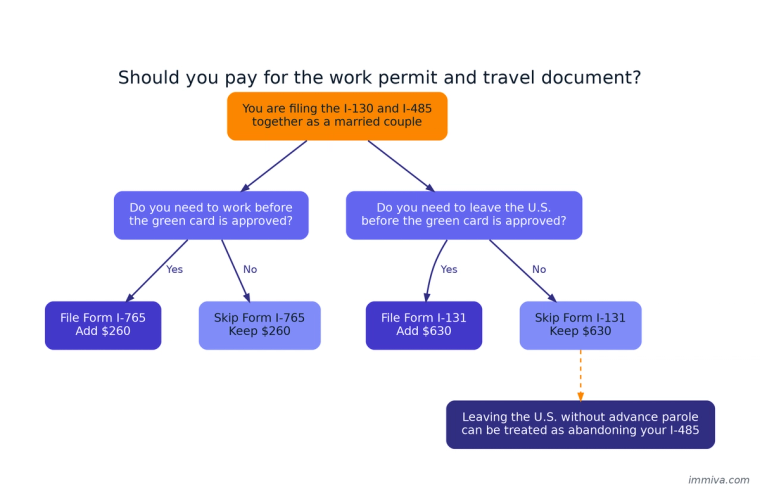
A simple way to decide whether the $260 work permit and the $630 travel document belong in your packet.
The costs nobody budgets for
USCIS fees are the visible part. These are the ones that show up after you have already decided you can afford this.
| Cost | Typical 2026 range | Notes |
|---|---|---|
| Medical exam with a civil surgeon | $200 to $500 | USCIS charges nothing; the doctor sets the price |
| Missing vaccinations | $50 to $200+ per series | Billed separately by the clinic |
| Certified translation | $20 to $40 per page | Any foreign-language document; no notarization needed |
| Passport-style photos | $8 to $18 | Varies widely by pharmacy |
| Birth certificate copy | $10 to $35 | State-dependent, plus service fees |
| Marriage certificate copy | $10 to $20 | From state vital records |
| Divorce decree, if either spouse was married before | $15 to $30 | Per copy |
| Postage with tracking | $10 to $30 | Concurrent packets are heavy |
Budget $300 to $800 on top of the government fees. The medical exam is the biggest single item and the prices genuinely vary, so call three civil surgeons before booking. Our I-693 medical exam guide explains what the appointment covers and how long the sealed results stay valid.
Translation costs are the sleeper expense. A birth certificate, a marriage certificate and a divorce decree at $30 a page add up faster than couples expect, particularly for multi-page civil documents.
Three ways to file, and what each really costs
| Approach | Preparation cost | What you get | Best for |
|---|---|---|---|
| Do it yourself | $0 | The blank forms and the instructions | Simple cases, patient people, no complications |
| Immiva | $149 + $249 | Both forms prepared, I-864 income math done, up to 37 pre-filing checks | Marriage cases that need to be right the first time |
| Other online services | $600 to $1,500 | Guided prep, sometimes an attorney review tier | Couples who want a human review step |
| Immigration attorney | $2,500 to $7,000+ | Full representation | Overstays, prior denials, criminal history, removal proceedings |
Whichever way you go, the government fees dwarf the preparation cost. You are paying somewhere between $2,065 and $3,005 to USCIS regardless. The question is only how much you add on top, and how much risk you carry.
Immiva charges $149 for I-130 preparation and $249 for I-485 preparation. I-485 preparation includes Form I-864 when it applies. Government filing fees are separate.
Compare that to the alternative. The inadmissibility block near the end of the I-485 runs dozens of yes-or-no questions about criminal history, security, fraud and public benefits, and answering one of them wrong is grounds for denial rather than a polite request to fix it. Attorneys charge thousands precisely because someone has to read those answers carefully. Immiva checks every one of them against the rest of your file automatically, for less than the cost of the passport photos and the medical exam combined.
One caveat: if there is an open immigration court case, a removal order or a prior denial in your history, that belongs with an attorney first. Immiva flags it in your report and says so.
How to pay without getting your packet rejected
Payment is where clean applications die. The rules are strict and USCIS does not call you to sort it out.
One payment per form. Each form needs its own separate payment authorization. A single G-1450 covering the I-130 and the I-485 together gets rejected. Filing all four forms means four separate authorization forms in the same envelope.
You cannot mix payment types for one form. USCIS will not accept a single form paid partly by card and partly by ACH, even if the total is exactly right (USCIS Filing Fees).
The amount must be exact. Wrong fee, and the entire package comes back. Not the one form, the package.
Tell your bank first. A multi-thousand-dollar charge from the Department of Homeland Security is exactly what fraud detection is built to block, and USCIS does not retry a declined card. Foreign-issued cards are also a common failure point, though prepaid cards bought in the U.S. work.
If you genuinely cannot use electronic payment, Form G-1651 requests an exemption to pay on paper. Our guide to paying USCIS filing fees walks through each method.
Fee waivers and the savings that actually work
Fee waivers on Form I-912 exist, but they rarely help marriage-based applicants, and the reason is structural. Your sponsor has to sign an I-864 affidavit of support proving income at 125% of the federal poverty guidelines, which for a household of two in 2026 is $27,050. Asking USCIS to waive fees for inability to pay while simultaneously certifying you can support an immigrant is a contradiction the agency notices. Read our sponsor income requirements guide for the full thresholds.
The savings that do work are unglamorous. File the I-130 online and keep $50. Skip advance parole if you have no travel planned and keep $630. Call several civil surgeons instead of booking the first one. And get the packet right the first time, because a rejection costs you months, not dollars.
Budgeting properly for concurrent filing fees on the I-130 and I-485 is mostly a matter of knowing that four forms exist rather than one, that two of them stopped being free in 2024, and that the medical exam is not a rounding error. Get those three things right and the number stops being a surprise. Then check the form editions before you seal the envelope.