
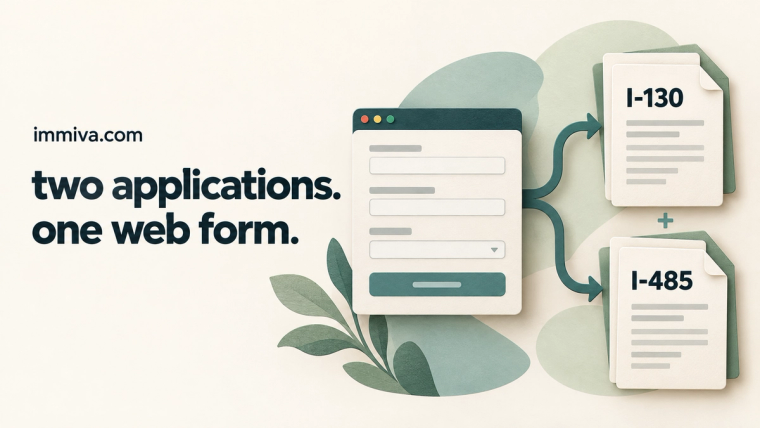
Filing the family petition and the green card application at once is the fastest route to a green card for a relative already in the U.S. It's also where do-it-yourself packets fall apart, because the same names, dates and marriage details have to line up across as many as four forms. Starting today, you can file I-130 and I-485 together without a lawyer using Immiva's concurrent filing application. The sponsor answers questions about the petition, the relative answers questions about the green card, and Immiva builds the whole packet from those answers.
For background on each form, see our I-130 petition for alien relative guide and our I-485 adjustment of status guide. This post is about doing both at once.
Who can file the I-130 and I-485 together
USCIS calls this concurrent filing: the I-485 goes in before the I-130 is approved, in the same package or while the petition is pending (USCIS, Concurrent Filing of Form I-485). Whether it's open to you comes down to three things.
Your relationship. Spouses, parents and unmarried children under 21 of U.S. citizens are immediate relatives. There's no yearly cap on their green cards, so they can always file together (USCIS). A citizen petitioning for a parent must be at least 21 (USCIS, Form I-130).
Visa availability. Every other family category, including spouses and children of green card holders, can file together only when a visa number is immediately available for that category and country (8 CFR 245.2(a)(2)(i)(B)). That means checking the Visa Bulletin and the chart USCIS says to use that month. Our visa bulletin checker shows the current dates by category.
Where the relative lives. Concurrent filing only exists for people adjusting status inside the U.S. A relative abroad goes through a U.S. consulate, and that route starts with the I-130 on its own (USCIS).
Being in the U.S. isn't the same as being able to adjust there. How the relative entered, whether they kept their status, and their answers to the background questions on the I-485 all decide whether the application can go forward. Settle that with the free I-130 and I-485 eligibility check before you send more than $2,000 in fees to USCIS.
Where DIY concurrent filings go wrong
With a concurrent packet, USCIS reads the petition and the application side by side. It decides the I-130 first, and if a visa is still available it generally takes up the I-485 at the same time (USCIS). So every detail that shows up on both forms has to agree.
The usual mistakes:
- Details that don't match. A marriage date, a former name or an earlier marriage that reads one way on the I-130 and another way on the I-485 invites a request for evidence.
- Missing companion forms. A spouse petition needs Form I-130A. Most family cases also need the Affidavit of Support on Form I-864, which measures the sponsor's income against the federal poverty guidelines (USCIS, Form I-864).
- The wrong edition. Since September 18, 2026, USCIS accepts only the 09/18/26 edition of Form I-485, with no grace period (USCIS, Form I-485). The form was revised for the new public charge rule (91 FR 45324), and our I-485 public charge rule explainer covers what changed.
- Fees you can't get back. Once USCIS accepts the packet, the filing fees are final, even if the case is later denied (USCIS, Form I-485).
All four need catching before the envelope goes out.
How to file I-130 and I-485 together without a lawyer on Immiva
Immiva's I-130 and I-485 concurrent filing packet treats the petition and the green card application as one application. Here's how it works:
- Create a free account and choose Family Green Card. No card needed to start.
- Answer the questions. The sponsor answers about their status and the relationship. The relative answers about their entry, status and background. Your answers save as you go.
- Enter it once. Names, dates, addresses and marriage details fill both forms, so the petition and the application always match. Form I-130A and Form I-864 are added when your answers call for them, with the household size and income math done for you. You can test the numbers first with our sponsor income calculator.
- Read your report. Every packet runs through up to 60 checks: 46 on the petition and the application, 2 on the I-130A, and 12 on the I-864. Some checks compare the forms directly, like whether the marriage details and the relationship match on both. You see every result, and how to fix anything that fails, before you pay.
- Download and file. You get the finished forms, one document list for the whole packet, and filing instructions. Mail everything in one envelope, or have the sponsor file the I-130 online first. The instructions cover both routes.
The checks go well past typos: how the relative was admitted, whether status was kept, the J-1 home residence rule, age-out risk for children, every admissibility question on the I-485, and whether the medical exam is still valid, the same cross-check a law firm runs by hand.
One thing to plan for separately: the work permit (Form I-765) and the travel document (Form I-131) aren't part of this packet. Leaving the U.S. without advance parole can count as abandoning the I-485 (8 CFR 245.2(a)(4)(ii)), so read our guide to working and traveling while I-485 is pending before anyone books a flight.
What it costs to file both forms together
The government fees are the same however you prepare the forms (USCIS Fee Schedule, Form G-1055):
| USCIS form | Fee |
|---|---|
| I-130 | $675 by mail, $625 online |
| I-485 (age 14 and up) | $1,440 |
| I-485 (under 14, filing with a parent) | $950 |
| I-130A and I-864 | No fee when filed with USCIS |
| I-765 with a pending I-485 (optional) | $260 |
| I-131 advance parole (optional) | $630 |
That puts the floor at $2,115 on paper, or $2,065 if the sponsor files the I-130 online. Our marriage green card cost breakdown walks through every line, and our guide on how to pay USCIS filing fees covers the payment side.
Preparation is where your options split:
| Who prepares it | What you pay to prepare |
|---|---|
| You, from the blank USCIS forms | $0, with no checks |
| Immiva, I-130 and I-485 bought separately | $398 |
| Immiva concurrent filing packet | $299 |
| Traditional immigration attorney | Typically $3,000 to $10,000+ |
The concurrent packet costs $99 less than buying the two forms separately on Immiva's pricing page, and a fraction of what our immigration lawyer cost guide shows attorneys charge. You pay once, after you've seen the report. And if USCIS rejects the packet because of an Immiva preparation error, you get the full Immiva fee back, as long as you claim it within 60 days of the rejection notice.
When a lawyer still makes sense
Immiva handles full concurrent packets, including earlier marriages, joint sponsors and household income, and children close to aging out. But a few situations belong with an attorney first: an open immigration court case, a removal order, or a past petition denied for fraud. If your answers point to one of those, the report tells you before you file. Immiva is software, not a law firm, and it doesn't give legal advice.
The Bottom Line
If your relative is in the U.S. and eligible, filing both forms at once is the shortest path to a green card. Now you can file I-130 and I-485 together without a lawyer: one set of answers, up to four forms that agree with each other, up to 60 checks, and one $299 fee you pay only after you've seen the results.