
The federal rule governing foreign-language documents in a USCIS filing is one sentence long. The industry built around it is much larger. Search for a certified translation for USCIS and you get page after page of companies quoting per-page rates, few of which mention that no federal rule requires the translator to hold any credential.
That gap matters, because translation is one of the few filing costs you control.
What the regulation actually says
The governing text is 8 CFR 103.2(b)(3). Any document containing foreign language submitted to USCIS must come with a full English translation the translator has certified as complete and accurate, plus the translator's certification that he or she is competent to translate from that language into English.
Three obligations sit inside that sentence:
- The translation must be full. A summary, or an excerpt of the lines you think matter, does not count.
- The translator certifies it is complete and accurate.
- The translator certifies competence in the specific language pair.
The USCIS Policy Manual settles the first point: a summary of a document prepared by a translator is unacceptable. That is not a new position. When the 1994 rule producing the current text was published, the legacy INS rejected public comments asking for extracts or partial translations, reasoning that only a full translation lets the agency analyze what you submitted.
What it does not say is just as useful. There is no accreditation requirement, no professional membership, no notarization, and no rule about who the translator may be. Those absences are why the market rate and the legal minimum sit so far apart.
The four things the form instructions add
The regulation is the floor. Every form instruction booklet builds on it in one easily missed paragraph near the back: the certification must also carry the translator's signature, printed name, signature date, and contact information.
Contact information is the element people skip. The Policy Manual contemplates a translator being produced at a later interview to confirm accuracy, and a certification with no way to reach the signer cannot be checked.
The requirement is identical across the forms most affected by it:
| Form | Instruction edition | Certification must include signature, printed name, date, contact info |
|---|---|---|
| I-130, Petition for Alien Relative | 04/01/24 | Yes |
| I-485, Adjustment of Status | 01/20/25 | Yes |
| I-751, Remove Conditions | 04/01/24 | Yes |
| N-400, Naturalization | 01/20/25 | Yes |
The I-130 documents checklist and I-485 document checklist cover the evidence these translations attach to.
Who is allowed to translate
Anyone competent in both languages who will sign the certification. A certified translation for USCIS does not require a certified translator. There is no agency licence, no approved vendor list, and no requirement to use a company. A bilingual coworker, a relative or an agency all satisfy the same rule.
One limit on that answer: the primary sources are silent on who the translator may be. They neither prohibit translating your own documents nor permit it. Because the translator attests to accuracy and may be asked to confirm it later, most filers use someone else, which costs nothing when a friend or colleague reads both languages.
A certification statement you can copy
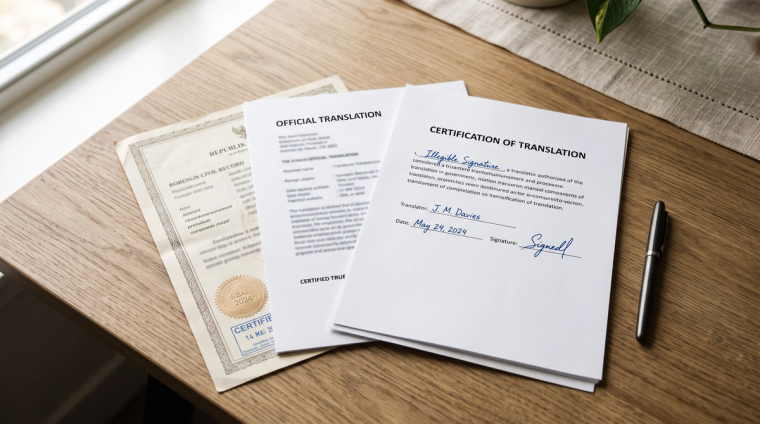
This wording covers everything a certified translation for USCIS needs, including the four elements the form instructions add. Put it on a separate sheet behind each translated document.
CERTIFICATION OF TRANSLATION
I, [full name of translator], certify that I am competent to translate from [source language] into English, and that the attached English translation of the document titled [name of document, e.g. Birth Certificate of Maria Lopez, issued 14 March 1991] is a complete and accurate translation of the original document to the best of my knowledge and ability.
Signature: ______________________________
Printed name: ___________________________
Date: ___________________________________
Address: ________________________________
Phone: __________________________________
Email: __________________________________
Attach the certification, the translation and a photocopy of the original as one unit. Do not send original civil records unless the instructions ask.
Which documents need a translation
Anything with foreign-language content on it, which is broader than most filers expect: birth certificates, marriage certificates, divorce decrees and annulment papers, death certificates, police and court records, adoption decrees, military records, and any bank or employment record you submit as evidence.
Two things routinely get missed. Bilingual documents still need their foreign-language portions rendered, including seals, stamps, marginal notes and anything handwritten across the certificate. And a document that seems self-explanatory, such as a foreign court order recording a name change, still needs the full treatment; the name change during naturalization rules turn on what that order said.
Which documents your case needs depends on the filing. The I-751 document checklist and the N-400 document checklist differ substantially, a spouse petition leans on marriage records, and a waiver-based I-751 after divorce pulls in decrees a joint filing never touches.
The mistakes that produce a Request for Evidence
Four patterns account for most translation-related problems.
Partial translations. A translated front page with an untranslated reverse is the most common version; foreign civil records carry registration data, corrections and office stamps on the back.
Untranslated seals and stamps. A seal is foreign-language content. It gets described and rendered like everything else.
Missing certification elements. A translation with no signature date, or with a company logo standing in for a named signer and contact details, does not meet the instructions.
Name and date mismatches. If a document transliterates a name differently from your form, reproduce the original faithfully rather than harmonising it, and explain the discrepancy elsewhere. Officers notice inconsistencies across documents, a recurring theme in the I-130 RFE response, I-751 RFE response and N-400 RFE response guides.
These matter more than they used to. USCIS updated its evidence guidance on August 5, 2026, and the Policy Manual now states that an RFE or NOID is not required by regulation, and that where required initial evidence is missing or fails to show eligibility, USCIS may deny the request outright. A defective translation is defective initial evidence.
Immiva prepares I-130, I-751 and N-400 packets and generates a document list built around your answers, though you or your translator still produce the translations themselves.
What certified translation costs
Paid services cluster tightly. RushTranslate lists certified translation at $24.95 per page; Day Translations starts at $29. Both define a page the same way, as up to 250 words counted by word count rather than physical sheets, which is worth knowing before you order.
A dense two-sided birth certificate can therefore bill as two or three pages, and a multi-page divorce decree runs well past the sticker rate. For a family filing with two birth certificates, a marriage certificate and one prior divorce decree, expect roughly $100 to $250.
Two add-ons are worth declining. Notarization is not required by USCIS; the regulation and the instructions ask for a signed certification, not a notarised one. Apostilles authenticate the original foreign document for use abroad and have nothing to do with translation. A state court, school, or vital records office may want either, so confirm before paying.
Immiva charges $149 for I-130 preparation. Certified translation costs are separate.
Consular cases and immigration court follow different rules
If your case goes through the National Visa Center rather than adjustment of status, the standard shifts twice. The State Department requires certified translations for documents not written in English or in the official language of the country you are applying from, a carve-out USCIS does not offer. Its certification is a two-part signed statement: the translation is accurate, and the translator is competent. The completeness wording is not restated.
This matters if you are choosing routes, which the I-485 versus consular processing comparison and I-130 consular processing timeline both cover.
Immigration court differs again. Under 8 CFR 1003.33, a foreign-language document offered in a removal proceeding needs a translation plus a certification, signed and legibly printed or typed, stating the translator is competent and the translation true and accurate to the best of their abilities. That is a softer standard, and the two are not interchangeable.