

Most guides tell you how to file. This one assumes the form is already open in front of you.
Learning how to fill out I-485 correctly is mostly a matter of knowing three things: which edition you are allowed to submit, what each part is asking, and what to write when a question does not apply to you. Get those wrong and the application comes back before anyone reads it.
The timing matters right now. USCIS is replacing the form in the middle of 2026, and the two editions are not interchangeable. If you already know the process side of things, our companion guide on how to file I-485 step by step covers eligibility, the medical exam, and where to mail the packet. This post stays on the form itself.
Which edition of Form I-485 to use before and after September 18, 2026
USCIS accepts exactly one edition of the form on any given day, and the changeover date is September 18, 2026.
Until then, file the 01/20/25 edition. USCIS also lists a 09/04/26 edition, published on September 4, 2026 for a narrow interim final rule and currently blocked by an injunction, so it is not the one to use. On September 18, USCIS publishes a revised 09/18/26 edition and starts rejecting both earlier editions. There is no transition window (USCIS Form I-485 page). The rule USCIS applies is the postmark date for paper filings, or the submission date for online filings, not the date you filled the form out.
Important: If your packet is postmarked on or after September 18, 2026, USCIS will reject the 01/20/25 and 09/04/26 editions. If it is postmarked before that date, USCIS will reject the 09/18/26 edition. Check the edition date printed at the bottom of every page before you seal the envelope.
The reason for the change is a regulation, not a routine form refresh. DHS published the Public Charge Ground of Inadmissibility final rule on July 20, 2026, and it takes effect the same day as the new form edition (91 FR 45324). That rule rescinds the 2022 public charge regulations and restores broader discretion to USCIS officers, which is why USCIS rewrote the Part 9 questions. Our explainer on the I-485 public charge rule covers the policy side in more depth.
USCIS is running a similar hard cutover for other forms this month. If you are also filing a work permit or a change of status application, read up on the I-765 and I-539 edition changes on September 15, 2026, because those dates are close together and easy to mix up.
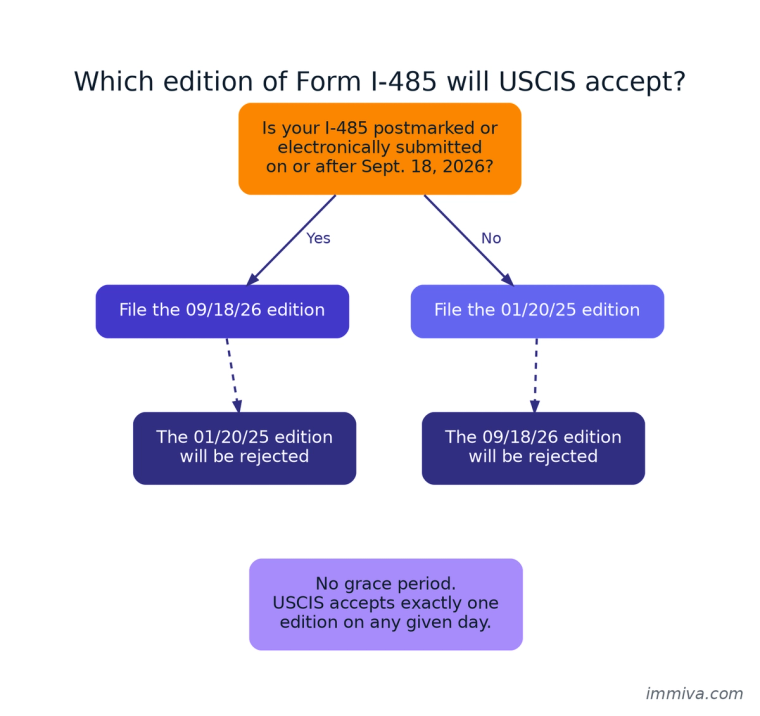
From September 18, 2026, USCIS accepts only the 09/18/26 edition, and there is no grace period.
How to Fill Out I-485: All 14 Parts, Mapped
Before filling anything in, it helps to see the shape of the form. Four of the 14 parts are conditional, so most applicants complete fewer sections than the page count suggests.
The part structure is identical in both the 01/20/25 and 09/18/26 editions. Same 14 parts, same titles, same 24 pages. What changed sits inside Part 9, which we cover below.
Two parts do most of the damage to self-filers. Part 2 decides which immigrant category you are applying under, and picking the wrong box means USCIS adjudicates your case under rules that do not apply to you. Part 9 is simply enormous. Everything else is biographical detail you already know.
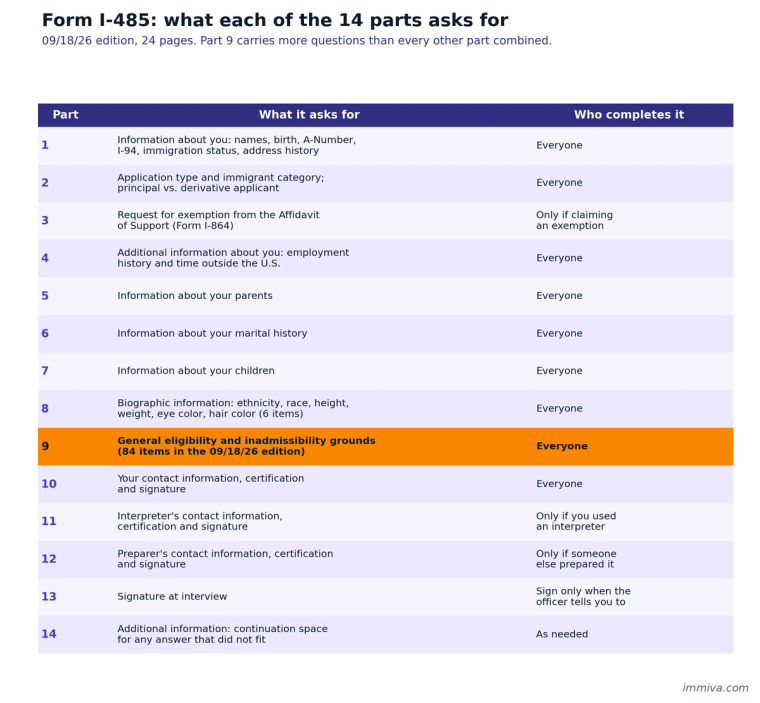
What each of the 14 parts of Form I-485 asks for and who has to complete it, based on the 09/18/26 edition.
Parts 1 to 3: who you are, which category, and the I-864 exemption
Part 1 collects your identity and status history across 19 item numbers. Three fields cause most of the trouble.
Your A-Number goes in the box at the top, without the letter A, and the form asks separately whether you have ever been assigned a different one. People who have had prior filings often have two. If you are not sure whether you have one at all, our guide to finding your Alien Registration Number explains where it appears.
The USCIS Online Account Number is not the same thing, and you only have one if you previously filed something through a USCIS online account. Leave it as N/A if you have not.
Part 1 also asks for your Form I-94 number, the immigration status shown on it, and the expiration date of your authorized stay. If your I-94 says D/S rather than a date, write D/S exactly. Your record is available through CBP, and our explainer on the I-94 arrival record covers how to pull it.
Part 2 is the one to slow down on. You select whether you are a principal or derivative applicant, then choose exactly one immigrant category from a long list grouped by family-based, employment-based, and special categories. Derivative applicants pick the box matching the principal applicant's category, not their own relationship. Item 1 asks whether you are filing with the immigration court while in removal proceedings, which is a different process entirely.
If you are filing alongside a petition, Part 2 also wants the receipt number and priority date of that underlying petition. Our guide to concurrent filing of the I-485 explains when you can send both together.
Part 3 is a single question with five options, and most applicants skip it. You only complete it if you are claiming an exemption from filing an Affidavit of Support, for example because you have 40 qualifying quarters of work credit, or you are a widow or widower filing on Form I-360, or you are a VAWA self-petitioner. Everyone else selects the last option. If you do need the I-864, our breakdown of the Affidavit of Support income rules walks through the thresholds.
Parts 4 to 8: history, family, and the biographic details
These five parts are where accuracy matters more than difficulty. Nothing here is conceptually hard, but gaps and inconsistencies generate Requests for Evidence.
Part 4 covers your recent address history, employment history, and time spent outside the United States. Account for every month. An unexplained gap between two addresses is one of the more common reasons applications stall, and our guide on I-485 denials and RFEs covers what officers ask about most.
Part 5 asks for information about both parents, including a mother's birth name. This is required even if a parent is deceased or you have never met them. Write what you know and use N/A only where the information genuinely does not exist.
Part 6 covers marital history: your current marriage, and every prior marriage for both you and your spouse. If you are applying through marriage, expect USCIS to cross-check this section against the petition.
Part 7 asks about all your children, regardless of age, marital status, or where they live. Include children who are not immigrating with you and children from prior relationships. Leaving one off looks like concealment even when it was an oversight.
Part 8 is Biographic Information, and it is only six items long: ethnicity, race, height, weight, eye color, and hair color. This surprises people who arrive expecting something harder.
A lot of applicants search for the Part 8 questions when what worries them is Part 9. If someone told you the I-485 has 80-plus security questions in Part 8, they were off by one section.
Part 9: the 84 questions that make people stop
Part 9 is titled General Eligibility and Inadmissibility Grounds, and in the 09/18/26 edition it runs to 84 item numbers. The 01/20/25 edition had 86. It is the longest part of the form, and it is the reason many people abandon a self-filing attempt halfway through.
The questions are grouped, and knowing the groups makes the section far less intimidating. In order, Part 9 covers:
- Organization membership (items 1 to 9). Item 1 asks whether you have ever belonged to any organization, association, party, club, or similar group anywhere in the world. If yes, you describe up to two of them and use Part 14 for more. This includes ordinary things like a professional association or a student club.
- Criminal acts and violations. Arrests, charges, convictions, and specific offenses, whether or not the record was expunged.
- Security. Terrorism, espionage, persecution, torture, genocide, armed groups, and the use of child soldiers.
- Public charge. Your finances, household, education, and benefit history.
- Illegal entries and other immigration violations. Misrepresentation, false claims to citizenship, smuggling, and stowaway questions.
- Removal, unlawful presence, or illegal reentry. Prior removal orders, entries without inspection, and unlawful presence since April 1, 1997.
- Miscellaneous conduct. Polygamy, child abduction, renouncing citizenship to avoid tax, and similar grounds.
Two things make this section manageable.
First, most applicants answer no to most of these questions, and a no answer requires nothing further. The volume is not the same as the difficulty.
Second, a yes answer is not automatically a denial. Many grounds have waivers, exceptions, or narrow definitions that do not match what the plain wording suggests. Unlawful presence, for example, has exceptions tied to age and to trafficking, and our guide to adjusting status after an overstay walks through them.
Be careful here: If you would answer yes to anything in the criminal, security, immigration violation, or removal groups, talk to an immigration attorney before you file. These are the answers where a wrong call is expensive to undo, and no software or article can substitute for advice on your specific record.
Where a yes answer needs explanation, the form directs you to Part 14 rather than giving you space inline. Write the explanation there, label it with the part and item number, and keep it factual.
This is the part of the form Immiva was built around. Instead of handing you 84 numbered questions, it asks them as a guided interview in plain English and runs up to 37 checks over your answers before you file, for a flat $249. A yes answer in the criminal, security, immigration violation, or removal groups still belongs with an attorney, and the eligibility check will tell you if yours is one of them.
What changed in the public charge questions
The public charge block is the only substantive change between the two editions, which matters if you are filing near the cutover date.
In the 01/20/25 edition, item 56 lets you select an exemption category, and applicants who are not exempt complete items 57 through 66. In the 09/18/26 edition, that same block runs from 57 through 64. Every item number after it shifts down by two, which is why you cannot copy answers from one edition into the other by item number.
USCIS also broadened the questions themselves. The older edition asked about a specific list of cash benefits, naming Supplemental Security Income, Temporary Assistance for Needy Families, and state or local general assistance, plus a separate question about long-term institutionalization at government expense. The new edition replaces both with a single, wider question about whether you have ever received any means-tested public benefit, and asks you to give the benefit, the dates, the amount where applicable, and the reason you received it.
USCIS reworded three other questions to track the statutory factors more closely. Household size became a broader question about your family status. Highest degree or grade of school became highest level of education. And the certifications question became a more general question about your skills.
Important: Being subject to the public charge ground is not the same as being inadmissible under it. Refugees, asylees, VAWA self-petitioners, and several other categories are exempt entirely, and item 56 is where you say so.
Parts 10 to 14: signatures, interpreters, and the continuation space
The last five parts are short, and they are responsible for a large share of outright rejections.
Part 10 is your contact information, certification, and signature. USCIS rejects any unsigned form (USCIS Form I-485 page). A typed name is not a signature on a paper filing. Sign in ink, and make sure the date is not earlier than the dates elsewhere in your packet.
Part 11 is only for an interpreter. If someone translated the form for you, they complete and sign this part naming the language used. If you completed the form in English yourself, leave it blank.
Part 12 is only for a preparer. This applies if another person filled the form out on your behalf, whether or not they were paid. Preparing your own form does not require anything here.
Part 13 is the one people sign too early. It is a signature at the interview, and you sign it only when a USCIS officer tells you to. Signing it in advance is not fatal, but leave it alone.
Part 14 is the continuation space, and it does more work than its position at the end of the form suggests. Any answer that did not fit goes here. If you attach a separate sheet instead, the instructions require your name and A-Number at the top, the page, part, and item number your answer refers to, and your signature and date on each sheet (Form I-485 Instructions).
Once the form is complete, the packet still needs assembling. The filing fee is $1,440 on paper or $1,390 online for applicants over 14, and $950 on paper or $900 online for a child under 14 filing at the same time as a parent (USCIS Fee Schedule, Form G-1055). You will also need the medical exam, since USCIS may reject an I-485 filed without a required Form I-693, and the rest of your evidence from the I-485 document checklist. Our guide on paying USCIS filing fees covers accepted payment methods.
N/A, None, or blank: the convention that gets forms rejected
The official instructions state the rule plainly. If a question does not apply to you, write N/A. If a question calls for a number and the answer is zero, write None (Form I-485 Instructions).
The two are not interchangeable. How many times have you departed the United States is a numeric question, so the answer is None, not N/A. The name of your current spouse when you have never married is not a numeric question, so the answer is N/A.
Almost never leave a field empty. A blank is ambiguous: an officer cannot tell whether you meant zero, meant it did not apply, or missed it, and ambiguity in a section like Part 9 invites a Request for Evidence. Filling every field costs you nothing and keeps the application moving.
If you have never been arrested, the criminal questions in Part 9 still get an answer, and that answer is No rather than a blank. If you have no children, Part 7 gets None where it asks how many, not a struck-through line. If you have no middle name, that field gets N/A rather than a dash. And if you have never used another name, the other-names fields get N/A rather than a repeat of your current name, which is a common and confusing mistake.
The same logic applies to Part 14. If you had nothing to continue, leaving it empty is correct and expected. The convention is about answering questions, not about covering every inch of paper.
The bottom line
Knowing how to fill out I-485 comes down to a handful of decisions rather than 24 pages of work. Confirm the edition against your postmark date, pick one category in Part 2 and pick it deliberately, work through Part 9 in its groups rather than as one wall of questions, use Part 14 for anything that needs explaining, and write N/A or None instead of leaving fields blank.
If a yes answer in Part 9 touches your criminal history, a prior removal, or an immigration violation, get advice before filing. Otherwise, the form is long but it is not beyond you. Compare what an immigration lawyer costs against doing it yourself, and pick the route that fits your situation.