

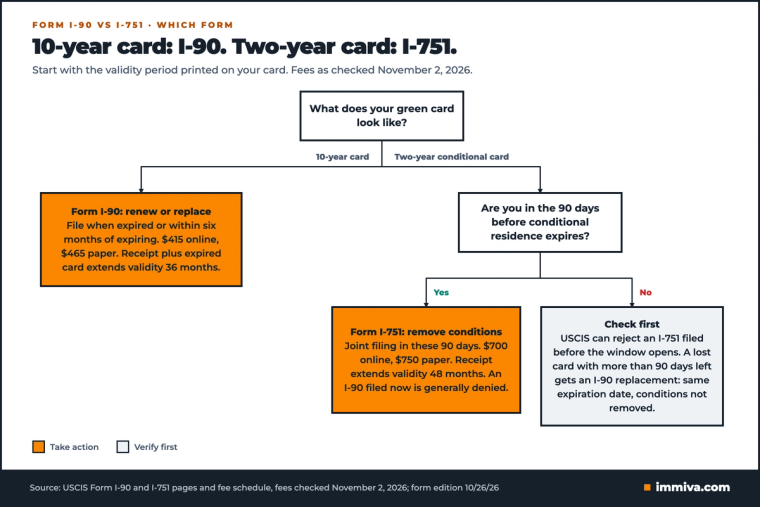
If your card says “Permanent Resident,” check the validity period printed on it. If you have a marriage-based conditional card, you need to apply to remove the conditions. Our green card renewal guide covers 10-year cards. The I-751 guide walks you through removing marriage-based conditions.
I-90 vs I-751 at a glance
You can get a new card through either process. The USCIS I-90 page explains how to use I-90 to ask USCIS to replace your proof of permanent residence. To ask USCIS to remove the conditions on your marriage-based residence, file I-751 as described on the USCIS I-751 page.
| Question | Form I-90 | Form I-751 |
|---|---|---|
| Main purpose | Renew or replace a card | Remove marriage-based conditions |
| Typical card | 10-year permanent resident card | Two-year conditional resident card |
| Standard filing window | When expired or expiring within six months | Joint filing: 90 days before conditional residence expires |
| General USCIS fee | $415 online; $465 paper | $700 online; $750 paper |
| Extension with qualifying receipt and expired card | 36 months for renewal | 48 months for removal of conditions |
The table draws on the USCIS replacement policy, I-751 filing rules, fee schedule, edition 10/26/26, I-90 extension, and I-751 extension. We checked the fees on November 2, 2026. You may qualify for an exemption or waiver.
Before you commit, compare Immiva’s I-90 preparation with Immiva’s I-751 preparation. Each page tells you what help you get with documents and which checks are included.
A two-year card has a different deadline
If your green card is conditional because of your marriage, renewing it means asking USCIS to remove the conditions. If you file jointly with your spouse, the USCIS I-751 filing rules say to submit I-751 during the 90 days immediately before your conditional residence expires. USCIS can reject your petition if you file too early.
Use the USCIS filing-window calculator to count back 90 days from the expiration date on your card. Counting back three months can give you a different date. Keep the calculation with your notes and double-check the date before you file.
Different timing applies to some I-751 filings. Depending on your circumstances, you may qualify for an individual filing or waiver after divorce, a spouse’s death, battery or extreme cruelty, or extreme hardship. USCIS allows these filings before your conditional status expires. The evidence and legal requirements depend on your filing basis. For details, see our joint filing versus waiver guide.
The I-751 instructions say USCIS can terminate your conditional status if you miss the required filing. Under the USCIS replacement policy, you still need to petition to remove the conditions even if your I-90 is pending.
When a conditional resident can use I-90
If you lose your conditional card, start with its expiration date. Under USCIS policy, you may use I-90 for an eligible replacement reason if your conditional status is not expiring within 90 days. Your replacement card has the same expiration date, and the conditions still apply.
If you lose your conditional card with a year left, you may need a replacement. When your conditional period nears its end, you need to file the appropriate petition to remove conditions. Use our lost green card guide to prepare for a replacement, and keep your separate deadline for removing conditions on your calendar.
During your final 90 days as a conditional resident, USCIS generally denies an I-90 and directs you to file a petition to remove conditions. One exception applies if you should have received unconditional residence and USCIS classified you as conditional by mistake. Correcting that error requires a review of the original grant of residence.
Already filed I-90 instead of I-751?
Check when your conditional residence expires. Under the USCIS replacement policy, you still need to meet the deadline for removing conditions while your I-90 is pending. Follow the steps below in order.
- Check how you qualify to file. Determine whether you can file jointly or need an individual filing or waiver.
- Prepare your petition promptly. Gather the required copies of your card and include evidence that you entered the marriage in good faith.
- If you file late, explain why. Put your explanation in writing and submit evidence that supports it. USCIS decides whether your circumstances excuse the delay.
- Keep records for both cases. Save your I-90 receipt, a copy of what you submitted, your payment record and any notices from USCIS.
The I-751 instructions explain how to choose your filing basis, what evidence to include and how to file late. Filing the wrong form does not guarantee USCIS will excuse a delay. If your card has expired or you received a termination or removal notice, get legal advice specific to your status and response deadlines.
Our late I-751 filing guide explains what to cover in your written explanation. Immiva’s I-751 preparation checks your answers and calculates your filing window before you pay. Use the I-751 evidence checklist to organize the records for your petition.
Under the USCIS I-90 withdrawal instructions, if you want to withdraw an I-90 you filed by mistake, you must ask USCIS in writing. USCIS says it will not refund your fee if you withdraw or cancel. Do not count on transferring your payment to I-751.
What proves your status while you wait?
The USCIS I-90 notice says that if your I-90 renewal qualifies, your receipt notice and expired card together extend your card’s validity by 36 months. Under the USCIS I-751 notice, your receipt notice and expired card give you an extension of 48 months if you properly filed I-751. Both extensions start on the expiration date printed on your card. During your extension, the receipt and expired card together show your continuing status and your authorization to work and travel.
An I-90 receipt for a replacement does not automatically extend your card. Check what your receipt notice says. If you no longer have your card, ask USCIS about temporary proof of status, such as the ADIT stamp described in the USCIS replacement policy.
Your extension can end before USCIS decides your case. Check the USCIS processing-times tool for your filing category. If you plan to leave the country, first read our travel guide for pending I-751 cases.
Frequently Asked Questions
No. Use I-751 to remove conditions if you have a marriage-based conditional card. If you qualify as an investor conditional resident, use I-829. See USCIS I-90. The I-751 guide covers the steps for removing marriage-based conditions.
Yes, USCIS currently lists online and paper filing options. Before you submit, check which instructions apply to your circumstances. See USCIS I-751. Our I-751 cost guide shows government fees separately from preparation costs.
No, you do not need a separate I-90 to get your card after approval. USCIS issues your new permanent resident card through the I-751 process. You generally use I-90 when that 10-year card needs renewal. For details about the new card, read the I-751 instructions. For renewal, consult the USCIS replacement policy. You can also use our I-90 form guide.
If you divorced after entering the marriage in good faith, you may qualify for an I-751 waiver. The end of your marriage does not make I-90 the right form. See USCIS I-751. Read the divorce waiver guide.
No. Your lawful permanent resident status continues when your card expires. The two types of residence have different rules. If your residence is conditional, you still need to apply to remove conditions. See the USCIS replacement policy.
Choose the form before paying
Confirm your filing window and gather your evidence before paying for I-90 or I-751. For a 10-year renewal, Immiva’s I-90 preparation lists the filing reason and documents you need. For marriage-based conditions, check your I-751 deadline first. See the USCIS form-selection guidance.