
A lot of the top-ranking pages for this question are still quoting fees USCIS retired over two years ago. One says $680. Another says $810. Neither figure is real anymore.
The current figure, taken from the USCIS fee schedule in effect right now: Form I-751 costs $750 by mail, or $700 filed online. No separate biometrics fee gets added on top. That's the entire government charge.
What you spend beyond that comes down almost entirely to who prepares the petition. The gap between the cheapest route and the most expensive one runs about $3,500.
What Form I-751 costs in 2026
| Cost component | 2026 amount | Notes |
|---|---|---|
| USCIS filing fee, paper | $750 | Form G-1055 fee schedule |
| USCIS filing fee, online | $700 | $50 less than mailing it |
| Biometrics | $0 | Folded into the base fee on April 1, 2024 |
| Battery or extreme cruelty waiver | $0 | No fee at all for this waiver category |
| Children filing with you | $0 | Included with the conditional resident parent |
| Passport photos | $15 to $20 | Pharmacy rate |
| Certified translations | $20 to $45 per page | Only for non-English documents |
| Certified record copies | $15 to $50 each | Marriage, birth, divorce certificates |
| Postage and tracking | $10 to $40 | Paper filings only |
| Attorney, joint petition | $1,250 to $2,750 | Government fee is charged separately |
| Attorney, waiver or divorce case | $3,000 to $3,500 | Interview attendance often billed extra |
The filing fee, and why competitors get it wrong
Those $750 and $700 numbers come straight from Form G-1055, the official USCIS fee schedule, current edition dated May 29, 2026. The $50 gap is simply a discount for filing through a USCIS online account instead of mailing paper.
So many pages get this wrong because USCIS restructured its fees on April 1, 2024. Before that, an I-751 ran $595 plus a separate $85 biometric services fee. Both of those charges are gone now. USCIS folded the biometrics fee into the base charge, which is why you see one number today instead of two. If a page still quotes $595, $85, or a $680 total, it's describing a fee structure that hasn't existed since 2024.
Two more figures are worth knowing, since almost no one mentions them:
Filing a waiver based on battery or extreme cruelty costs $0. The fee schedule itself lists it at zero.
Everyone else can request a fee waiver through Form I-912. You may qualify if your household income sits at or below 150% of the Federal Poverty Guidelines, if you already receive a means-tested benefit, or if you can document financial hardship. One detail worth knowing: USCIS lists the I-751 among the forms that accept a fee waiver request online, so you can upload a completed Form I-912 through your USCIS online account instead of switching to a paper petition.
Paying USCIS in 2026
This one still trips people up. As of October 28, 2025, USCIS stopped accepting personal checks or money orders.
Your payment options now are Form G-1450 to authorize a credit or debit card, Form G-1650 for an ACH debit from a US bank account, or paying directly inside the portal if you file online. If you need a hardship exemption, Form G-1651 covers that. A surprising number of law firm pages still haven't updated this, and a check stapled to a petition in 2026 sends the whole package back. Our guide to paying USCIS filing fees covers the mechanics, and we wrote about the day checks stopped being accepted when the change first landed.
The costs nobody quotes you
The filing fee is the easy part to predict. These are the costs that show up later.
Evidence gathering. No marriage-based form asks for more proof than the I-751, since you're documenting two years of a shared life rather than a single wedding date. Joint tax transcripts don't cost anything. Certified copies of deeds, leases, birth certificates, and bank records do. Most filers end up spending $50 to $200 here without having budgeted for it. Our I-751 document checklist lists what actually counts as evidence.
Requests for Evidence. When USCIS isn't satisfied with what you sent, it issues an RFE with a deadline attached. Handling it yourself costs nothing. Have an attorney handle it, and it's often billed separately, on top of whatever you already paid. One filer reported getting charged $500 just to mail in a document they could have mailed themselves. Our guide on responding to an I-751 RFE walks through the process.
Interviews. USCIS has stepped up scrutiny on these petitions, and interview rates have climbed along with it. Having an attorney attend typically adds $500 to $750 to the bill.
Time. It never shows up on an invoice, and it still costs you. I-751 processing currently stretches well past two years, and your receipt notice extends conditional status for 48 months while you wait it out. There's no premium processing option here. See our breakdown of current I-751 processing times.
What immigration lawyers actually charge
Published flat fees and quotes reported by filers look like this:
- $1,250 to $2,750 for a joint petition, government fee billed separately
- $2,100 flat, quoted by one firm for a routine joint filing
- $2,750 for joint filings and $3,500 for waivers, per a published fee schedule
- $3,500 quoted to one filer, who turned it down as too much
- $500 to $750 more if an interview gets scheduled
Divorce and waiver cases land at the top of that range for good reason. Instead of showing that a marriage exists, you have to show it was entered in good faith even though it later ended, and that's a tougher evidentiary argument to make. If that's your situation, our guide to filing an I-751 waiver after divorce walks through what changes.
For broader context on what attorneys charge across different immigration forms, see our page on what immigration lawyers cost.
Your real options, side by side
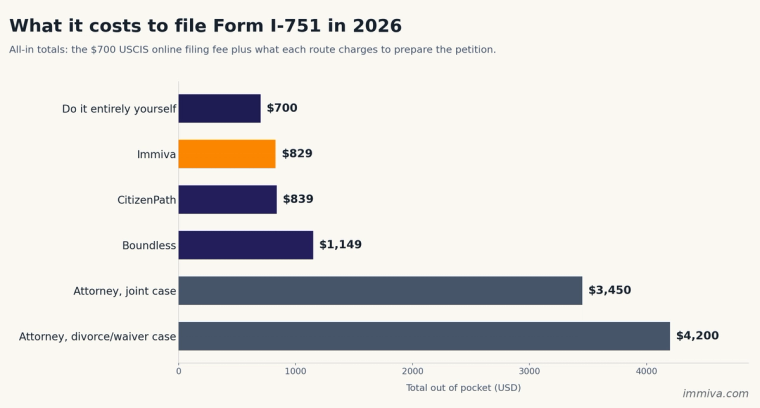
The chart above shows total out-of-pocket cost, government fee included. What matters more is where that money goes. Every route pays USCIS the same fee, $700 if you file online. The difference comes down to preparation.
| Do it yourself | Immiva | Attorney | |
|---|---|---|---|
| Preparation cost | $0 | Price temporarily unavailable flat | $1,250 to $3,500 |
| Filing window calculated for you | No | Yes, from your card expiry date | Yes |
| Answers checked before filing | No | Yes, 8 pre-filing checks | Yes |
| Evidence list for your specific route | No | Yes, joint or waiver | Yes |
| Handles waiver and divorce cases | You are on your own | Yes | Yes |
| Legal advice and representation | No | No, it is software | Yes |
| When you pay | Upfront to USCIS | After you see your full report | Retainer before work starts |
| Money-back guarantee | None | Yes, published terms | Rare |
Immiva prepares the I-751 for a flat Price temporarily unavailable, built specifically for this form rather than adapted from a generic form filler. It calculates your 90-day filing window from your green card's expiration date, rewrites every question into plain English, runs eight checks across your answers, and builds an evidence list matched to your specific route, since joint filings and each waiver category call for different proof. Before you pay anything, you see the full pre-filing report, with every flag and the fix for each. And if USCIS rejects the packet because of a preparation error on Immiva's end, the fee comes back under a published guarantee.
Two things it isn't: a law firm, and a source of legal advice. It also doesn't include the USCIS fee, which you pay directly to the government no matter which route you take.
Among the guided services, CitizenPath comes closest on price at $139 while Boundless runs $449 and reserves attorney review for its Premium tier. Add attorney review on top of any of these, and you're into four figures.
When paying an attorney is worth it
It comes down to what's actually difficult about your case, not how intimidating the form looks on the page.
Filers who joint-file with solid documentation of an ongoing marriage rarely say they regret going the self-prepared or guided route. On forums, the more common regret runs the opposite direction: money spent on representation that turned out unnecessary.
An attorney earns their fee when there's a real legal question buried under the paperwork. Consider hiring one if any of these apply to you:
- Your marriage ended and you're arguing a good faith waiver
- There's a criminal record, an immigration violation, or a prior misrepresentation in your file
- You experienced abuse and are filing under that waiver category
- You've already been denied once, or you're answering a second RFE
- Your evidence is thin because you lived apart for legitimate reasons
If your situation lands on the harder end of that list, read our guides on I-751 denials, the abuse waiver, and late filing before you commit to a retainer. We also have a dedicated comparison of joint filing versus a waiver.
Five ways to pay less
File online and keep the $50. You're filing the same petition, adjudicated the same way, just for less. The main reason left to file on paper is a hardship exemption from paying electronically.
Don't file an I-90 you don't need. This is the single most expensive avoidable mistake people make with this form. Once USCIS accepts your I-751, the receipt notice extends your conditional resident status for 48 months past the printed expiration on your green card, work and travel authorization included. That notice, paired with your expired card, is your proof of status. Filing Form I-90 to replace the card runs $465 by mail, and most people with a pending petition simply don't need it. Our full I-751 guide covers what the extension letter does and doesn't cover, and travelling while your petition is pending explains which documents to carry.
Pull tax transcripts instead of paying for copies. IRS transcripts don't cost anything, and USCIS accepts them. Joint returns rank among the strongest evidence you can submit, yet people routinely pay a preparer for copies they could just download themselves.
Check fee waiver eligibility before you pay anything. If your household income sits at or below 150% of the poverty guidelines, or you already receive a means-tested benefit, the entire $750 may get waived. Our explainer on how USCIS fee waivers work uses the N-400 as its example, but the I-912 eligibility standard is identical.
Get it right the first time. A rejected packet is the outcome that actually costs you. USCIS sends it back, you fix it, you refile, and that delay can push you outside your filing window entirely. The cheapest filing is always the one that gets accepted on the first try.
Fee changes on the horizon
Immigration fees are shifting right now, so which of them touch this form?
None of them. DHS published a proposed rule on June 23, 2026 that would raise naturalization fees substantially and eliminate fee waivers for citizenship applications. The comment period closed on August 24, 2026, and the rule applies only to Forms N-400 and N-336. The One Big Beautiful Bill Act added or raised fees across asylum, work permits, parole, TPS, and adjustment of status, and none of those provisions touch the I-751 either.
Separately, a DHS rule effective August 11, 2026 lets USCIS make electronic filing mandatory for forms that have been available online for at least 180 days, with 60 days' notice per form and a hardship waiver built in. E-filing isn't mandatory for the I-751 as of today. If that changes, the $700 rate stops being a discount and becomes the standard fee.
If citizenship is your next step, know that a pending I-751 doesn't block an N-400 filing. See applying for citizenship while your I-751 is pending and our breakdown of N-400 costs.