

What you can prepare now
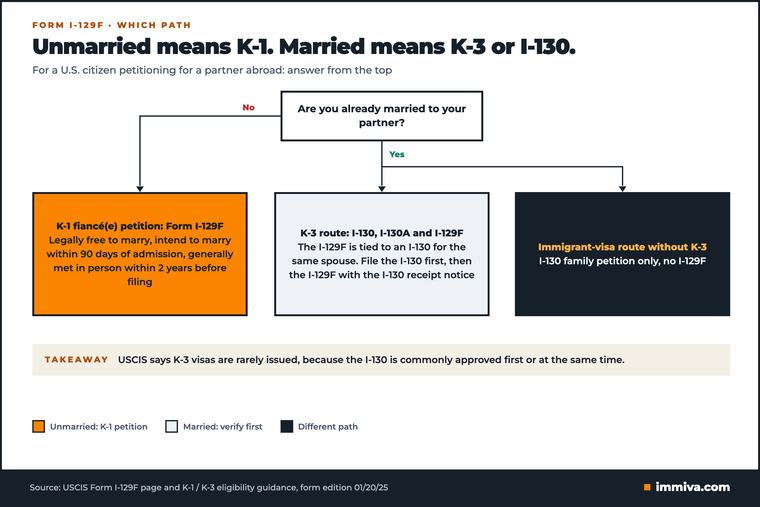
If you plan to marry your fiancé(e) after arrival, the USCIS form page says you’ll use Form I-129F. You can also use it if you’re already married and considering K-3 while the family petition for your spouse is pending. The two routes have different eligibility rules and require different documents.
For a fiancé(e) abroad: Immiva’s K-1 petition package uses your answers to plain-English questions to fill out Form I-129F. You get a document list and guidance on the filing fee and mailing address. A report flags items to review in required fields, address and employment history, answers about marriage, and earlier petitions. Preparation costs $149, and you pay the USCIS fee separately.
For a spouse abroad: The K-3 spouse package uses one set of answers to prepare I-130, I-130A, and I-129F for $249. You enter names, marriage dates, and addresses once. The software compares those details across forms and gives you one document list. The package prepares the forms together. It does not submit them together.
If you plan to pursue an immigrant visa without filing a K-3 petition, you can get the I-130 family petition package separately. If you’re deciding whether to marry abroad or after arrival, read the I-130 vs K-1 fiancé visa comparison.
Choose your package based on whether you’re married and how you plan to immigrate. Under the USCIS K-1 eligibility rules, marriage puts you in a different classification even if you originally planned to file for K-1.
Before you file I-129F without a lawyer
To petition for your fiancé(e) under K-1, you must be a U.S. citizen. Under the USCIS K-1 rules, you must both be legally free to marry and intend to marry within 90 days of your fiancé(e)’s admission. In general, you must also have met in person within the two years before you file. A video call does not count as an in-person meeting. USCIS can waive the meeting requirement only in narrowly defined circumstances.
To petition under K-3, you must be a U.S. citizen and already married to your spouse abroad. The USCIS K-3 rules also require an I-130 for that spouse. The I-129F is part of your spouse’s case and cannot serve as another fiancé(e) petition.
Before you pay for preparation, check that any previous marriage ended legally. Compare your meeting dates with the in-person requirement. The I-129F instructions explain when earlier petitions or certain criminal convictions may require you to disclose more information or obtain a waiver.
Even with a complicated history, you can use software to organize and check your answers. Get legal advice if you’re unsure whether a divorce is valid, whether you qualify for a meeting waiver, or how a criminal record affects your case.
Before you choose a package, flag any answer you can’t back up with a record or a clear explanation. The K-1 eligibility check walks you through the initial questions. Keep track of which legal questions still need answers and which dates or documents you can find yourself.
For a section-by-section explanation of the form, read the I-129F instructions.
Prepare online, then review, sign, and mail
You can prepare your petition online. Completing the questionnaire does not file your petition. The mailing address USCIS currently gives for I-129F on its I-129F form page is its Dallas lockbox. If you’re filing I-130, the USCIS I-130 page also lists an online option.
Once you prepare I-129F online, print and sign it, then follow the current instructions to mail it. Your account confirmation, completed questionnaire, or downloaded PDF cannot serve as a USCIS receipt notice.
The preparation process takes you from choosing your route to mailing your packet.
- Choose your route. Answer the questions for a fiancé(e) or a spouse, depending on whether you’re married. For the spouse package, indicate whether an I-130 is already on file.
- Enter your information. Before you enter names, dates, addresses, employment history, or details of previous marriages, check them against the records you’ll submit.
- Review each flag. Check the completed forms against your records. If you find an error, correct it before you copy it into another document.
- Gather the evidence. Follow the document list for your petition. If you’re filing for your spouse, the I-130 documents checklist explains which records to gather.
- Download and file. When you’re ready, pay for preparation and print the packet. Follow the signature instructions and include your evidence and the correct payment authorization. Mail the packet to the address USCIS currently lists for your filing.
USCIS can reject your packet if pages or signatures are missing or if you mix form editions. Check that the edition and page numbers are visible on the printed pages. On October 23, 2026, the accepted I-129F edition was 01/20/25. Confirm the current edition before you mail your packet.
With the K-3 package, you file I-130 first, then I-129F with the I-130 receipt notice. The USCIS K-3 filing guidance also explains how to file the petitions together. The bundle prepares separate filings, so follow the mailing instructions in your packet. If your I-130 is already pending, use the receipt information from that filing to avoid a duplicate petition.
When you’re ready to mail your forms, look up the address again. USCIS changed the I-130 filing location on October 7, 2026. An I-130 address you found in an old article or got from a friend may be out of date. Use the current USCIS address for your circumstances and delivery method.
What preparation costs, and what comes later
Budget for both fees. You pay Immiva for the software you use to prepare your packet and the government to process your filing.
The government fees below reflect the rates in effect on October 23, 2026 according to the USCIS G-1055 fee schedule checked that day. The table also shows current preparation prices.
| Option | Preparation charge | Initial USCIS petition fee |
|---|---|---|
| K-1 I-129F package | $149 | $675 |
| K-3 package: I-130, I-130A, I-129F | $249 | I-130: $675 by mail or $625 online; K-3 I-129F: $0 |
| I-130 family petition package | $149 | $675 by mail or $625 online |
You can confirm preparation prices on the product pages above. The USCIS fee schedule, G-1055, lists the government fees in its 10/16/26 edition.
The online I-130 fee applies when you file through the official government site. The K-3 package leaves filing to you. Decide how you’ll submit your I-130 before you add up the fees.
For K-1, budget $149 for preparation and $675 for the initial USCIS I-129F fee. For K-3, budget $249 for preparation and $675 if you mail I-130. USCIS charges no additional I-129F fee for that K-3 filing. Those figures cover preparation and initial filing only. As you work toward a visa or green card, later steps such as those in the USCIS K-1 guide could bring other costs, including separate applications and medical exams.
Before you compare prices, ask for a written description of what each professional service covers. An attorney’s quote may include legal advice or representation. The immigration lawyer cost guide can help you compare those quotes.
What the checks help you review
Check the marriage date on one form against your records, then make sure it matches across forms. Compare the printed petition with your notes to catch any gaps in your address history.
Immiva’s K-3 preparation tools use one set of answers to fill out I-130, I-130A, and I-129F and compare details that appear on multiple forms. The K-1 preparation tools check required fields and specific answers about your history and marital status before you pay. Compare the report with your records. The software cannot verify that an answer is true or supply missing evidence.
USCIS can give you three different responses to a filing.
Rejection means USCIS has declined to accept your filing for processing. The USCIS I-129F page lists required fields and explains that USCIS can reject your I-129F if you skip those fields or leave the form unsigned. Check your packet before you mail it.
A request for evidence means USCIS needs more information to review your petition. The USCIS K-1 guide explains that USCIS may ask for more documentation before it decides your fiancé(e) petition. Read the notice and respond to each request.
Denial means USCIS decided your petition did not establish eligibility. Even if every field is complete, you still need records that show your relationship qualifies. The USCIS I-130 page lists the official evidence requirements. If you’re filing for your spouse, check your records against the document requirements for a spouse’s I-130 petition.
Immiva provides preparation software and filing support. Legal advice and representation fall outside that service. The pricing page explains when you qualify for a preparation fee refund if USCIS rejects your filing because Immiva prepared a form incorrectly. The guarantee excludes government fees and makes no promise of petition approval or visa issuance.
Keep the K-3 outcome in view
A K-3 petition cannot guarantee you’ll reunite sooner. According to the USCIS K-3 guidance, processing times for I-129F and I-130 are often similar, and K-3 visas are rare. If USCIS approves I-130 first or approves both petitions at the same time, your spouse proceeds through immigrant-visa processing.
The K3 visa guide explains when the National Visa Center closes a case.
If you’re unmarried, you start the K-1 process with a fiancé(e) petition. Under the USCIS K-1 rules, you marry after admission. If you’re married, you can file I-130 for an immigrant visa. If you also want to pursue K-3, you can use that I-130 as the basis for a separate K-3 petition. After you buy a preparation package, you still have visa processing ahead of you, even after petition approval.
Read the I-130 consular processing timeline as you plan the next stages, and check current government processing information. A preparation estimate alone is too little to go on when booking nonrefundable travel or making nonrefundable wedding plans.
Frequently Asked Questions
Yes, you can prepare the petition yourself. The I-129F instructions explain which sections to complete if someone helps you. You remain responsible for reviewing and signing the petition. The K-1 preparation package offers guided questions and checks to help you organize your paperwork. For the signature and preparer rules, read the Official I-129F instructions.
No. You can prepare I-129F through the service, but you still file it yourself. USCIS currently directs you to mail I-129F to its lockbox. You apply for your visa at the consular stage after petition approval. The service cannot issue a visa. Read about the preparation process and USCIS K-1 stages.
Yes, in a K-3 spouse case USCIS says you can file I-129F with I-130 or afterward. With this package, you file I-130 first, then include its receipt when you file I-129F. Check the instructions for the K-3 spouse package alongside the USCIS filing rules.
Yes, the K-3 package includes the spouse supplement, I-130A, along with I-130 and I-129F. USCIS requires I-130A when you file for your spouse. The I-130A form guide explains how the supplement works, and the official I-130 page states the requirement.
No. Paying for preparation helps you check your paperwork and has no effect on agency or consular timing. USCIS says K-3 visas are rare because it commonly approves the I-130 first or approves both petitions at the same time. Before you plan around a faster reunion, read the USCIS K-3 guidance for details.
Start with the route that matches your relationship
Use the questions for your route to prepare I-129F without a lawyer. Resolve any legal questions before you mail your packet, then check your evidence and signatures against the current filing instructions.