

Most processing time articles quote one number for one form on one day. That tells you very little, because the number moves and because it does not always move in the direction the queue does.
We took the twenty monthly USCIS Application Processing Data reports from December 2024 through July 2026 and lined up the average processing time USCIS published for each of eleven form categories, month by month. Then we compared each form's processing time against how much its own backlog aged over the same period.
Those two things should track each other. Mostly they did. In three cases they pointed in opposite directions, and that gap is the most useful thing in this data.
This post is the numbers. If you want the mechanics of how USCIS builds the figure and why your own case can run well past it, that is a separate piece: our explainer on how USCIS calculates average processing time covers the methodology, and this post does not repeat it.
The overall picture
Weighted by the number of cases completed each month, the average across these eleven categories went from 6.4 months in early 2025 to 9.0 months in mid-2026. That is a 40% increase in under two years.
That average hides an enormous spread, and there is a reason it looks as low as it does. Work permits alone account for 52.6% of the cases USCIS completed in these categories in 2026, and the I-765 is the fastest form in the report at 4.9 months. One high-volume, fast-moving form is pulling the whole weighted figure down. Treat all eleven categories as equals instead, and the plain average of their processing times is 18.4 months, roughly double the weighted number.
Neither figure is wrong. They answer different questions. The weighted 9.0 months describes the experience of a typical completed case. The unweighted 18.4 months describes the typical form. If you are not filing an I-765, the second number is closer to your world.
Three categories were at their worst in the final month of the data rather than somewhere in the middle: naturalization at 11.4 months, work permits at 5.8, and asylum-based adjustment at 30.6. Those three were still getting worse when the series ended rather than coming down from a peak.
Form by form, what actually changed
Eight of the eleven categories slowed. Three sped up.
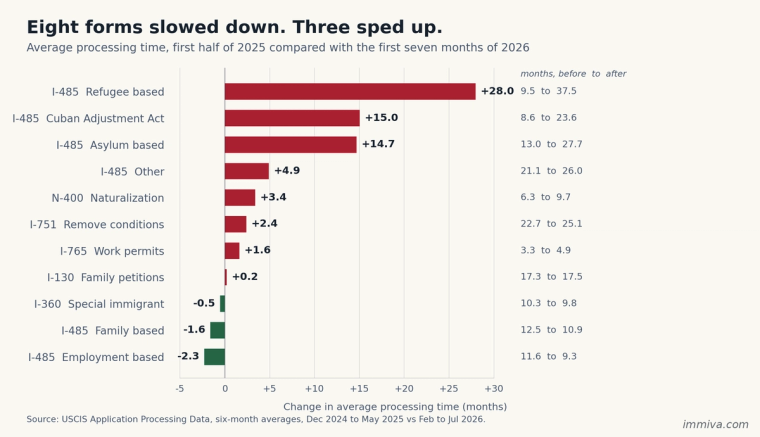
Change in average processing time by form category, comparing early 2025 (December 2024 to May 2025) with mid-2026 (February to July 2026).
Naturalization went from 6.3 months to 9.7, a 54% increase, and the single monthly figure for July 2026 was 11.4. That is the largest proportional slowdown among the high-volume forms. Our N-400 processing time guide tracks the current figure and what drives it.
Work permits went from 3.3 months to 4.9, up 49%. In absolute terms that is a small number, but an I-765 is the form where a delay does immediate damage, because a gap in the card is a gap in the right to work. This is why filing an EAD renewal early matters more than it used to, whether you are filing an H-4 EAD or a J-2 EAD.
Removing conditions was already the slowest of the mainstream forms and got slower still, from 22.7 months to 25.1. Anyone filing an I-751 should plan around a wait measured in years rather than months. The I-751 processing time guide has the detail. You may also become eligible for citizenship while the I-751 is still pending.
Family petitions barely moved, from 17.3 months to 17.5. See the I-130 processing time guide for the relationship-by-relationship breakdown, since the I-130 average conceals very different waits for spouses, parents and siblings.
The humanitarian categories moved most and mean least. Refugee-based adjustment went from 9.5 months to 37.5. Cuban Adjustment Act cases went from 8.6 to 23.6. Asylum-based adjustment went from 13.0 to 27.7. Those are real published figures, but they come from categories where the number of decisions collapsed to almost nothing, which makes the averages unstable. More on that below.
Three forms got faster. Only one actually improved.
For three categories, the published number and the queue behind it came apart.
USCIS calculates average processing time from cases it completed during the reporting period. That is a reasonable way to build the metric, but it means the figure describes the cases that got out, not the cases still waiting. If an office works through its newer, simpler files and leaves the hard ones sitting, the published average can fall while the queue behind it gets older.
So we plotted each form's change in processing time against the change in its own share of cases waiting more than six months.
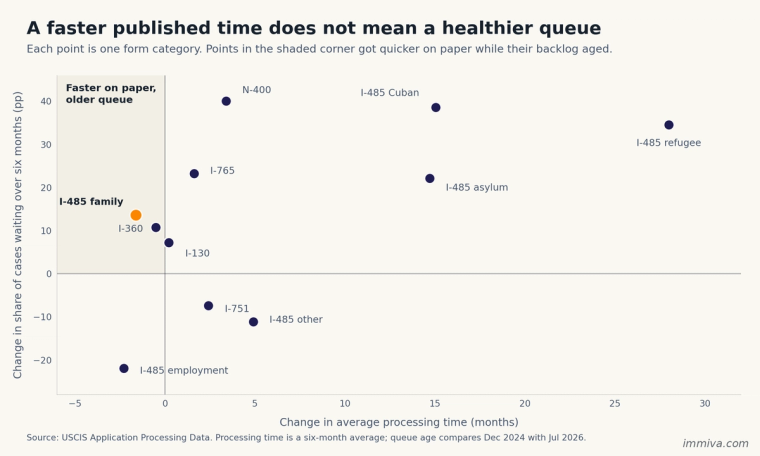
Change in average processing time plotted against change in the share of cases waiting more than six months, by form category.
Three categories show a shorter average processing time in mid-2026 than in early 2025. They are not the same story.
Employment-based adjustment genuinely improved. Its processing time fell from 11.6 months to 9.3, and its share of cases older than six months fell too, from 72.4% to 50.5%. Both measures moved the same way. This is the only category in the report where that happened, and it lines up with completions roughly doubling over the period. Our I-485 processing time guide covers the stages.
Family-based adjustment did not. Its published processing time fell from 12.5 months to 10.9, a 13% improvement. Over the same period the share of pending family I-485s waiting more than six months rose from 60.2% to 73.9%. The average got better while the queue got older. The most likely reading is that the cases being finished were not representative of the cases waiting.
Special immigrant petitions show the same split. The I-360 average dipped slightly, from 10.3 months to 9.8, while its over-six-month share rose from 71.3% to 82.0%.
This is not evidence of anything improper. It is a property of how the metric is built: USCIS states in the notes to each report that the average covers only the applications completed in that period. But it does mean a falling processing time is not by itself good news, and you should not read one as a signal that your particular case is about to move.
When the average rests on almost nothing
One figure in this dataset deserves a warning label.
In February 2026, the published average processing time for refugee-based adjustment of status was 87.6 months. That is more than seven years. It was calculated from nine completed cases. The month before it was 22.7 months, and the month after it was 24.1.
That is not a processing time in any meaningful sense. It is what happens when you take an average of a handful of very old files. The same caution applies across the Cuban, refugee and asylum-based I-485 categories throughout 2026, where monthly decisions fell into the tens and hundreds from thousands at the start of the series.
You can check this yourself, and it takes a minute. The monthly reports are published as plain CSV files on the USCIS data page, and each row carries the approvals and denials alongside the processing time. Add those two columns together for your form and you have the number of decisions the average was built from. A figure resting on tens of cases tells you the category has stopped moving. A figure resting on tens of thousands, as the work permit and family petition numbers do, is describing something real.
The same check is worth running whenever a processing time swings sharply between two months. Large moves in the high-volume forms are usually genuine. Large moves in the small categories usually are not.
What to do with these numbers
Published processing times are useful for planning and close to useless for prediction.
Plan against the slower end, not the average. An average is not a ceiling, and a large share of completed cases ran well past it. If the published figure for your form is 9 months, a 14-month wait is not unusual and does not mean something has gone wrong. That matters for decisions with real deadlines attached, like travel while an N-400 or I-751 is pending, or whether you need advance parole alongside an I-485.
Do not wait for the number to improve before filing. Eight of eleven categories slowed over this period, and the three that improved on paper mostly did not improve underneath. Filing when you become eligible puts you ahead of everyone who files after you, which is the only part of your queue position you control. For citizenship, the residence and physical presence calculators will tell you the earliest date you can file.
Protect against the delays you can actually prevent. A rejection for a missing signature or an outdated form edition removes you from the queue entirely, and you start again from zero. A request for evidence has a similar effect, sending a case back for another cycle. In a system where the average has risen 40% in under two years, those are the expensive mistakes. This is the part Immiva is built to prevent: it checks each answer as you enter it, flags the questions that most often trigger an RFE with plain guidance before you commit, and reviews the full packet against the form requirements before you download it. If you do get one, our guides on responding to an N-400 RFE and an I-751 RFE walk through it. Form editions also change on a schedule, and our summary of the USCIS changes taking effect September 15, 2026 covers the current round.
Immiva prepares and checks the filing for a flat fee, a fraction of what traditional lawyers ask, covering N-400, I-751, I-130 and I-485, plus H-4 EAD and J-2 EAD. You pay the USCIS filing fee separately, directly to the government. You see the verification report before you pay, and if USCIS rejects your packet because of a preparation error on Immiva's end, Immiva refunds its fee. Immiva is software rather than a law firm, so it prepares and verifies forms and does not give legal advice about your particular case.
The short version
USCIS processing times rose about 40% on a completion-weighted basis between early 2025 and mid-2026, and eight of the eleven reported form categories slowed. Naturalization and work permits both rose by roughly half.
Three categories posted faster averages, but only one of them improved on both measures. For the other two the published figure fell while the queue behind it aged. The metric describes the cases that got out, not the ones still waiting. Use it to plan, not to predict.