
Search "do I need a lawyer for I-130" and you will get a wall of law firm pages that all end the same way. That is what happens when the only people writing about a question are the people selling the answer.
Form I-130 is a petition that proves a family relationship exists. It is a documentation exercise. If your relationship is real, your paperwork is in order, and neither of you has an immigration or criminal history that complicates things, you can handle the petition without an attorney. If any of those things are not true, the calculation changes fast, and this post will tell you exactly where.
What shifted in 2026 is the cost of getting it wrong, not the difficulty of the I-130.
The short answer
No, you do not need a lawyer to file Form I-130 in most family petition cases. USCIS is explicit that you may file forms and represent yourself before the agency (USCIS Legal Services). In fiscal year 2025, USCIS approved roughly 93% of immediate relative I-130 petitions, about 718,610 approvals against a 7% denial rate (USCIS Immigration and Citizenship Data).
You should get professional help if the beneficiary has an overstay, an unlawful entry, a removal order, a criminal record, or a prior petition that was denied or withdrawn. Those facts are not paperwork problems. They are legal problems, and they need a lawyer, not a better-prepared form.
What the I-130 actually does (and what it does not)
This is where most confusion starts, and it matters for the lawyer question.
Form I-130 establishes two things: that a qualifying family relationship exists, and, for preference categories, your place in line via a priority date (INA 204). That is all. It does not grant status, work authorization, or the right to stay in the United States. An approved I-130 is not a green card. Our breakdown of the I-130 versus the I-485 walks through the distinction in more detail.
After approval, the case moves in one of two directions. If the beneficiary is already in the United States and eligible, they file Form I-485 to adjust status. If they are abroad, the case goes to the National Visa Center and then to a consulate, which our I-130 consular processing timeline covers step by step.
That split matters. The I-130 asks factual questions: who are you, who is your relative, prove it. The I-485 asks judgment questions about admissibility, public charge, immigration history, and discretion. Law firm content tends to blur the two, describing the risk of the second stage while quoting a price for the first.
The I-130 is a documentation exercise. The I-485 is where legal judgment starts to earn its fee.
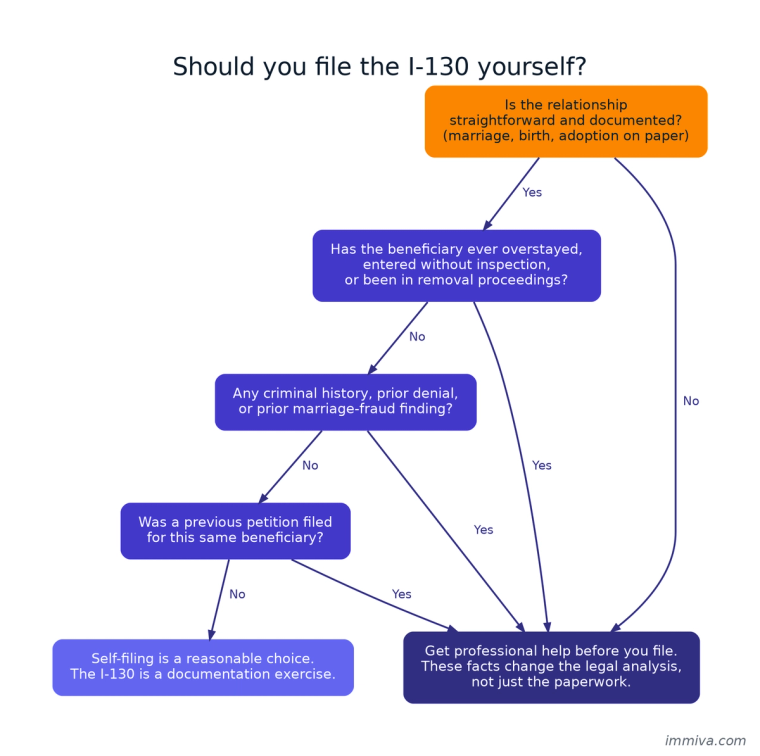
Four questions that determine whether an I-130 petition is a paperwork task or a legal one.
Can you legally file the I-130 without a lawyer?
Yes, and this is settled. Federal regulation lists who may represent you before USCIS: licensed attorneys, supervised law students, accredited representatives of recognized organizations, and a narrow category of unpaid reputable individuals (8 CFR 292.1). Nothing in that regulation requires you to have any of them. Self representation is the default.
There is also a middle option most people never hear about. Nonprofits recognized by the Department of Justice employ accredited representatives who can prepare and represent you on an I-130 at little or no cost. If money is the reason you are considering doing this alone, look for a recognized organization near you before you assume attorney or nothing.
One warning matters more than any other. In the United States, a notario público is not authorized to give immigration legal advice, despite the title meaning something closer to "lawyer" in many Latin American countries. Only a licensed attorney or a DOJ accredited representative can advise you on your case (USCIS Avoid Scams). Unauthorized preparers are a leading source of botched filings.
Software sits in a different category than either of those. Immiva is a guided self-filing platform, not a law firm, and it does not give legal advice or represent you before USCIS. It walks you through the I-130 and I-130A question by question, flags the answers that commonly cause rejections, and builds a document checklist specific to your relationship type. You stay the petitioner and you stay self-represented.
The honest decision framework
Two variables decide this: who you are petitioning for, and what is in the beneficiary's history.
By relationship type
If you are a US citizen petitioning for a spouse, a parent, or an unmarried child under 21, you are filing for an immediate relative. There is no annual visa cap and no priority date wait (INA 201). These are the most common and most self-fileable petitions. Our guides on filing an I-130 for a spouse and petitioning for a parent cover the specifics.
Preference categories work differently. Petitions for siblings, married children, and the relatives of green card holders are numerically capped, so approval is followed by a wait for a visa number. In the September 2026 Visa Bulletin, the sibling category (F4) sat at October 2011 for most countries, meaning a roughly fifteen year queue (Department of State Visa Bulletin). The petition itself is no harder to prepare. See our I-130 for siblings guide and our explainer on I-130 priority dates for how the queue works.
A long wait is not a reason to hire a lawyer. A lawyer cannot move your priority date.
By red flag
These are the situations where you should stop and get advice before filing anything:
- The beneficiary entered without inspection or has accrued unlawful presence. Our post on filing for an undocumented spouse explains why.
- There is any removal order, deportation history, or pending immigration court case.
- Either party has a criminal record beyond minor traffic matters.
- A prior petition was filed for this beneficiary and denied, withdrawn, or investigated.
- There is any prior finding of marriage fraud. Under INA 204(c), that bar is permanent and cannot be waived.
- Overlapping or rapid marriage and divorce timelines that will look inconsistent on paper.
- A child approaching 21 where age-out protection under the Child Status Protection Act may apply.
If none of those apply, you are looking at a documentation task. If one does, the money is far better spent on a consultation now than on an appeal later.
What changed in 2025 and 2026
This is the part competitors get wrong.
Payments changed first. Since October 28, 2025, USCIS no longer accepts checks or money orders for most filings. Paper filers pay by card using Form G-1450 or by bank transfer using Form G-1650. Get this wrong and the entire package is rejected and returned, which for preference categories means losing your place in line. Our guide to paying USCIS filing fees covers the mechanics.
Then the safety net shrank. On August 5, 2026, USCIS issued Policy Alert PA-2026-05, restoring officers' full discretion to deny a benefit request without first issuing a Request for Evidence or a Notice of Intent to Deny (USCIS newsroom). It applies to cases already pending as well as new filings. RFEs still happen, but you can no longer count on getting one. If your initial evidence does not establish eligibility, the case can simply be denied.
And the second stage got harder. The May 2026 adjustment of status memo raised the discretionary bar for I-485 applicants, and in-person interviews are back for essentially all marriage-based cases. On September 18, 2026, USCIS replaces Form I-485 with a new edition aligned to the public charge rule, with no grace period for the old version (USCIS I-485 page). We covered the discretionary shift in our analysis of the adjustment of status memo.
Almost all of the 2026 tightening lands at the green card stage, not on the petition. You can still file the I-130 yourself. What changed is that a complete, correct, internally consistent first filing matters more than it did a year ago. That argues for careful preparation, not automatically for an attorney.
Before you file, check the edition date printed at the bottom of your form against the USCIS I-130 page. USCIS rejects outdated editions, and every page you submit must come from the same one. Immiva always generates the current edition, which removes a common and avoidable rejection cause.
What it actually costs
Preparation cost is the real decision, since the government fee is identical no matter who prepares your forms. Filing Form I-130 costs $675 by paper or $625 online, a $50 discount that has been in place since the April 2024 fee rule (USCIS Fee Schedule G-1055). There is no separate fee for Form I-130A, and general family petitioners cannot use Form I-912 to waive the I-130 fee. Our I-130 fee breakdown has the full accounting.
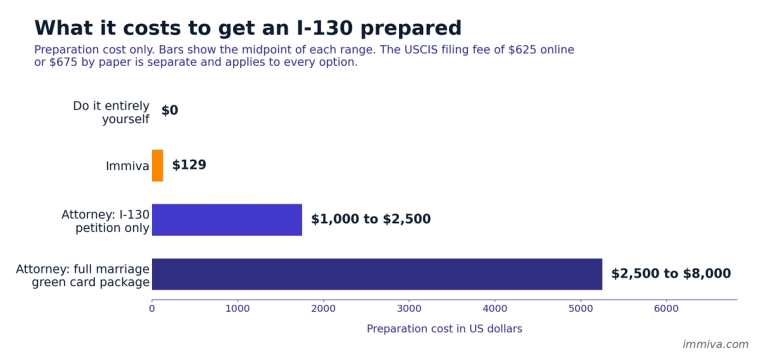
Preparation cost by approach, with the USCIS filing fee excluded because it applies to every option equally.
Attorney pricing splits along the same line as the forms. A standalone family petition typically runs $1,000 to $2,500. A full marriage-based package that carries you through the I-130, the I-485, the affidavit of support, and the interview usually runs $2,500 to $8,000. That second number is often quoted in answer to a question about the first, which makes self-filing look like a bigger gamble than it is.
Guided platforms generally run from a few hundred dollars to well over a thousand depending on the provider. Immiva charges $149 per application, covering every USCIS form that application requires, so an I-130 with its I-130A is a single charge. There is no retainer and no second invoice. You pay when your packet is finished, after you have seen the pre-filing review.
You are not choosing between safety and savings. You are choosing how much preparation support you need for a filing you are legally entitled to make yourself.
Four myths worth retiring
"A lawyer speeds up processing." No. USCIS processing time depends on the service center, the form, and the category. Current I-130 waits run roughly nine to eighteen months depending on where your case lands (USCIS Processing Times), and no representative changes that. Our I-130 processing time guide breaks the numbers down by relationship.
"Filing a G-28 gets you better service." A Form G-28 tells USCIS who is authorized to receive notices about your case. It is an administrative designation, not a priority lane.
"Self-filers get denied constantly." The frightening representation statistics circulating online come from immigration court removal proceedings, where the stakes and the process are entirely different. They say nothing about affirmative petitions filed at a lockbox. The immediate relative approval rate is around 93%.
"You need a lawyer at the interview." You do not. Interviews are about consistency and genuine evidence of your relationship. Our I-485 interview questions post covers what is actually asked.
The bottom line
So, do I need a lawyer for I-130? For a documented relationship and a clean history, no. The petition asks factual questions, USCIS approves the large majority of immediate relative cases, and the law explicitly permits you to represent yourself. Where an attorney earns the fee is in the facts that change the legal analysis: unlawful presence, removal history, criminal records, prior denials, and anything touching marriage fraud.
Be honest with yourself about which of those describes your case. Then file a complete, correct packet on the current edition.