

There is an assumption buried in most backlog coverage: that the pile is growing because too many people are applying. For the forms USCIS reports on monthly, that stopped being true some time in 2025.
We combined all twenty monthly USCIS Application Processing Data reports from December 2024 through July 2026 and tracked the pending caseload rather than the decisions. Receipts across these forms fell by roughly half. The pending pile grew by more than two million cases anyway. And the part of it that is aging grew faster than the pile as a whole, which is only possible if the newer cases are shrinking as a share of the total.
This post is about the shape of the queue, not how long any one case takes. For the wait-time side, our guide to how USCIS calculates average processing time explains why the published averages sit below what most applicants experience. The official backlog metric itself is defined in our explainer on what the USCIS net backlog measures.
Fewer applications, a bigger pile
Start with the two numbers that are supposed to move together and did not.
In December 2024, USCIS received 692,905 applications across the eleven form categories in this report. In July 2026 it received 344,054. That is a drop of just over 50%. Averaged across six months to smooth out the noise, receipts went from about 765,000 a month to about 423,000.
Over the same period, pending cases in these categories went from 5,559,113 to 7,586,846. An increase of 2,027,733, or 36.5%.
The growth did not arrive at a steady rate, and the middle of the series is the interesting part. Pending rose by 935,566 in the first half of 2025. It then held almost perfectly flat through the second half, adding just 3,494 cases between June and December 2025. From December 2025 onward it climbed again, adding 1,029,067 by June 2026. The pause in late 2025 lines up with the period when receipts were falling fastest, and it did not hold.
Both things are true at once because completions fell further than receipts did. USCIS finished 630,143 cases in December 2024 and 283,257 in July 2026, a drop of 55%. When the outflow falls faster than the inflow, the pile grows no matter how few people apply. There is more on the decision side of this in our analysis of USCIS denial rates across the same twenty months, which covers approvals, refusals and decision volume rather than the queue.
Nearly all of the growth is in cases that have gone stale
The headline pending number does not show this, but the monthly files do. USCIS reports pending cases twice in each: the total, and the subset that has been waiting more than six months. The six-month mark is the agency's own reporting threshold rather than a legal deadline, and it is a useful one, because it roughly separates cases moving through normal handling from cases that have stalled. Splitting the pile that way changes what the growth means.
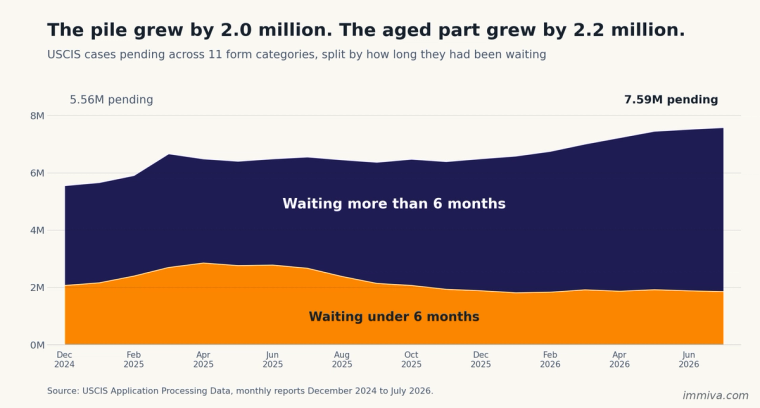
Pending USCIS cases across eleven form categories, split into cases waiting under six months and cases waiting longer, December 2024 through July 2026.
Cases waiting more than six months went from 3,483,437 to 5,725,831, an increase of 2,242,394.
Read those two increases next to each other. The whole pile grew by 2.03 million. The aged part of it grew by 2.24 million. The aged part grew by more than the total, which means the newer part shrank. It did: cases waiting under six months fell from 2,075,676 to 1,861,015, down 10.3%.
So the queue is aging faster than it is growing. In December 2024, 62.7% of everything pending had been waiting more than six months. By July 2026 it was 75.5%. Three out of four people waiting on one of these forms had already been waiting more than half a year.
That distinction matters for how you read your own position. A pile that grows because new filings are flooding in tends to clear when filings slow down. A pile that grows while filings fall is not going to clear on its own.
Where the aging concentrated
The shift was not evenly spread. Some forms aged sharply and some barely moved.
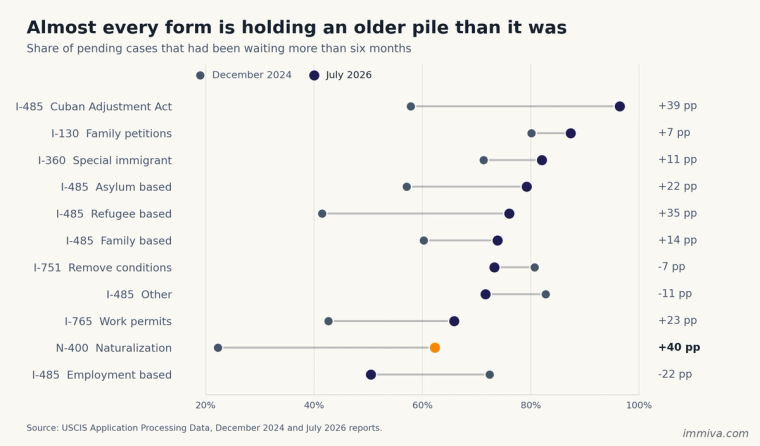
Share of pending cases waiting more than six months, by form category, December 2024 compared with July 2026.
Naturalization moved the most. In December 2024, only 22.2% of pending N-400s had been waiting more than six months, the freshest queue of any form in the report. By July 2026 it was 62.3%. The count of aged citizenship cases went from 119,145 to 485,003. Pending N-400s overall rose from 535,601 to 778,489, and this happened while receipts fell by about a quarter. Our N-400 processing time guide tracks what that looks like as a wait.
Work permits added the most cases. I-765 pending rose from 1,190,183 to 2,100,336. The aged portion alone grew by 875,303, which is 39% of all the aging across every category in the report. Two thirds of pending work permit cases are now over six months old, against 43% at the start. That is the practical reason filing an EAD renewal early has become more important than it used to be, and it applies to H-4 EAD and J-2 EAD filings alike.
Family petitions were already old and got older. I-130 pending barely moved, from 2,313,876 to 2,451,921, because receipts fell alongside decisions. But 87.4% of those petitions are now more than six months old, the highest share of any category. A queue can be stable in size and still be deteriorating in age. The I-130 processing time guide and our family green card backlog breakdown cover both stages.
Removing conditions is a trap for the eye. I-751's aged share fell from 80.7% to 73.3%, which looks like improvement until you check the count. The number of I-751 petitions over six months old rose from 175,256 to 256,939. The share fell only because new filings came in faster still, with receipts up about 25%. More fresh petitions diluted the percentage while the pile of old ones kept growing. Our I-751 processing time guide has the current picture.
Three categories aged because adjudication nearly stopped. The Cuban Adjustment Act, refugee-based and asylum-based I-485 categories show the most extreme aging in the report, with the Cuban category reaching 96.4% of cases over six months old. That figure is real but it does not mean the same thing as the others. Monthly approvals in these three categories fell to 308, 60 and 827 respectively by July 2026, from thousands each at the start of the series. When decisions stop almost entirely, everything left in the queue ages by definition. Together these three hold 8.5% of the pending caseload but account for 17.8% of all the aging. Those figures measure a pause in adjudication, and they should not be read as a picture of the queue everyone else is waiting in.
Across all eleven categories, the count of cases older than six months rose in ten. Only one category ended the period holding fewer aged cases than it started with.
The one category that pulled the other way
Employment-based adjustment of status is the exception, and it is worth being precise about how small the exception is.
Its aged share fell from 72.4% to 50.5%, the largest improvement in the report. Its aged count fell too, from 137,103 to 136,226. That is a decline of 877 cases over twenty months. Employment-based I-485 receipts rose about 30% over the period and completions roughly doubled, which is the only combination in this dataset where output kept pace with input.
Even there, total pending still rose, from 189,370 to 269,963, because the new filings outran the improvement. So one category out of eleven stopped its aged pile from growing, and none shrank theirs by a meaningful amount. Our I-485 processing time guide covers the stage-by-stage detail, and if your wait is driven by visa availability rather than adjudication speed, how the visa bulletin works is the separate system to understand.
What a growing pile changes about filing
You cannot make the queue shorter. The data still changes how and when it makes sense to file.
Getting in earlier is worth more than it used to be. In a queue that is lengthening rather than clearing, every month of delay puts you behind a month of additional filings and a month of unreleased older cases. Waiting for conditions to improve is a bet against the trend in this data. If you are eligible now, the arithmetic favors filing now. For citizenship, the residence and physical presence calculators will tell you the earliest date you can file.
A rejection costs far more than it did in 2024. A lockbox rejection for a missing signature, the wrong fee, or a superseded form edition means you were never in the queue at all. Losing two or three months to a rejection and refiling used to be an annoyance. Now that three quarters of pending cases are already past six months, it is a much more expensive mistake. Form editions change on a schedule, and our summary of the USCIS changes taking effect September 15, 2026 covers the current round.
An avoidable request for evidence adds months to the wait. A case that draws an RFE in month nine is not decided in month nine. USCIS holds it until you answer, the deadline it sets can run up to twelve weeks, and no extension is available. The case is not sent to the back of the queue, but every month it spends waiting on your response is a month the rest of the pile keeps aging. This is where careful preparation pays for itself, and it is what Immiva is built for. It checks each answer as you enter it, flags the questions that most often trigger an RFE with plain guidance before you commit, and reviews the whole packet against the form requirements before you download it. If you do get one, our guides on responding to an N-400 RFE and an I-751 RFE walk through it.
A long wait also changes the planning around the case. Decisions that assume a quick answer need rethinking, starting with travel while a case is pending, whether for N-400 or I-751, and whether you need advance parole alongside an I-485.
Immiva prepares and checks the filing for a flat fee that depends on the form, covering N-400, I-751, I-130, I-485, H-4 EAD and J-2 EAD. The current price for each form is on the pricing page. You pay the USCIS filing fee separately, directly to the government. You see the verification report before you pay, and if USCIS rejects your packet because of a preparation error on Immiva's end, Immiva refunds its fee. Immiva is software rather than a law firm, so it prepares and verifies forms and does not give legal advice about your particular case.
The short version
Fewer people are filing with USCIS than at any point in the last two years, and the USCIS backlog is growing anyway. Pending cases across these eleven forms rose by 2.03 million between December 2024 and July 2026. Cases waiting more than six months rose by 2.24 million, which means the newer portion of the queue shrank.
A pile that grows while filings fall does not clear when filings fall further. You cannot change the queue, but you can control when you enter it and whether your file gives anyone a reason to send it back.